
Explore the precision, magnetostatics, and durability of Hall Effect Sensors, their operation, applications, and future in technology.
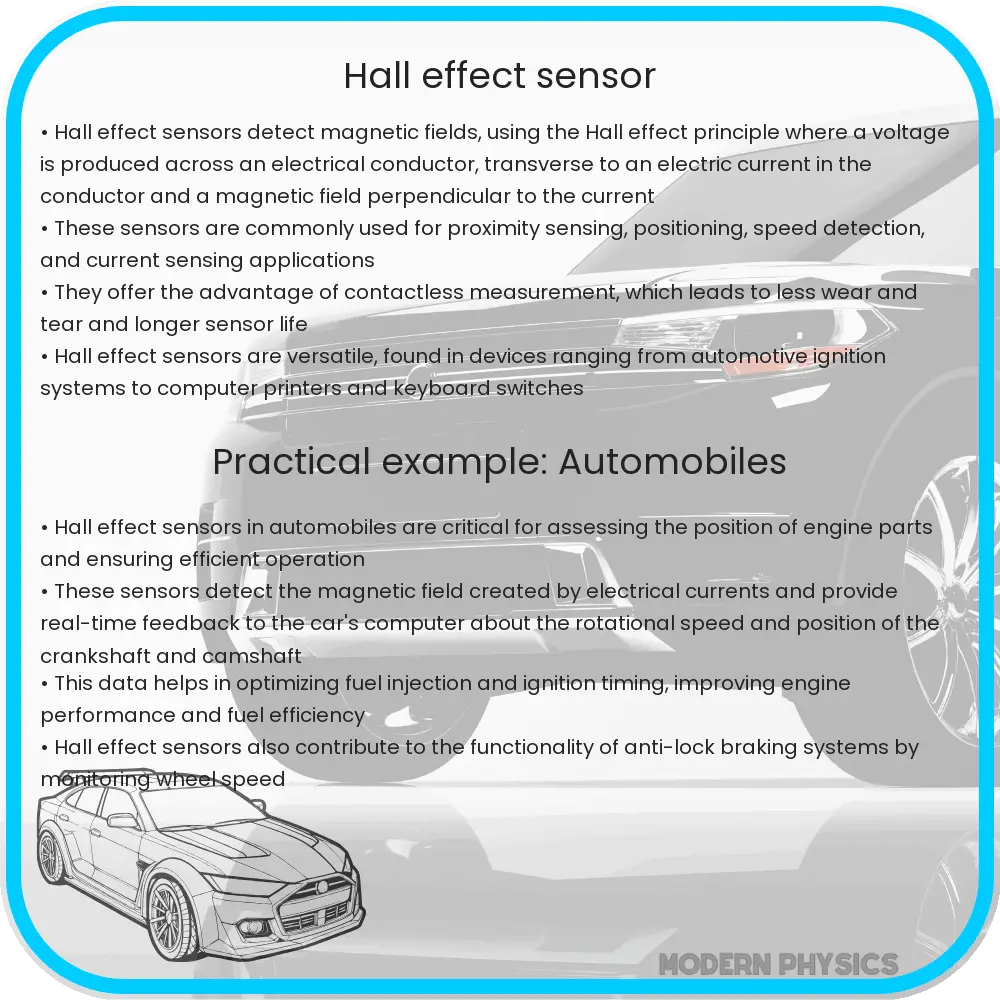
Understanding Hall Effect Sensors: Precision, Magnetostatics, and Durability
The Hall Effect Sensor, a pivotal component in modern electronics, operates on the principles of magnetostatics and precision. These sensors have revolutionized numerous applications by providing efficient, reliable, and accurate detection of magnetic fields and electrical current flow. In this article, we delve into the fundamental working, key features, and diverse applications of Hall Effect Sensors.
Principle of Operation
At its core, the Hall Effect Sensor leverages the Hall Effect principle, discovered by Edwin Hall in 1879. This principle states that when a current-carrying conductor is placed in a magnetic field, a voltage (Hall voltage) is generated perpendicular to both the current and the field. The magnitude of this voltage is directly proportional to the strength of the magnetic field, making these sensors highly effective in measuring magnetic field intensity.
Components and Materials
Typically, Hall Effect Sensors are composed of a thin strip of a semiconductor material such as indium antimonide (InSb) or indium arsenide (InAs). These materials are chosen for their high electron mobility, which enhances the sensor’s sensitivity and accuracy. The basic structure also includes a source of direct current, a magnetic field, and a voltmeter to measure the Hall voltage.
Key Features
- Precision: Hall Effect Sensors offer exceptional precision in detecting magnetic fields, even at low levels. This precision is crucial in applications requiring fine control and accuracy.
- Magnetostatics: These sensors operate on static or slowly changing magnetic fields, making them ideal for various static and quasi-static applications.
- Durability: With no moving parts and robust construction, Hall Effect Sensors are highly durable and resistant to wear and environmental factors.
Applications
Hall Effect Sensors find widespread use in various industries. They are instrumental in automotive systems for detecting the position of gears, in consumer electronics for proximity sensing, and in industrial applications for current sensing and speed detection. The versatility and reliability of these sensors make them indispensable in modern technology.
Understanding the technical intricacies of Hall Effect Sensors helps in appreciating their role in advancing technological capabilities. In the next section, we will explore their advantages, limitations, and future prospects in greater detail.
Advantages and Limitations of Hall Effect Sensors
Hall Effect Sensors offer several advantages, making them highly sought after in various applications. Their ability to operate without physical contact ensures minimal wear and tear, leading to a longer lifespan. Moreover, these sensors are not affected by dirt, dust, or oil, which is particularly beneficial in harsh industrial environments. However, they do have limitations, such as sensitivity to thermal variations and a need for precise calibration to ensure accuracy.
Future Prospects and Innovations
The future of Hall Effect Sensors looks promising, with ongoing research focusing on enhancing their sensitivity and minimizing their size for integration into microelectronics. Advancements in materials science, such as the development of graphene-based sensors, are set to revolutionize their capabilities. These innovations could lead to broader applications, including more sophisticated biomedical devices and enhanced aerospace technology.
Integrating Hall Effect Sensors into Systems
Integrating Hall Effect Sensors into systems requires a nuanced understanding of their operational characteristics. Factors such as the range of magnetic field strength, desired sensitivity, and environmental conditions must be considered. Additionally, the choice of the semiconductor material can be tailored to specific applications, balancing sensitivity with other factors like temperature stability.
Conclusion
In conclusion, Hall Effect Sensors represent a remarkable intersection of physics and engineering, offering precision, durability, and versatility. Their applications range from simple position sensing to complex industrial processes, underlining their significance in modern technology. While they come with certain limitations, ongoing advancements promise to mitigate these drawbacks and expand their capabilities. As we continue to innovate and integrate these sensors into various fields, their impact on technology and everyday life is set to grow, marking them as a key component in the evolution of electronic devices and systems.
With their blend of practicality and innovation, Hall Effect Sensors are not just tools of the present but also building blocks for future technological advancements. Their continuous development and integration into new domains exemplify the dynamic nature of technology and its relentless push towards refinement and excellence.