
Explore the intriguing world of hadronization in QCD, uncovering particle evolution, experimental insights, and its cosmic significance.
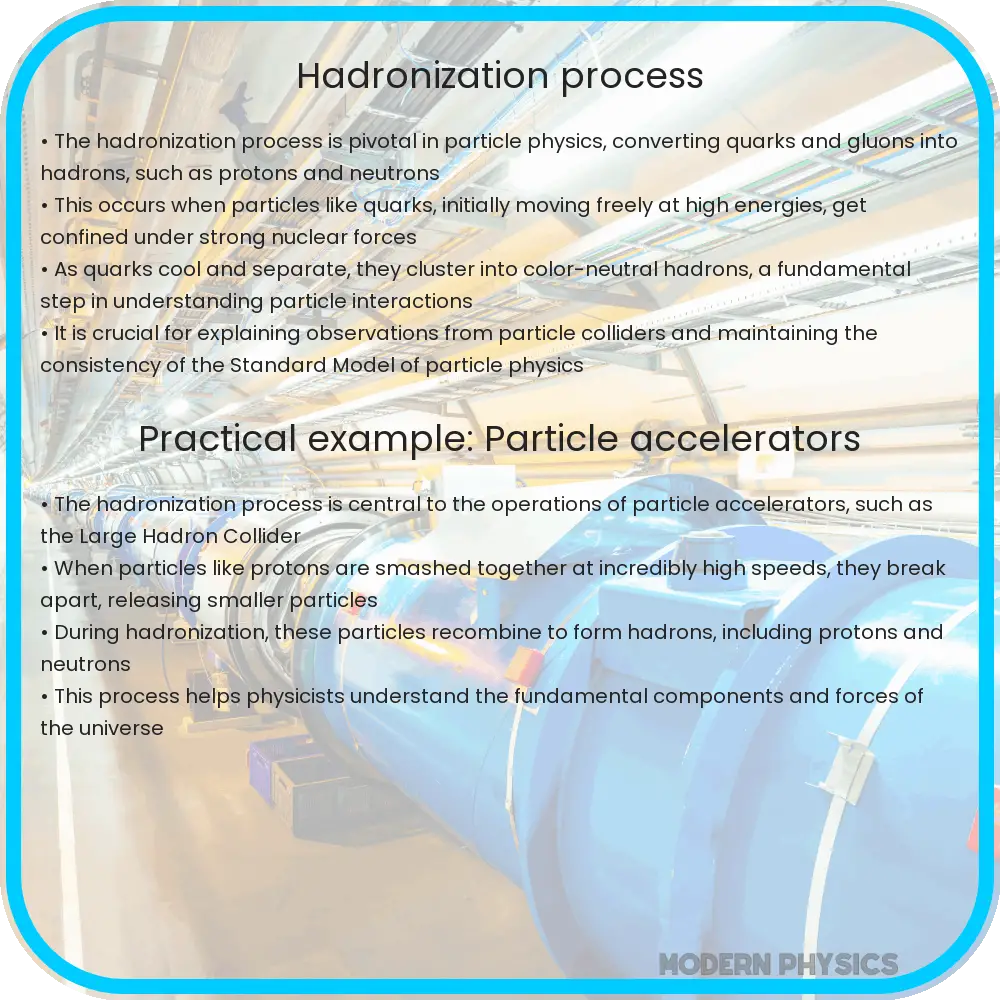
Understanding Hadronization in Quantum Chromodynamics
Hadronization is a fundamental process in Quantum Chromodynamics (QCD), the theory that describes the strong interaction – one of the four fundamental forces of nature. This interaction governs the behavior of quarks and gluons, the basic constituents of protons, neutrons, and other hadrons. The hadronization process is essential for understanding how the universe evolved from a quark-gluon plasma in the moments following the Big Bang to the matter-dominated universe we observe today.
The Mechanics of Hadronization
In QCD, hadronization refers to the transition from a state of free quarks and gluons to bound states, known as hadrons. This process occurs due to the unique property of QCD called confinement, which prevents quarks from existing in isolation under normal conditions. As quarks move away from each other, the force between them does not diminish, leading to the formation of new quark-antiquark pairs, eventually resulting in the emergence of hadrons.
Stages of Particle Evolution in Hadronization
The evolution of particles during hadronization can be broadly divided into several stages:
- Quark-Gluon Plasma Formation: Initially, in high-energy collisions, such as those in particle accelerators, a hot, dense state of matter consisting of free quarks and gluons is formed, known as quark-gluon plasma (QGP).
- Color Deconfinement: Within this plasma, quarks and gluons are deconfined, meaning they can move freely without being bound into hadrons due to the extreme conditions.
- Cooling and Hadronization: As the plasma expands and cools, the quarks and gluons begin to combine into hadrons, a process driven by the QCD confinement property.
This sequence of events is crucial for understanding not only the early universe but also the ongoing processes in high-energy particle collisions.
Experimental Insights and Data Analysis
Experimental studies of hadronization are conducted using particle accelerators like the Large Hadron Collider (LHC). Here, particles are accelerated to near-light speeds and collided, momentarily recreating the conditions similar to those of the early universe. The resulting quark-gluon plasma cools rapidly, leading to hadronization. Advanced detectors and data analysis techniques are employed to study the resulting hadrons, providing insights into the dynamics of this complex process.
Understanding hadronization requires analyzing vast amounts of data generated by these collisions. Sophisticated algorithms and data analysis techniques are used to identify patterns and extract meaningful information about the hadronization process. This information helps physicists refine their models of QCD and gain a deeper understanding of the fundamental forces and particles that constitute our universe.
Challenges and Future Directions in Hadronization Research
Despite significant advancements, hadronization remains one of the less understood aspects of QCD. The non-perturbative nature of the confinement phase transition poses a substantial challenge. Unlike electromagnetic interactions, where perturbation theory can be applied effectively, the strong force requires different approaches, such as lattice QCD simulations. These simulations provide a framework for calculating the properties of hadrons from first principles but demand substantial computational resources.
Another challenge lies in the interpretation of experimental data. While accelerators like the LHC can recreate conditions akin to the early universe, the transient nature of these states and the complexity of the resulting particle interactions make data analysis highly non-trivial. Researchers rely on sophisticated models and computational techniques to decode the information contained in the byproducts of these high-energy collisions.
The Role of Hadronization in Cosmology and Astrophysics
The study of hadronization extends beyond particle physics, offering insights into astrophysical phenomena and cosmology. For instance, understanding the nature of hadronization can shed light on the behavior of neutron stars, where quark matter might exist in the core. Additionally, the study of hadronization contributes to our understanding of the early universe, particularly during the quark epoch, a period in the universe’s history when quarks and gluons were the dominant forms of matter.
Furthermore, hadronization plays a role in the ongoing search for new physics beyond the Standard Model. Explorations into this process might unveil phenomena that cannot be explained by our current understanding, potentially leading to groundbreaking discoveries in particle physics.
Conclusion
In conclusion, hadronization is a cornerstone process in the study of Quantum Chromodynamics, offering a window into the fundamental nature of matter and the forces that shape our universe. While the challenges in understanding and simulating hadronization are significant, ongoing research in this field continues to push the boundaries of our knowledge. The insights gained from studying hadronization not only enhance our understanding of the early universe but also pave the way for future discoveries in both particle physics and cosmology. As experimental techniques and theoretical models evolve, our grasp of the intricate dance of quarks and gluons will undoubtedly grow, further illuminating the complex tapestry of our universe.