
Explore the gyrocompass’s role in precision navigation and dynamic stability, its evolution, and integration with modern navigational systems.
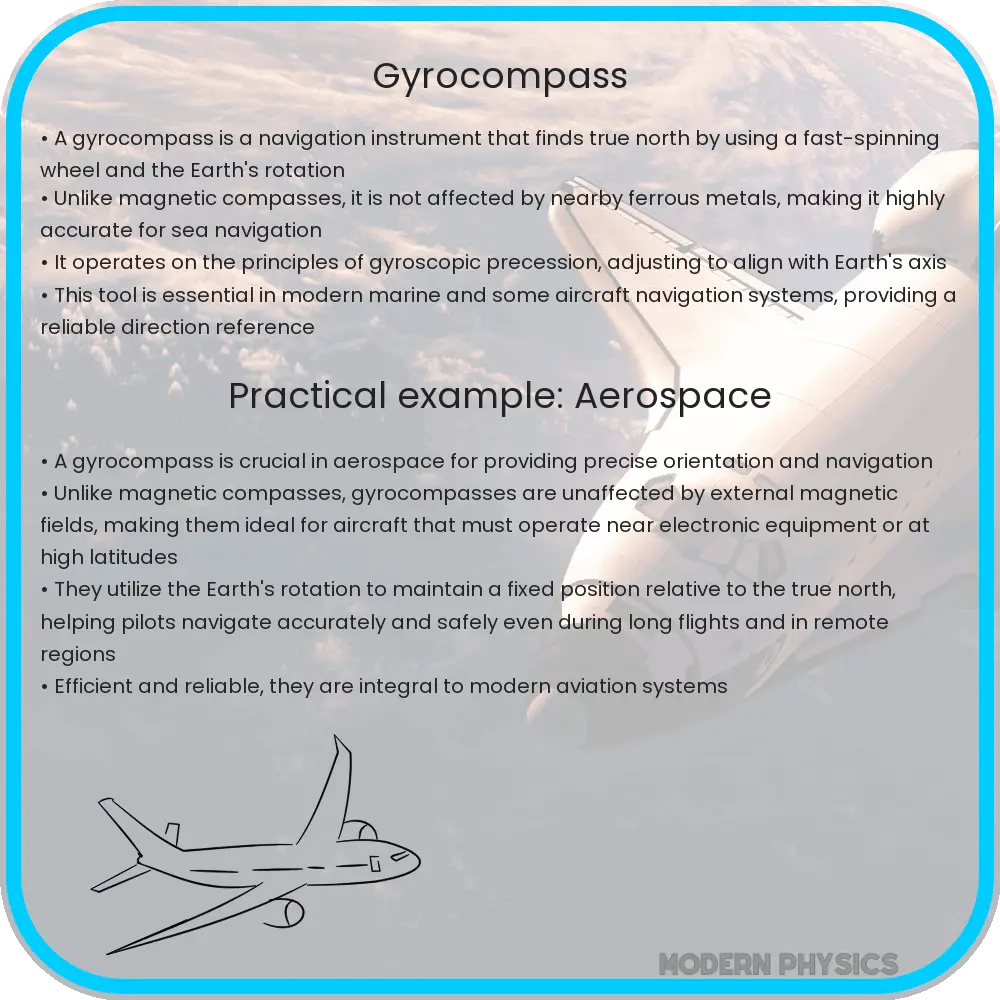
Gyrocompass: Revolutionizing Precision Navigation
The gyrocompass, a marvel of modern engineering, stands as a cornerstone in the realm of precision navigation and dynamic stability. Unlike traditional magnetic compasses, which align with the Earth’s magnetic field, a gyrocompass leverages the principles of angular momentum and rotation to accurately determine true north. This distinction is critical in scenarios where precision and reliability are paramount, particularly in maritime navigation and aerospace applications.
Understanding the Gyrocompass
At the heart of the gyrocompass is a rapidly spinning wheel or rotor, mounted in a framework allowing it to freely pivot in any direction. This setup, known as a gimbal system, ensures that the rotor maintains its orientation regardless of external movements. When set in motion, the gyrocompass exploits the Earth’s rotation and the principles of precession—a phenomenon where a spinning object tends to maintain its angular momentum—to align itself with the meridian and point towards true north.
Advantages Over Traditional Magnetic Compasses
The gyrocompass offers several key advantages over its magnetic counterpart. It is impervious to magnetic interference, a crucial feature for modern ships and aircraft laden with electronic equipment. This immunity to magnetic anomalies makes the gyrocompass a reliable tool even in regions where the Earth’s magnetic field is erratic. Additionally, a gyrocompass does not require periodic recalibration, ensuring consistent accuracy over time.
Applications in Maritime and Aerospace Industries
Maritime navigation is one of the primary arenas where gyrocompasses have become indispensable. Large vessels, including commercial freighters, naval ships, and luxury cruise liners, rely on gyrocompass technology for accurate heading information. In the aerospace industry, gyrocompasses play a critical role in the stability and navigation systems of aircraft, contributing to safer and more precise flights.
Enhancing Dynamic Stability
Beyond navigation, gyrocompasses significantly contribute to dynamic stability in various vehicles. In ships, they assist in stabilizing the craft against rolling motions induced by waves. In aircraft, they are integral to attitude control systems, aiding in maintaining a stable flight path. This application of gyrocompass technology extends its influence beyond mere directional guidance, cementing its status as a vital component in modern transportation systems.
Technological Evolution of the Gyrocompass
The gyrocompass has undergone significant evolution since its inception. Early models were mechanically complex and sizeable, making them suitable only for larger vessels and aircraft. With advancements in technology, modern gyrocompasses have become more compact, reliable, and efficient. The integration of digital technology has further enhanced their precision, allowing for real-time data processing and integration with other navigational systems such as Global Positioning System (GPS) and Inertial Navigation Systems (INS).
Challenges and Limitations
Despite its numerous advantages, the gyrocompass is not without limitations. One of the primary challenges is the gyrocompass’s initial settling time, which can vary from a few minutes to several hours, depending on the system. This aspect can be crucial in scenarios requiring rapid deployment. Additionally, gyrocompasses can be sensitive to extreme temperatures and vibrations, necessitating robust design and careful handling in harsh environments.
Future Prospects and Innovations
The future of gyrocompass technology lies in ongoing innovation and miniaturization. Research is focused on enhancing the accuracy and reducing the size of gyrocompasses, making them more accessible for smaller vessels and aircraft, and even for land-based applications. Emerging technologies, such as fiber-optic and laser gyroscopes, offer promising avenues for further advancements. These newer models promise higher precision, faster settling times, and greater resistance to environmental factors.
Integrating with Advanced Navigational Systems
Integration with advanced navigational systems represents another frontier for gyrocompass technology. Modern gyrocompasses are increasingly being integrated with satellite navigation and advanced computer systems, providing comprehensive navigational solutions. This integration allows for seamless transition between gyrocompass and GPS data, ensuring uninterrupted navigation and stability under various conditions.
Conclusion
The gyrocompass has become an indispensable tool in the realm of precision navigation and dynamic stability. Its ability to provide accurate, reliable directional information regardless of magnetic interference has revolutionized maritime and aerospace navigation. As technology advances, the gyrocompass continues to evolve, becoming more sophisticated, compact, and integrated with other navigational systems. Its ongoing development ensures that it will remain a vital component in the navigation and stability systems of various vehicles, playing a crucial role in ensuring safe and efficient travel in an increasingly complex and interconnected world.