
Explore the precision and range of gravitational wave detectors like LIGO and Virgo, their breakthroughs, and the future prospects of gravitational wave astronomy.
Understanding Gravitational Wave Detectors
Gravitational waves are ripples in the fabric of spacetime, predicted by Albert Einstein’s theory of general relativity over a century ago. They are caused by some of the most violent and energetic processes in the universe, such as colliding black holes or exploding stars. Detecting these elusive waves requires precision and innovation, leading to significant breakthroughs in physics and astronomy.
The Precision of Gravitational Wave Detectors
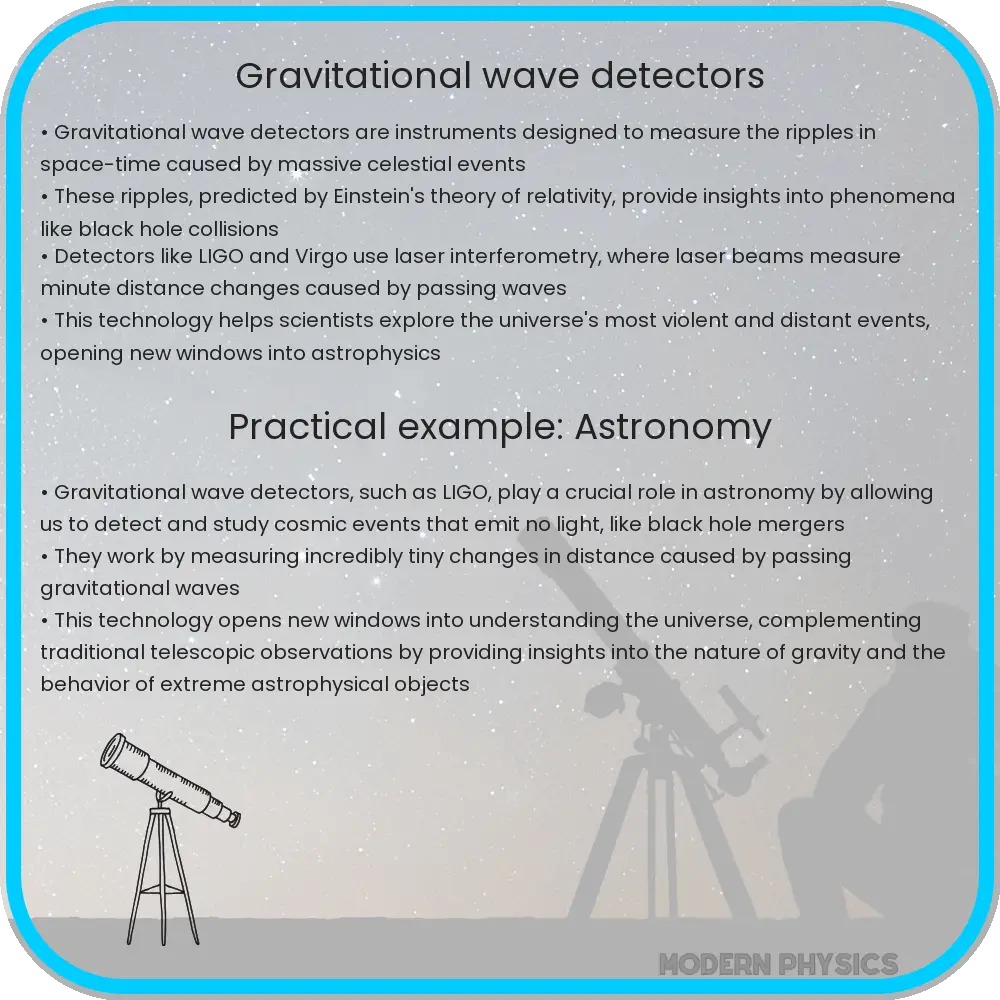
Gravitational wave detectors, such as LIGO (Laser Interferometer Gravitational-Wave Observatory) and Virgo, are marvels of precision engineering. These facilities use laser interferometry to measure the minute distortions in spacetime caused by passing gravitational waves. The detectors must be incredibly precise, as the distortions are smaller than one ten-thousandth the diameter of a proton. This level of sensitivity is achieved through advanced technology, including ultra-stable lasers, massive mirrors suspended as pendulums, and sophisticated feedback systems to reduce noise.
Range and Sensitivity
The range of a gravitational wave detector refers to the distance within which it can detect events causing gravitational waves. Current detectors can observe events occurring hundreds of millions of light-years away, enabling scientists to study astrophysical phenomena from distant corners of the universe. The sensitivity of these detectors is constantly being improved, with upgrades aimed at increasing their range and allowing them to detect weaker or more distant signals.
Breakthroughs in Gravitational Wave Astronomy
The detection of gravitational waves has opened a new window onto the cosmos. The first direct detection in 2015 confirmed Einstein’s century-old prediction and inaugurated the field of gravitational wave astronomy. Since then, detectors have observed gravitational waves from various sources, including binary black hole mergers and neutron star collisions. These observations have led to numerous scientific breakthroughs, such as tests of general relativity under extreme conditions, measurements of the universe’s expansion rate, and insights into the nature of dense matter.
Enhancements and Future Prospects
The future of gravitational wave astronomy is promising, with plans for more sensitive detectors and new observatories. The upcoming LIGO-India project and the proposed Einstein Telescope in Europe aim to expand the global network of detectors, improving the localization of gravitational wave sources and enhancing the detection rates. Moreover, space-based detectors like the Laser Interferometer Space Antenna (LISA) are in development, which will be able to detect lower frequency gravitational waves than their ground-based counterparts, opening up a new range of astrophysical targets.
Interdisciplinary Impact
The impact of gravitational wave detection extends beyond astrophysics. It has significant implications for fundamental physics, cosmology, and even nuclear physics. By providing a new method of observing the universe, gravitational wave astronomy allows for the testing of theoretical models and offers insights into the properties of matter under extreme conditions. Additionally, the technological advancements driven by the demands of gravitational wave detection have applications in other fields, such as precision metrology, quantum computing, and materials science.
Conclusion
Gravitational wave detectors have revolutionized our understanding of the universe. Their unmatched precision and growing range have allowed us to detect the echoes of cosmic events billions of light-years away. As we stand on the brink of a new era in astronomy, the continual improvement of these detectors promises to uncover more of the universe’s secrets. The interdisciplinary nature of gravitational wave research ensures that its impact will be felt across science, pushing the boundaries of what is possible in both theoretical and applied physics. Indeed, the future of gravitational wave astronomy holds not just the promise of new discoveries, but the potential for a deeper understanding of the cosmos and our place within it.