
Explore gravitational singularities: their types, role in black holes, and challenges in reconciling general relativity with quantum mechanics.
Understanding Gravitational Singularity: A Dive into the Depths of Spacetime
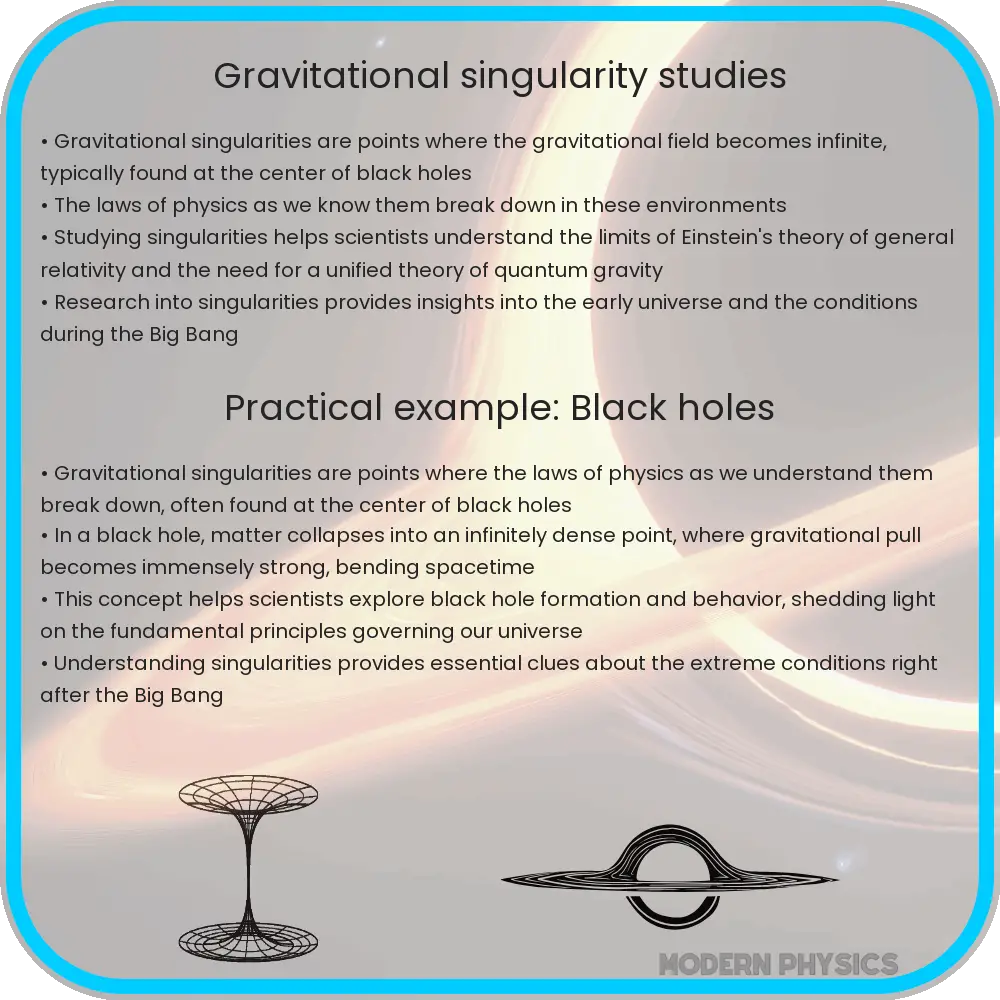
The concept of a gravitational singularity represents one of the most intriguing and enigmatic aspects of astrophysics and general relativity. At its core, a singularity is a point in spacetime where the gravitational field becomes infinite in strength. This phenomenon is often associated with black holes, where the laws of physics as we understand them cease to function normally.
Theoretical Foundations of Singularities
Singularities are deeply rooted in the framework of Albert Einstein’s theory of general relativity. This theory describes how mass and energy warp spacetime, creating the phenomenon we perceive as gravity. In the realms of extreme gravity, such as the center of a black hole, the predictions of general relativity suggest that spacetime becomes infinitely curved. This curvature leads to what we refer to as a singularity.
Types of Singularities
There are two main types of singularities discussed in theoretical physics:
- Space-like Singularities: Found at the core of black holes, these are hidden behind event horizons, making them inaccessible to outside observers.
- Time-like Singularities: These are theoretically possible but are not hidden behind an event horizon, making them more observable in theory, though none have been detected.
Properties and Challenges
Gravitational singularities are characterized by their extreme conditions:
- Infinite Density: The mass of an object is compressed into an infinitely small space, leading to infinite density.
- Breakdown of Physical Laws: The infinite curvature of spacetime at the singularity implies that our current understanding of physics, including general relativity, cannot describe these conditions adequately.
These extreme conditions present significant challenges for physicists. The singularity at the center of a black hole, for instance, is a region where our current models of physics, including quantum mechanics and general relativity, do not provide a coherent description. This has led to intense theoretical work, including the pursuit of a unified theory that can describe all fundamental forces of nature, including gravity, at such extreme scales.
Quantum Mechanics and Singularities
Incorporating quantum mechanics into the understanding of singularities is a major area of research. Quantum theories suggest that at very small scales, such as those at the singularity, the discrete nature of quantum mechanics could play a significant role in understanding these enigmatic points. This has led to various approaches, including string theory and loop quantum gravity, which aim to reconcile the apparent contradictions between quantum mechanics and general relativity.
The Role of String Theory and Loop Quantum Gravity
String theory and loop quantum gravity are two prominent approaches in the quest to understand singularities within the framework of quantum mechanics. String theory posits that the fundamental particles are not point-like, but rather one-dimensional “strings. This theory potentially avoids singularities by replacing the point-like particles of standard physics with strings, which cannot be compressed to an infinitely small point. On the other hand, loop quantum gravity attempts to quantize spacetime itself, suggesting that spacetime is made of discrete loops, which could mean that spacetime is not infinitely divisible and thus, singularities may not be truly ‘infinite.’
Black Holes and the Information Paradox
The study of singularities is closely linked to the black hole information paradox, a fundamental problem in theoretical physics. The paradox arises from the apparent conflict between quantum mechanics and general relativity. According to quantum mechanics, information cannot be destroyed, while general relativity suggests that information entering a black hole is lost to the singularity. This paradox has significant implications for our understanding of singularities and has fueled much of the recent research in theoretical physics.
Experimental Evidence and Observations
While singularities remain a theoretical concept, indirect evidence supports their existence. Observations of black holes, such as the Event Horizon Telescope’s image of a black hole’s shadow, provide indirect evidence of the extreme conditions near singularities. However, direct observation of singularities remains beyond our current technological capabilities, primarily due to the shielding effect of the event horizon.
Conclusion
In summary, gravitational singularities represent a frontier in our understanding of the universe. They challenge our current theories, specifically the reconciliation of general relativity and quantum mechanics. The study of singularities not only probes the limits of our understanding of gravity and spacetime but also offers potential insights into a unified theory of physics. Although direct observation remains elusive, ongoing theoretical and observational efforts continue to shed light on these mysterious entities, gradually unveiling the secrets of the cosmos. As technology advances and our theoretical models become more refined, we edge closer to unraveling the mysteries of gravitational singularities, a pursuit that could fundamentally alter our grasp of the universe and its origins.