
Explore the fascinating world of gravitational radiation, its detection, and the theory behind space-time ripples in this in-depth article.
Gravitational Radiation: Unveiling the Ripples of Space-Time
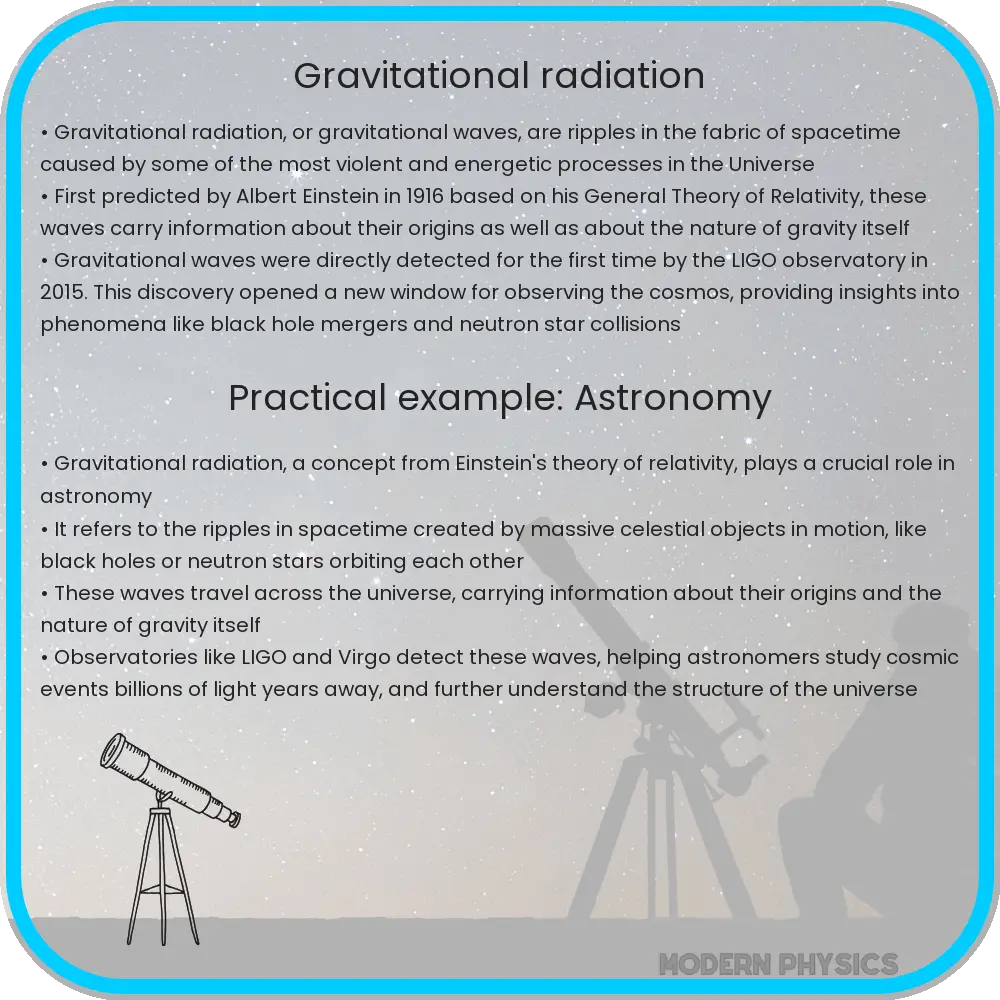
Gravitational radiation, a cornerstone prediction of Albert Einstein’s General Theory of Relativity, stands as a pivotal concept in modern astrophysics. This phenomenon, often described as ‘ripples in the fabric of space-time’, arises from the acceleration of massive objects in the universe. As these waves travel at the speed of light, they carry with them information about their violent and energetic origins, offering astronomers a unique tool to probe the cosmos.
Theoretical Foundations
The concept of gravitational radiation emerges directly from the equations of General Relativity. In Einstein’s theory, gravity is not a force acting at a distance, as Isaac Newton proposed, but rather a curvature of space-time caused by mass and energy. When massive objects like black holes or neutron stars accelerate, they disturb the space-time around them, creating waves that propagate outward, much like ripples on a pond’s surface.
Detecting the Undetectable
Gravitational waves were long considered impossible to detect directly due to their incredibly weak effect on matter. However, the 21st century heralded a new era with the advent of advanced laser interferometers like LIGO (Laser Interferometer Gravitational-Wave Observatory) and Virgo. These detectors, through their exquisitely sensitive instruments, can measure changes in distances smaller than a fraction of a proton, thus capturing the faint whispers of gravitational waves as they pass through Earth.
Gravitational Waves and Cosmic Events
The most common sources of detectable gravitational waves are cataclysmic astronomical events. Collisions and mergers of black holes or neutron stars, supernovae, and even the rapid rotation of neutron stars with irregularities in their shape can produce these elusive waves. Each event leaves a unique imprint on the wave it produces, allowing scientists to glean valuable information about the event’s nature, such as the mass and energy involved.
Implications for Science and Humanity
The study of gravitational waves opens a new window onto the universe. It not only confirms a fundamental prediction of General Relativity but also provides insights into areas of the universe that were previously inaccessible. By observing gravitational waves, astronomers can now explore the extreme realms of black holes and neutron stars, investigate the rate of expansion of the universe, and even glimpse events from the very early universe, moments after the Big Bang.
Revolutionizing Astronomy
The detection of gravitational waves marks a significant breakthrough in astronomy. Unlike electromagnetic waves, which can be absorbed or scattered by interstellar dust and gas, gravitational waves travel through the universe virtually unimpeded. This characteristic allows scientists to observe phenomena that are otherwise hidden or too distant for traditional telescopes. Gravitational wave astronomy thus complements electromagnetic observations, providing a more comprehensive understanding of the universe.
Future Prospects in Gravitational Wave Research
The future of gravitational wave research is promising and multifaceted. Upcoming advancements in technology and new observatories like LISA (Laser Interferometer Space Antenna) aim to detect a wider range of gravitational wave frequencies. This would enable the observation of supermassive black hole mergers and potentially even the primordial waves from the infancy of the universe. Moreover, combining gravitational wave data with other astronomical observations (multi-messenger astronomy) is expected to unravel more mysteries of the cosmos.
Challenges and Limitations
Despite its potential, gravitational wave research is not without challenges. The primary limitation is the sensitivity of current detectors. Gravitational waves are extraordinarily weak, and their detection requires incredibly precise measurements. Environmental noise and quantum fluctuations also pose significant challenges, necessitating continuous technological improvements in detector sensitivity and noise reduction techniques.
Conclusion
Gravitational radiation, once a mere theoretical concept, has now become a reality in observational astronomy. The successful detection of gravitational waves has opened a new era in the study of the universe, providing insights into some of the most extreme and enigmatic phenomena in the cosmos. As technology advances, gravitational wave research promises to deepen our understanding of the universe, offering a unique perspective on the workings of space and time. This burgeoning field stands not only as a testament to human ingenuity and curiosity but also as a bridge to the next frontier of astronomical discovery.