
Explore the fundamentals of gravitational force, its impact on celestial mechanics, and the latest advancements in gravitational research.
Understanding Gravitational Force: The Dynamics of Motion and Mass Interaction
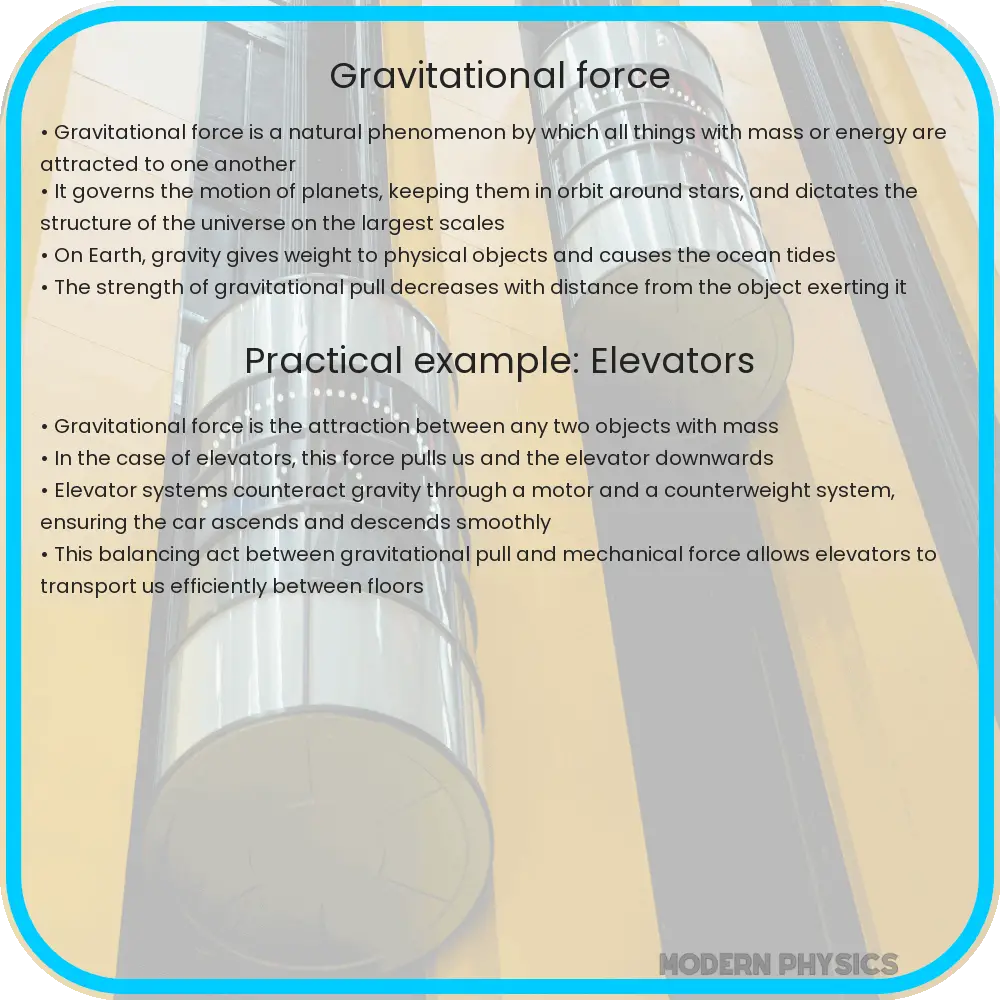
Gravitational force is a fundamental interaction in the universe, influencing the motion of objects with mass. This invisible force, first articulated by Sir Isaac Newton in the 17th century, is what keeps planets in orbit around stars, moons around planets, and imparts weight to objects on Earth. In this article, we delve into the dynamics of gravitational force, exploring how it governs motion and mass interaction.
Newton’s Law of Universal Gravitation
Newton’s Law of Universal Gravitation states that every particle in the universe attracts every other particle with a force that is directly proportional to the product of their masses and inversely proportional to the square of the distance between their centers. Mathematically, it is expressed as:
\[ F = G \frac{m_1 m_2}{r^2} \]
Where F represents the gravitational force, G is the gravitational constant (6.674 × 10⁻¹¹ N(m/kg)2), m1 and m2 are the masses of the two objects, and r is the distance between their centers.
The Role of Mass and Distance
Mass is a key factor in gravitational attraction. Larger masses exert a stronger gravitational pull. For example, the Sun, with its massive size, exerts a gravitational force strong enough to keep the entire solar system in orbit. Distance also plays a crucial role. The gravitational force diminishes with the square of the distance; hence, objects that are far apart exert significantly less gravitational pull on each other.
Gravitational Force in Motion
Gravitational force is integral in determining the motion of objects. It is the reason why planets follow elliptical orbits around the Sun. This force acts towards the center of the mass, causing the orbiting object to continually fall towards it, yet its forward motion keeps it from falling directly in, creating a stable orbit.
On Earth, gravity is what gives weight to physical objects and causes the ocean tides. The gravitational attraction between Earth and the Moon causes the oceans to bulge, leading to high and low tides. Additionally, gravity affects the trajectory of projectiles, influencing their parabolic paths.
Understanding gravitational force not only helps in comprehending celestial mechanics but also plays a pivotal role in various fields such as aerospace engineering, astrophysics, and even everyday life. The principles of gravity are applied in satellite communications, space explorations, and understanding the universe’s structure and evolution.
In the next section, we will explore the applications of gravitational force in modern science and technology, along with the contemporary challenges and advancements in gravitational research.
Applications and Advancements in Gravitational Research
The principles of gravitational force are instrumental in many modern scientific and technological endeavors. In the field of aerospace engineering, understanding gravity is essential for the launch and orbit of satellites, as well as for manned space missions. By calculating the gravitational pull of Earth and other celestial bodies, scientists can determine the necessary velocity and trajectory for spacecraft to enter and maintain orbit, or to land on other planets.
Astrophysics also relies heavily on gravitational theories to understand the cosmos. The movements of galaxies, the formation of stars, and the behavior of black holes are all governed by gravitational interactions. Recent advancements in gravitational wave astronomy, marked by the first detection of gravitational waves in 2015, have opened a new window to observe and understand the universe. These waves, predicted by Einstein’s theory of general relativity, are ripples in the fabric of spacetime caused by some of the most violent and energetic processes in the universe.
Gravitational research has also led to the development of technologies that benefit everyday life. For example, GPS systems rely on precise timing, which is affected by the gravitational pull of Earth. Adjustments for these gravitational effects are necessary to ensure the accuracy of GPS coordinates.
Challenges and Future Prospects
Despite its long-standing presence in science, the study of gravity still poses significant challenges. One of the most prominent is unifying gravity with quantum mechanics. While general relativity explains gravity on a large scale, it conflicts with quantum mechanics, which governs the subatomic world. Resolving this inconsistency remains one of the major quests in theoretical physics.
The future of gravitational research is promising, with potential breakthroughs in understanding dark matter and dark energy, which are thought to constitute a significant portion of the universe’s mass and energy but remain poorly understood. Exploring these concepts could not only deepen our understanding of gravity but also provide insight into the fundamental nature of the universe.
Conclusion
Gravitational force is a key player in the grand orchestra of the universe. From the orbits of planets to the tides on Earth, it continuously shapes our world and beyond. The study of this fundamental force has led to significant scientific and technological advancements, while still posing intriguing challenges and mysteries. As we continue to explore and understand gravity, it holds the promise of unlocking deeper secrets of the universe, propelling us further into the realms of discovery and innovation.