
Explore the fundamentals and complexities of gravitational field equations, from General Relativity to quantum gravity and gravitational waves.
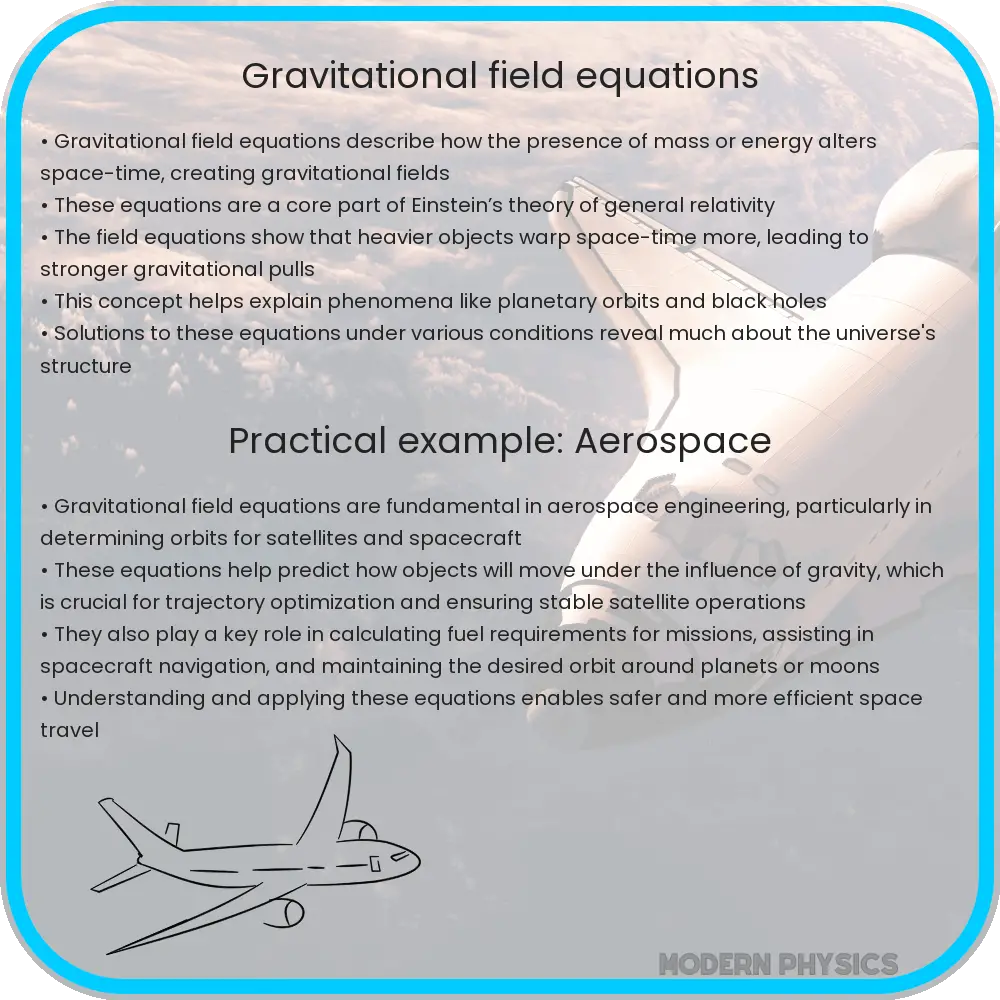
Understanding Gravitational Field Equations
Gravitational field equations are the cornerstone of Einstein’s General Theory of Relativity, a groundbreaking theory that revolutionized our understanding of gravity. Unlike Newton’s Law of Universal Gravitation, which describes gravity as a force between masses, General Relativity treats gravity as the curvature of spacetime caused by mass and energy.
Basics of General Relativity
General Relativity, proposed by Albert Einstein in 1915, posits that massive objects cause a distortion in the fabric of spacetime, which is perceived as gravity. This theory is encapsulated in the famous Einstein Field Equations (EFE). These equations describe how energy and momentum in the universe influence spacetime curvature.
The EFE is expressed as:
\[ G_{\mu\nu} + \Lambda g_{\mu\nu} = \frac{8\pi G}{c^4} T_{\mu\nu} \]
Here, \( G_{\mu\nu} \) represents the Einstein tensor, encapsulating the curvature of spacetime. \( \Lambda \) is the cosmological constant, \( g_{\mu\nu} \) the metric tensor of spacetime, \( G \) the gravitational constant, \( c \) the speed of light, and \( T_{\mu\nu} \) the energy-momentum tensor.
Solutions and Significance
Various solutions to the EFE have been found, each corresponding to different physical scenarios. The most famous is the Schwarzschild solution, which describes the spacetime around a spherical, non-rotating mass like a static black hole or star. Other solutions, like the Kerr solution for rotating black holes and the Friedmann-Lemaître-Robertson-Walker (FLRW) metric for cosmology, have significantly expanded our understanding of astrophysical and cosmological phenomena.
These solutions have led to predictions and subsequent confirmations of phenomena such as the bending of light by gravity (gravitational lensing), the expansion of the universe, and the existence of black holes. They also provide a framework for understanding the dynamics of galaxies, the lifecycle of stars, and the large-scale structure of the universe.
However, the EFE is not without its complexities. Solving these equations generally requires advanced mathematical techniques and assumptions about the nature of spacetime and the distribution of mass-energy. Moreover, the EFE does not encompass quantum mechanical effects, leading scientists to seek a theory of quantum gravity that can reconcile general relativity with quantum physics.
Challenges and Advances in Gravitational Field Theory
The quest for a unified theory that merges general relativity with quantum mechanics, known as quantum gravity, remains one of the most significant challenges in modern physics. The difficulty arises from the fundamentally different natures of the two theories: while general relativity is a classical field theory, quantum mechanics is a probabilistic theory that governs the microscopic world. Efforts like string theory and loop quantum gravity aim to bridge this gap, although a complete and experimentally verified theory of quantum gravity is yet to be achieved.
Another area of intense research is the study of gravitational waves. Predicted by Einstein in 1916, these ripples in spacetime were first directly detected by the Laser Interferometer Gravitational-Wave Observatory (LIGO) in 2015. This discovery opened a new window for observing the universe, allowing scientists to detect and study events like the merging of black holes and neutron stars, which are otherwise invisible through traditional electromagnetic observation methods.
The Role of Numerical Relativity
Numerical relativity, which involves solving Einstein’s field equations through numerical methods and simulations, has become increasingly important. It plays a crucial role in predicting the signatures of gravitational waves and understanding scenarios like the collision of black holes. These computer simulations are essential for interpreting the data from gravitational wave detectors and for testing the predictions of general relativity under extreme conditions.
Conclusion
The study of gravitational field equations continues to be a vibrant and dynamic field, driving forward our understanding of the universe. From the early success of general relativity in explaining the precession of Mercury’s orbit to the recent observations of gravitational waves, Einstein’s theory has been remarkably successful in describing the gravitational phenomena of the cosmos. Despite its success, the quest for a deeper understanding continues, particularly in reconciling it with quantum mechanics and exploring the extreme conditions of the universe. As research advances, we may find answers to some of the most profound questions about the nature of space, time, and the universe itself, continuing the legacy of Einstein’s revolutionary idea.