
Explore the accuracy and relativity in GPS technology, including satellite timing, challenges like signal interference, and future advancements.
Understanding GPS Technology: Accuracy, Relativity, and Satellite Timing
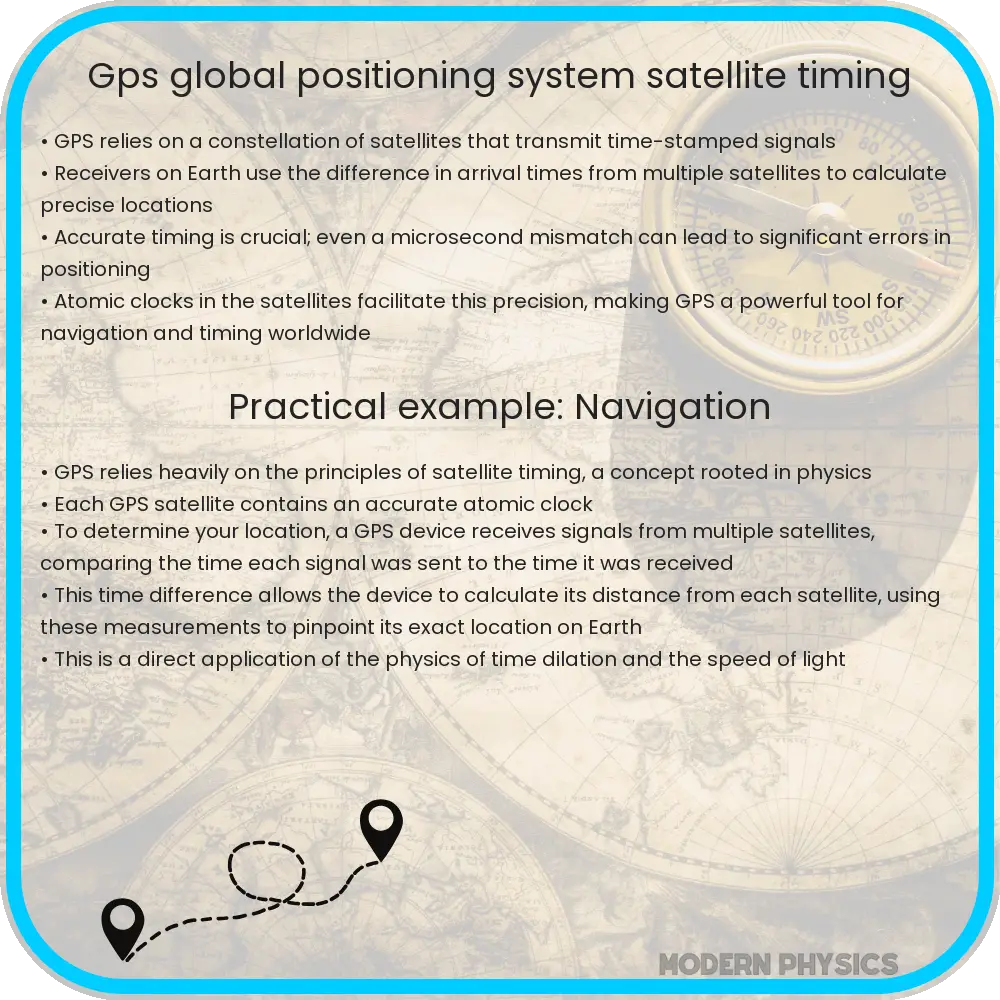
Global Positioning System (GPS) technology has become a cornerstone in modern navigation and timekeeping. Its remarkable accuracy and reliability hinge on advanced principles from physics and a complex network of satellites. In this article, we delve into the intricacies of GPS technology, focusing on its accuracy, the effects of relativity, and the precision of satellite timing.
Accuracy of GPS
GPS technology offers unparalleled accuracy in determining a user’s position. This precision is achieved through a network of at least 24 satellites orbiting the Earth, each transmitting signals that GPS receivers use to calculate location. The accuracy of GPS depends on factors such as signal blockage, atmospheric conditions, and the quality of the receiver. Typically, GPS can pinpoint a location to within a 5-meter radius under open sky conditions.
Impact of Relativity on GPS
One of the most fascinating aspects of GPS technology is its consideration of Einstein’s theory of relativity. Two effects from relativity play crucial roles: the time dilation effect and the gravitational frequency shift. Time dilation, a concept from special relativity, suggests that time observed from a satellite moving at high speeds is slightly slower compared to time on Earth. Conversely, general relativity predicts that time observed closer to a massive object (like Earth) runs slower than time observed further away. These effects, if uncorrected, could lead to significant errors in GPS readings.
Precision in Satellite Timing
The heart of the GPS’s precision lies in the incredibly accurate atomic clocks aboard each satellite. These clocks measure time based on the vibration frequencies of atoms, primarily Cesium (55Cs) or Rubidium (37Rb). The atomic clocks are synchronized with each other and with ground-based clocks. This synchronization is vital because a mere nanosecond (10-9 seconds) discrepancy can lead to a positioning error of about 30 centimeters. The system continuously adjusts the clocks to account for the relativistic effects, ensuring high accuracy in positioning and timing.
Thus, GPS technology is not just a triumph of engineering but also a practical application of advanced physics concepts. The next section will further explore how GPS deals with challenges such as signal interference, multipath effects, and the future advancements in this technology.
Is this conversation helpful so far?
Overcoming GPS Signal Challenges
Despite its advanced technology, GPS faces challenges like signal interference and multipath effects. Signal interference, caused by natural or man-made sources, can degrade GPS accuracy. Solar flares, for instance, emit charged particles that can disrupt satellite signals as they pass through the Earth’s atmosphere. Man-made interference includes signal jamming, which is a significant concern for military and aviation applications.
Multipath effects occur when GPS signals reflect off surfaces like buildings or mountains before reaching the receiver. This causes errors as the GPS receiver might calculate a slightly longer travel time for the signal, leading to inaccuracies in position calculation. Advanced algorithms and improved receiver designs are continually being developed to mitigate these issues.
Advancements and Future of GPS Technology
The future of GPS technology looks promising with several advancements on the horizon. One significant development is the deployment of next-generation satellites, such as the GPS III series, which promise improved accuracy, better resistance to jamming, and longer lifespans. Additionally, integration with other global navigation satellite systems like Europe’s Galileo or Russia’s GLONASS can enhance global coverage and reliability.
Another exciting advancement is the incorporation of more sophisticated signal processing technologies. These include techniques like Real-Time Kinematic (RTK) positioning, which can provide centimeter-level accuracy by comparing the phase of the GPS signal carrier wave with a fixed base station. This technology is especially beneficial in fields like geodesy, agriculture, and autonomous vehicle navigation.
Conclusion
In conclusion, GPS technology represents an extraordinary fusion of advanced physics, engineering, and computer science. It has revolutionized navigation and timekeeping in the modern world. While challenges like signal interference and multipath effects persist, ongoing advancements ensure that GPS will continue to become more accurate and reliable. The integration with other global navigation systems and the adoption of new signal processing techniques herald a future where GPS technology will play an even more integral role in our daily lives, from driving cars to tracking global changes.
As we continue to push the boundaries of what is possible with GPS, it remains a testament to human ingenuity and our ability to harness complex scientific principles for practical, everyday use.