
Explore the essentials of Quantum Chromodynamics through the gluon field strength tensor, unraveling the dynamics of quarks and gluons in particle physics.
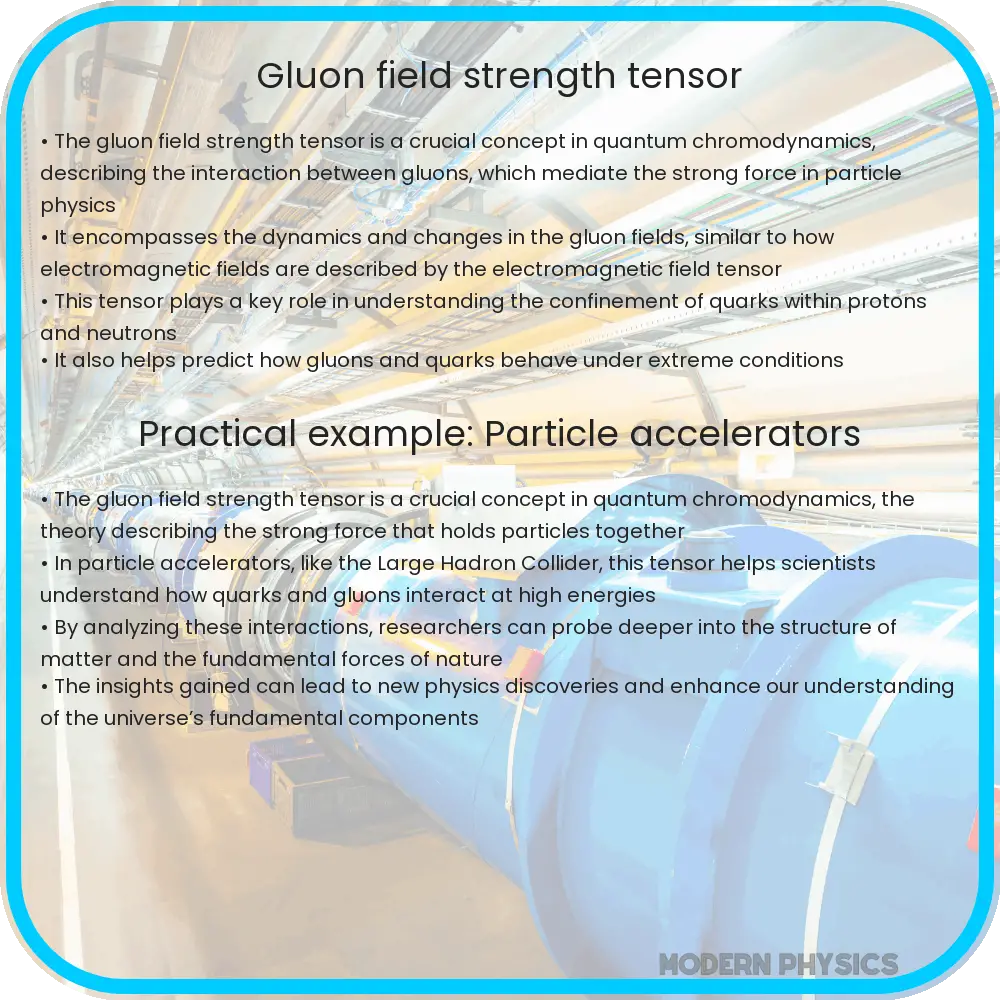
Gluon Field Strength Tensor: Unveiling the Fabric of Quantum Chromodynamics
Quantum Chromodynamics (QCD), the theory describing the strong interaction—one of the four fundamental forces of nature—relies heavily on the concept of the gluon field strength tensor. This tensor is pivotal in understanding the dynamics of particles like quarks and gluons, which are the building blocks of protons, neutrons, and other hadrons.
At its core, QCD is a gauge theory that’s part of the Standard Model of particle physics. It portrays the strong interaction as mediated by gluons, analogous to how photons mediate the electromagnetic force. However, unlike electromagnetism, QCD exhibits unique features such as color confinement and asymptotic freedom, making its study both intriguing and complex.
The gluon field strength tensor, denoted as Fμνa, where μ and ν are spacetime indices and a runs over the color charges, encapsulates the dynamics of the gluon fields. It’s derived from the gluon fields Aμa and is vital in formulating the Lagrangian density of QCD. This tensor not only represents the intensity of the gluon field but also its orientation in the color space, a conceptual space representing different types of color charges inherent in quarks and gluons.
In the language of mathematics, the gluon field strength tensor is expressed as:
Fμνa = ∂μAνa – ∂νAμa + gƒabcAμbAνc
Here, g represents the strong coupling constant, and ƒabc are the structure constants of the SU(3) group, the mathematical group that underlies QCD. This equation highlights the non-Abelian nature of QCD, where the self-interactions of gluons play a significant role, a stark contrast to the Abelian gauge theories like electromagnetism.
Understanding the gluon field strength tensor is essential for exploring the complex phenomena of particle physics, such as hadronization—the process where quarks and gluons transform into hadrons. It also provides insights into the confinement of quarks and gluons inside hadrons, an area still ripe with theoretical challenges and experimental inquiries.
The study of the gluon field strength tensor extends beyond theoretical curiosity. It has practical implications in high-energy physics experiments, like those conducted at the Large Hadron Collider (LHC), where understanding the behavior of quarks and gluons under extreme conditions is crucial for probing the fundamental laws of nature.
Exploring the Implications of the Gluon Field Strength Tensor in Particle Physics
Delving deeper into the gluon field strength tensor opens up a realm of phenomena in Quantum Chromodynamics (QCD). One of the most fascinating aspects is the role it plays in the confinement of quarks. This phenomenon, where quarks are perpetually bound within hadrons, is a distinctive feature of the strong force and is directly tied to the properties of the gluon fields as described by the tensor. The mathematical complexity arising from the tensor’s non-linear terms is at the heart of this confinement, a subject of ongoing research in theoretical physics.
Another critical phenomenon illuminated by the gluon field strength tensor is asymptotic freedom. As quarks come closer, the strong force weakens, allowing them to behave almost as free particles at high energies. This counterintuitive aspect, verified through high-energy particle experiments, earned the Nobel Prize in Physics in 2004 for David Gross, Frank Wilczek, and H. David Politzer. Their work, deeply rooted in the properties of the gluon field strength tensor, has been pivotal in advancing our understanding of QCD.
Furthermore, the tensor plays a significant role in the study of the quark-gluon plasma, a state of matter believed to have existed shortly after the Big Bang. In this plasma, quarks and gluons are not confined within hadrons, and understanding the dynamics of this state relies heavily on the complexities of the gluon field strength tensor.
In the context of technological advancement, insights gained from studying the gluon field strength tensor have implications in various fields, including material science and nuclear physics. For instance, understanding the behavior of quarks and gluons under extreme conditions can inform the development of new materials with unique properties.
Conclusion
The gluon field strength tensor is more than just a mathematical construct in the realm of particle physics; it’s a fundamental tool that helps us decode the mysteries of the universe at its most elemental level. Its role in explaining phenomena like quark confinement, asymptotic freedom, and the properties of quark-gluon plasma underscores its importance in the Standard Model of particle physics. As research continues, both in theoretical and experimental physics, the gluon field strength tensor remains a key focus, offering potential breakthroughs in our understanding of the universe. The ongoing exploration of this tensor not only enriches our knowledge of fundamental forces but also inspires technological innovations, demonstrating the profound impact of theoretical physics on the broader scientific and technological landscape.