
Gamma-ray lasers or GRASERs use stimulated emission to amplify high-energy gamma rays, offering potential revolutionary applications in various fields.
Understanding Gamma-ray Lasers
Gamma-ray lasers, commonly abbreviated as GRASERs (Gamma-Ray Amplification by Stimulated Emission of Radiation), represent an advanced concept within the field of photonics, a branch of physics that deals with light generation, detection, and manipulation. GRASERS operate similarly to their well-known counterparts, optical lasers, which are commonly used in everyday life in applications ranging from scanning barcodes at supermarkets to treating medical conditions.
The Principles Behind Gamma-ray Lasers
At the core of a GRASER’s functionality is the physics principle known as stimulated emission, first introduced by Albert Einstein in 1917. Stimulated emission occurs when an excited atom or molecule, already in a high-energy state, is induced to release its energy in the form of photons (light particles). This process is fundamental to all lasers, including gamma-ray lasers.
However, the distinction between GRASERS and other forms of lasers lies in the type of electromagnetic radiation they emit. While typical lasers emit visible light, ultraviolet, or infrared rays, GRASERS emit gamma rays, which are located at the high-energy end of the electromagnetic spectrum. Gamma rays have exceedingly short wavelengths, generally less than 10-11 meters, which equip them with unique properties and challenges in their production and control.
Working Mechanism of Gamma-ray Lasers
The technical realization of a GRASER involves several complex steps. Firstly, an appropriate medium that can sustain a population inversion is essential. A population inversion is a condition in which more atoms or molecules in a medium are in an excited state than in their ground state. In the context of GRASERS, achieving and maintaining this condition is particularly challenging due to the high energy levels associated with gamma rays.
Once the medium is appropriately prepared, the next step involves the stimulation of the excited atoms or molecules by passing external gamma photons through the medium. This triggers a cascade of stimulated emissions, amplifying the intensity of the gamma ray beam.
Current viable approaches for achieving population inversion in GRASERs include nuclear transitions. Unlike electronic transitions used in conventional lasers, nuclear transitions deal with energy changes in the atomic nucleus, which can be adequate to produce gamma rays.
Uses of Gamma-ray Lasers
Although gamma-ray lasers are yet to be fully realized in practical applications due to their complex and demanding technology, their potential uses are profound. Here are some prospective fields that could benefit from GRASER technology:
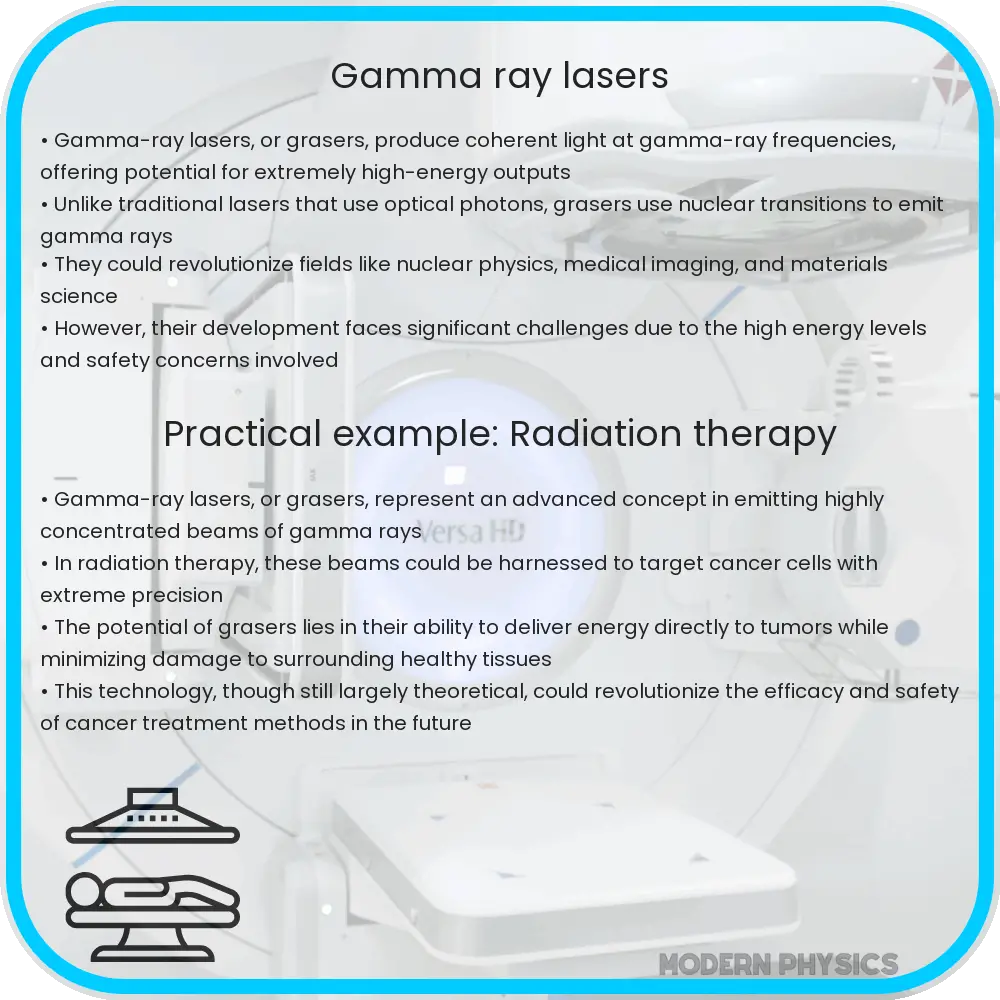
- Medicine: In the medical field, GRASERS could be used in highly precise radiosurgery to target cancerous cells without damaging the surrounding healthy tissue. Their high energy and penetrating power make them ideal for such applications.
- Astronomy and Astrophysics: GRASERS could also find applications in astronomical research, providing new ways to probe and understand cosmic phenomena.
- Nuclear Waste Management: The manipulation of nuclear materials using gamma rays might offer new methods in the processing and neutralization of radioactive waste.
Moreover, the military could utilize gamma-ray lasers in developing advanced weapon systems due to their potent energy and penetration capabilities, though such applications are surrounded by ethical and legal concerns.
In conclusion, while the development of gamma-ray lasers presents significant scientific and engineering challenges, the potential impacts and applications of successfully harnessing this technology could be revolutionary. The next section will delve deeper into the technical challenges, recent advancements, and the future prospects of gamma-ray laser technology.
Challenges and Recent Advancements in GRASER Technology
The road to fully operational gamma-ray lasers is fraught with substantial scientific and engineering hurdles. One of the primary challenges lies in the creation and maintenance of the required population inversion at the extreme energies characteristic of gamma rays. Additionally, the materials used to facilitate these nuclear transitions must withstand immense levels of radiation without degrading.
Recent advancements in material science and nuclear physics, however, have begun to open possible pathways to overcome these challenges. Innovations such as the development of new, more radiation-resistant materials and more refined techniques for controlling nuclear reactions offer a glimpse into the potential future where GRASER technology could be viable.
Future Prospects of Gamma-ray Lasers
Looking forward, the realization of fully operational GRASERS would not only transform the fields listed earlier but also potentially catalyze new technologies. For example, the high precision and energy of gamma rays could lead to breakthroughs in microscopic imaging and even quantum computing, where controlling quantum states with precision is paramount.
Moreover, the prospect of GRASERs highlights the importance of interdisciplinary collaboration in modern science and technology. Physicists, engineers, material scientists, and professionals from various fields must work together to tackle the multifaceted challenges presented by this advanced technology.
Conclusion
Gamma-ray lasers, or GRASERS, while still largely theoretical, offer a fascinating window into the future of technology and its potential impacts across various fields. From cutting-edge medical treatments and astrophysical research to handling nuclear waste and potentially revolutionizing computing, the successful development of GRASER technology could mark a pivotal point in scientific and technological advancement.
However, the road to achieving this is not straightforward. It requires overcoming formidable challenges, particularly in materials science and nuclear physics. Continued research, innovation, and collaborative efforts are crucial to moving forward. Whether in the near future or in more distant decades, the journey toward operational gamma-ray lasers continues to inspire scientists and engineers around the globe, offering a promising example of how pushing the boundaries of knowledge can lead to extraordinary possibilities.