
Explore the gamma factor in relativity and its impact on time dilation, length contraction, and mass in this insightful article on Einstein’s theory.
Understanding the Gamma Factor in Relativity
The concept of the gamma factor (\( \gamma \)) is central to Einstein’s theory of special relativity. It plays a crucial role in explaining phenomena such as time dilation, length contraction, and the relativity of simultaneity, fundamentally altering our understanding of space, time, and mass at high velocities.
Speed and the Lorentz Transformation
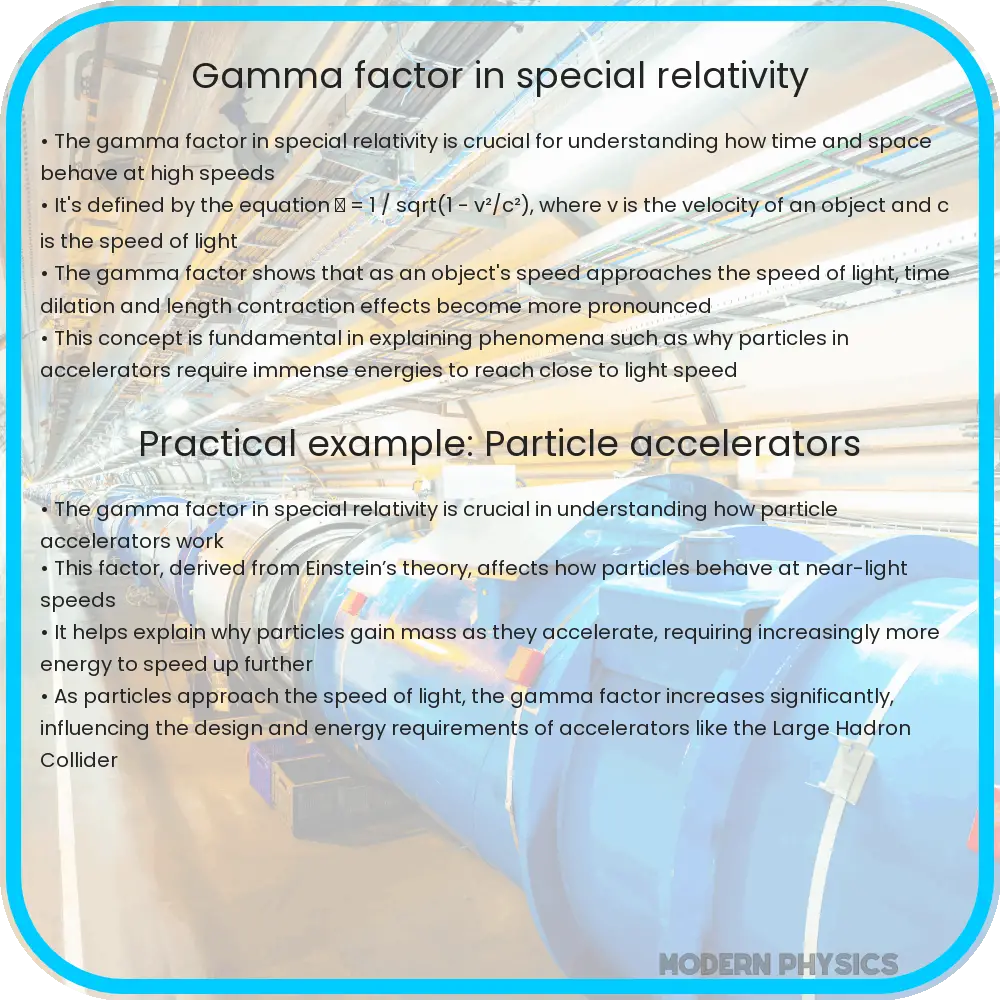
In special relativity, the Lorentz transformation equations are used to convert between the measurements of space and time made by observers in different inertial frames. The gamma factor is a key component of these equations. It is defined as:
\[ \gamma = \frac{1}{\sqrt{1 – \frac{v^2}{c^2}}} \]
where \( v \) is the relative velocity of the observer and \( c \) is the speed of light in a vacuum. This factor becomes significant as \( v \) approaches \( c \), showing that the laws of physics as observed in a moving frame differ from those in a stationary frame.
Time Dilation: A Consequence of High Velocity
One of the most intriguing consequences of the gamma factor is time dilation. According to relativity, time passes slower for an object in motion compared to an object at rest. This effect is described mathematically as:
\[ \Delta t’ = \gamma \Delta t \]
Here, \( \Delta t’ \) is the time interval measured in the moving frame (such as a fast-moving spacecraft), and \( \Delta t \) is the time interval measured in the stationary frame. As \( v \) increases, \( \gamma \) increases, leading to a larger discrepancy in time perception between the two frames.
Relativistic Mass and the Gamma Factor
Another aspect where the gamma factor is crucial is in the concept of relativistic mass. As an object’s velocity approaches the speed of light, its mass appears to increase from the perspective of a stationary observer. This is expressed as:
\[ m_{rel} = \gamma m_0 \]
where \( m_{rel} \) is the relativistic mass and \( m_0 \) is the rest mass of the object. The increase in mass as speed increases has profound implications in particle physics and astrophysics, especially in the context of accelerating particles to high speeds.
In summary, the gamma factor is an essential element in understanding the relativistic effects of time dilation, length contraction, and mass increase. It encapsulates the idea that measurements of time, space, and mass are not absolute but depend on the relative motion of the observer.
Length Contraction: Space Altered by Velocity
Another phenomenon profoundly influenced by the gamma factor is length contraction. Objects in motion are observed to contract in the direction of motion from the perspective of a stationary observer. The formula for length contraction is:
\[ L’ = \frac{L_0}{\gamma} \]
where \( L’ \) is the contracted length, and \( L_0 \) is the rest length of the object. This effect, like time dilation, becomes more pronounced as the object’s velocity approaches the speed of light.
Relativity of Simultaneity
The relativity of simultaneity is another intriguing aspect of special relativity influenced by the gamma factor. It refers to the phenomenon where two events that appear simultaneous to an observer in one frame of reference may not appear simultaneous to an observer in another frame of reference moving at a high velocity. This effect underscores the idea that there is no absolute simultaneity in the universe.
The Role of the Gamma Factor in Modern Physics
The implications of the gamma factor extend beyond theoretical physics into practical applications. In particle accelerators, understanding and accounting for relativistic effects like mass increase and time dilation are crucial for accurate predictions and operations. In the field of astrophysics, the gamma factor helps explain the behavior of cosmic phenomena like pulsars and black holes. Moreover, Global Positioning System (GPS) technology must account for relativistic effects to provide accurate location data, highlighting the gamma factor’s relevance in everyday technology.
Conclusion
The gamma factor in Einstein’s theory of special relativity is a cornerstone concept that has revolutionized our understanding of physics. It provides the mathematical framework to explain how time, space, and mass are perceived differently by observers moving at high velocities relative to each other. Through its integral role in phenomena such as time dilation, length contraction, and the relativity of simultaneity, the gamma factor has not only deepened our comprehension of the universe but also enabled significant technological advancements. Its influence extends from the minute scale of particle physics to the vastness of cosmic exploration, proving its indispensability in both theoretical and applied physics.