
Explore the Galaxy Luminosity Function (GLF) to understand galaxy brightness distribution, trends across types, and insights into universe structure and evolution.
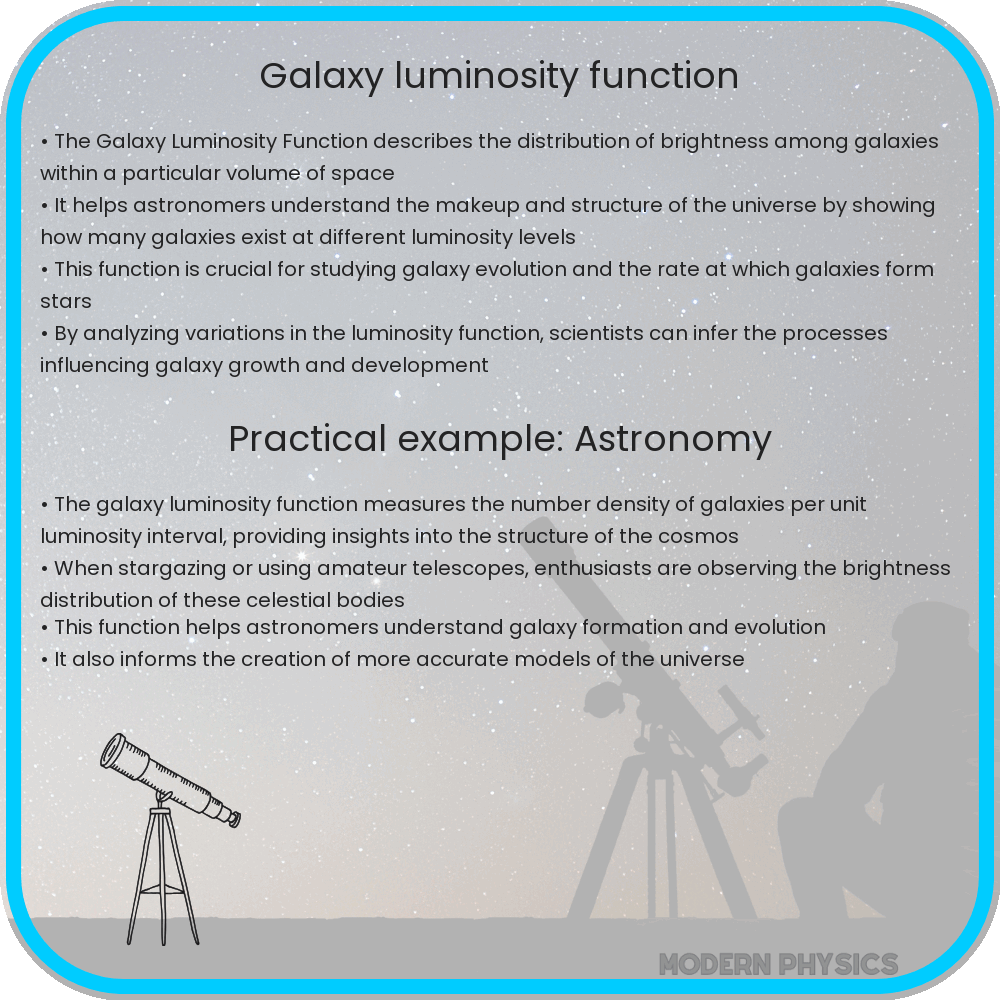
Understanding the Galaxy Luminosity Function
The Galaxy Luminosity Function (GLF) is a pivotal tool in astronomical studies, offering deep insights into the distribution, density, and evolutionary trajectory of galaxies across the cosmos. This statistical measure describes the number of galaxies per unit volume as a function of luminosity, shedding light on the underlying processes governing galaxy formation and development.
Trends and Patterns in Galaxy Formation
Analysis of the GLF reveals significant trends and patterns in galaxy formation. Most notably, the function typically exhibits a Schechter-like shape, characterized by a power-law slope at low luminosities and an exponential decline at high luminosities. This shape reflects a universe where dwarf galaxies are plentiful, while massive galaxies are rare, echoing the hierarchical model of galaxy formation. The GLF varies with the environment, being denser in regions such as galaxy clusters and less so in voids, indicating the influence of environment on galaxy evolution.
Insights from the Luminosity Function
Studying the GLF across different wavelengths and epochs provides valuable insights into the cosmic history of star formation, the accumulation of stellar mass, and the interplay between dark matter and baryonic matter. For instance, a shift in the peak of the luminosity function over time can indicate a significant epoch in the universe’s history, such as the era of peak star formation rate.
Challenges in Measuring the Galaxy Luminosity Function
Despite its utility, measuring the GLF presents several challenges. Foremost among these is the need to account for cosmic variance and observational biases such as redshift, dust extinction, and the limitations of telescopic technology. Furthermore, converting from observed luminosity to intrinsic luminosity requires understanding the complex physics of galactic light emission, including stellar populations, gas content, and active galactic nuclei.
Understanding the Galaxy Luminosity Function
The Galaxy Luminosity Function (GLF) is a fundamental tool used in astronomy to characterize the distribution of brightness among galaxies within a given volume of space. This function is crucial for understanding the structure and evolution of the universe, as it provides insights into the formation and development of galaxies over time.
Trends in Galaxy Luminosity
Recent observations have revealed several important trends in the GLF. Firstly, there is a clear distinction between the luminosity functions of different types of galaxies, such as elliptical, spiral, and irregular galaxies. Each type has its unique distribution pattern, reflecting different formation and evolutionary processes. Secondly, the shape of the GLF varies with the environment, being different in dense clusters of galaxies compared to more isolated regions of space.
Insights from the GLF
Studying the GLF provides valuable insights into the physical processes governing galaxy formation and evolution. For instance, the steep slope of the GLF at low luminosities indicates a vast number of faint, dwarf galaxies. This suggests that small-scale galaxy formation was a prevalent process in the early universe. Moreover, the evolution of the GLF over cosmic time can help astronomers understand the rate at which galaxies merge and grow.
Conclusion
The Galaxy Luminosity Function is an essential tool in cosmology, offering a window into the past and present universe. By analyzing the distribution and trends of galaxy brightness, astronomers can infer the underlying physics driving galaxy formation and evolution. As observational techniques improve and more data becomes available, our understanding of the GLF and its implications for cosmology will continue to deepen, helping to unravel the mysteries of the cosmos.