
Explore the mysteries of galactic magnetic fields, their structure, evolution, and impact on the cosmos, as we delve into advanced observational techniques and challenges.
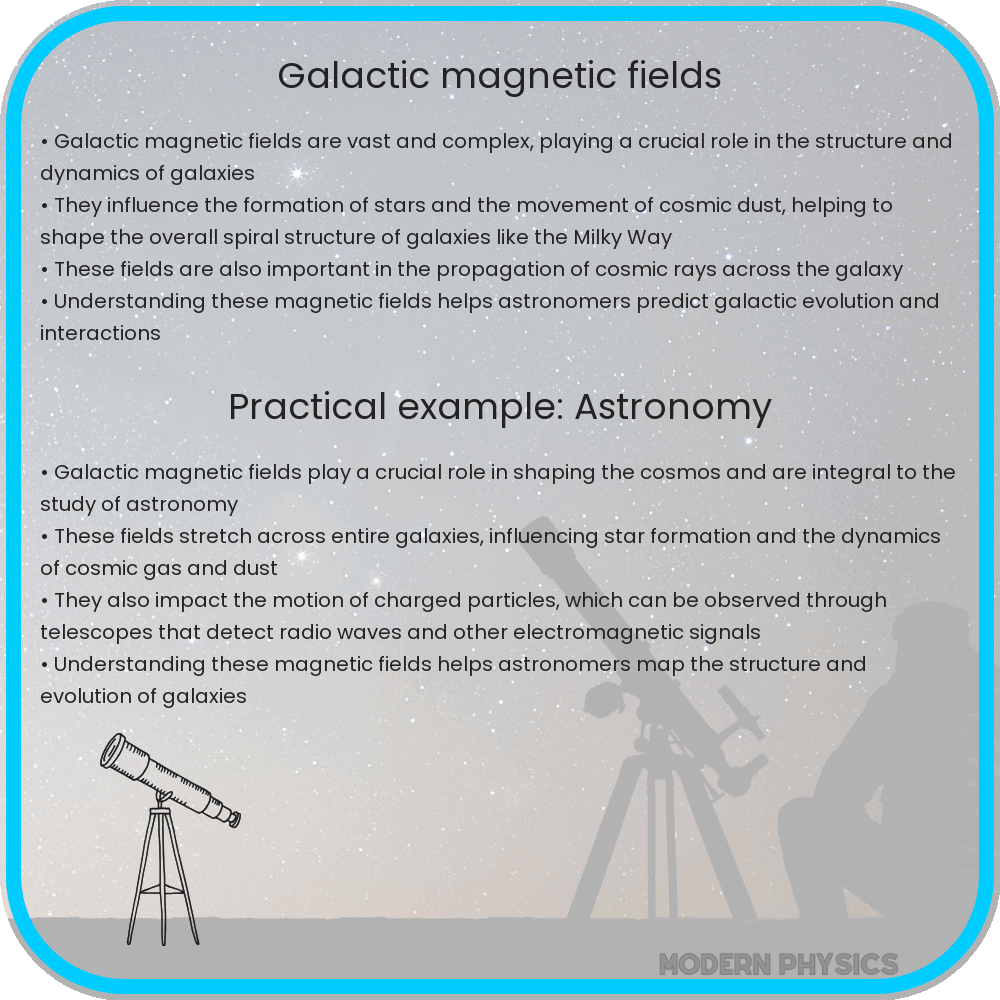
Unveiling the Mysteries of Galactic Magnetic Fields
The cosmos, a vast expanse filled with enigmatic phenomena, holds many secrets, with galactic magnetic fields standing out as one of the most intriguing. These invisible forces weave through the Milky Way and other galaxies, influencing cosmic events and structures. Yet, despite their importance, many aspects of these fields remain shrouded in mystery, challenging astronomers and physicists alike to decode their complexities.
The Structure of Galactic Magnetic Fields
Galactic magnetic fields are not uniform or simple in structure. Instead, they are complex and multifaceted, varying significantly from one galaxy to another. In spiral galaxies like the Milky Way, magnetic fields tend to follow the spiral arms, enhancing the already stunning visual spectacle of these cosmic formations. These fields are believed to be generated and maintained by dynamo processes, where the kinetic energy of moving ionized gas (plasma) is converted into magnetic energy. However, the exact mechanisms behind these processes, and how they influence the overall structure of the galaxy, are still under intense study.
Evolution and Effects of Galactic Magnetic Fields
The evolution of galactic magnetic fields is a slow and continuous process, intimately linked with the life cycle of a galaxy. As galaxies form, merge, or collide, their magnetic fields undergo dramatic changes, growing in strength and complexity. These fields play a crucial role in various astrophysical phenomena, from the shaping of cosmic rays to the formation of stars and the dynamics of interstellar medium. They also influence the propagation of electromagnetic radiation, affecting the observations astronomers make from Earth.
- Star Formation: Magnetic fields can either foster or hinder star formation by controlling the collapse of molecular clouds.
- Cosmic Ray Propagation: Galactic magnetic fields bend and twist the paths of cosmic rays, affecting their movement and distribution.
- Interstellar Medium Dynamics: These fields contribute to the turbulence and heating of the interstellar medium, impacting the lifecycle of galaxies.
The study of galactic magnetic fields not only enhances our understanding of the cosmos but also sheds light on fundamental physical processes. Despite the challenges, advancements in observational techniques and theoretical models continue to peel back the layers of this cosmic enigma, promising exciting discoveries in the years to come.
Advancements in Observing Galactic Magnetic Fields
Recent advancements in technology and methodology have significantly improved our ability to study galactic magnetic fields. Techniques such as radio astronomy, particularly through the use of polarization measurements, have become invaluable. Polarization allows scientists to map the orientation and intensity of magnetic fields across different regions of galaxies. Additionally, the advent of high-resolution telescopes and space observatories has enabled astronomers to probe deeper into the electromagnetic spectrum, enhancing our understanding of how these fields evolve over cosmic timescales.
Challenges and Future Prospects
Despite these advancements, numerous challenges remain. One of the primary difficulties in studying galactic magnetic fields lies in their invisibility and the indirect methods required to detect them. Furthermore, the vast scales and complexities involved pose significant theoretical and computational challenges. Future research will likely focus on integrating observations with advanced simulations to develop a more cohesive understanding of these magnetic fields. Additionally, interdisciplinary approaches, combining insights from plasma physics, astrophysics, and cosmology, are expected to play a crucial role in unraveling the mysteries of galactic magnetism.
Conclusion
Galactic magnetic fields are a fundamental component of the universe, weaving through the fabric of space and influencing the evolution of galaxies. Despite their elusive nature, recent technological advancements have shed light on their structures and dynamics, revealing their critical role in cosmic phenomena. However, much remains to be discovered about the origins, evolution, and full impact of these magnetic fields. As we stand on the brink of a new era in astronomy, the mysteries of galactic magnetic fields continue to fuel scientific inquiry and imagination. The journey to fully understand these cosmic forces is long and filled with challenges, but it is one that holds the promise of deepening our understanding of the universe and our place within it.