
Explore the potential of fusion plasma as a sustainable, safe, and infinite energy source, addressing technical challenges and the future of clean energy.
Fusion Plasma: Unlocking the Potential for Infinite Energy
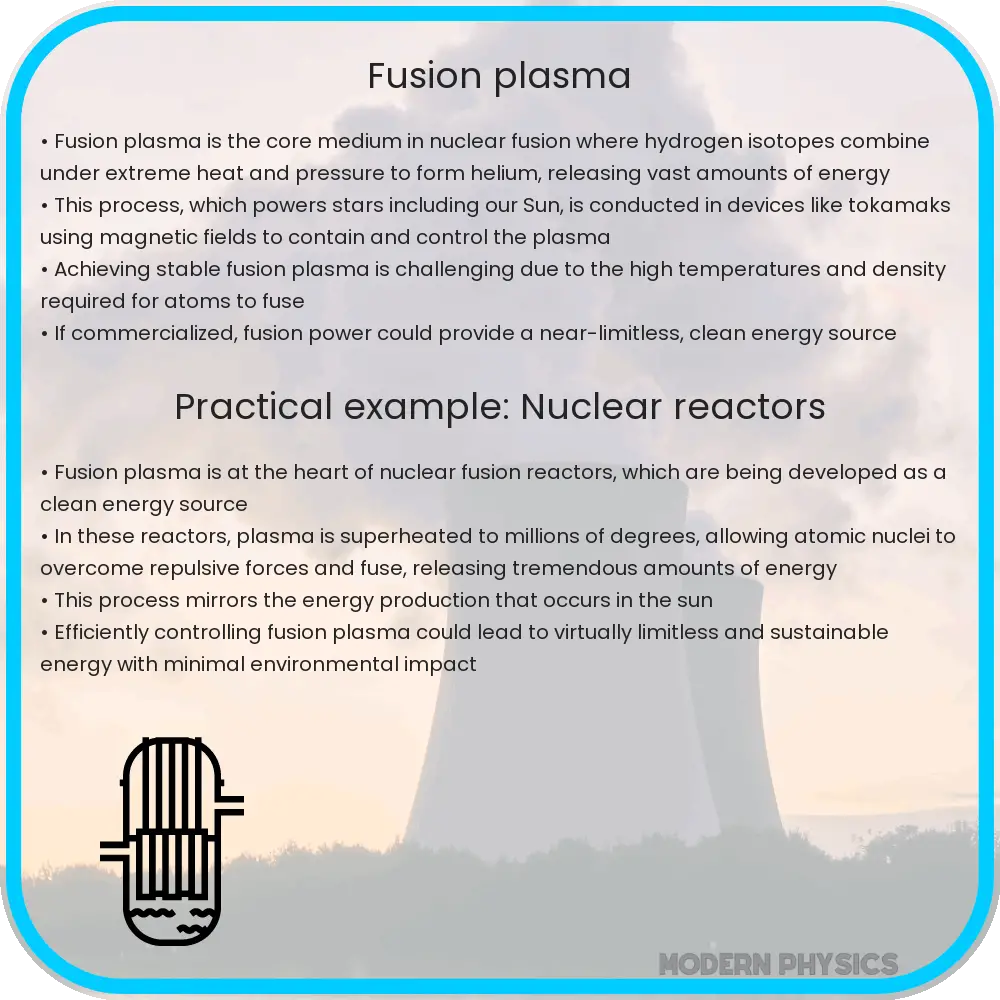
Fusion plasma represents one of the most promising frontiers in the quest for a sustainable and limitless energy source. At its core, fusion is the process that powers our sun and the stars, where light atomic nuclei combine to form heavier nuclei, releasing vast amounts of energy in the process. This energy, harnessed efficiently on Earth, has the potential to revolutionize our energy systems, offering a high-power, safe, and virtually infinite energy source.
How Fusion Plasma Works
Fusion energy is generated when hydrogen isotopes, deuterium (D) and tritium (T), are heated to extremely high temperatures, creating a plasma state where electrons are separated from nuclei. The conditions necessary for fusion require temperatures exceeding 100 million degrees Celsius, at which point the D and T nuclei can overcome their electrostatic repulsion to fuse, forming helium-4 (4He) and a neutron (n), and releasing approximately 17.6 Mega-electronvolts (MeV) of energy per reaction.
The Promise of Infinite Energy
The allure of fusion energy lies in its fuel source. Deuterium can be extracted from seawater, while tritium is breedable from lithium, resources that are abundant and accessible on Earth. This means the fuel for fusion is virtually inexhaustible, positioning fusion energy as a cornerstone for future energy sustainability. Moreover, the energy yield from fusion is extraordinarily high, with a single kilogram of fusion fuel capable of producing the same amount of energy as 10 million kilograms of fossil fuel.
High Power and Safety
Unlike fission reactors, fusion does not rely on a chain reaction, and the process ceases if the controlled conditions are not maintained, significantly reducing the risk of accidents. Furthermore, fusion produces no long-lived radioactive waste, addressing a critical concern associated with current nuclear energy production. The only major by-product, helium, is non-toxic and has valuable applications in medicine and industry. These factors make fusion energy not only a high-power solution but also an inherently safer alternative to existing energy sources.
As research and technology advance, the dream of harnessing the power of the stars here on Earth inches closer to reality. The challenges that remain are substantial, involving complex engineering and scientific breakthroughs, but the potential rewards promise a future of abundant, clean energy for all.
Challenges in Achieving Fusion Energy
The path to practical fusion energy is fraught with technical and scientific hurdles. One of the most significant challenges is achieving and maintaining the extreme conditions necessary for fusion to occur. This requires sophisticated confinement methods, such as magnetic confinement in tokamaks or inertial confinement using lasers, to keep the plasma stable and hot enough for fusion. Additionally, the materials used in fusion reactors must withstand the intense heat and neutron bombardment, necessitating the development of new, resilient materials.
Current Progress and Future Prospects
Despite the challenges, progress in fusion research has been steadily advancing. Experimental reactors like ITER (International Thermonuclear Experimental Reactor) and various national projects are paving the way toward making fusion energy a reality. ITER, in particular, aims to demonstrate the feasibility of fusion as a large-scale and carbon-neutral source of energy, with operations expected to begin in the 2025 timeframe.
Advancements in superconducting materials, plasma control, and energy extraction technologies continue to push the boundaries of what’s possible, gradually closing the gap between experimental success and commercial viability. The international collaboration in fusion research highlights the global recognition of its potential as a transformative energy source.
Conclusion
Fusion plasma holds the key to unlocking a future of infinite energy, offering a solution to the world’s growing energy needs that is both sustainable and safe. While the challenges ahead are substantial, the ongoing advancements in fusion technology and the concerted efforts of the global scientific community provide a solid foundation for optimism. Fusion energy, with its promise of high power, environmental safety, and virtually limitless fuel supply, stands as a beacon of hope for a cleaner, more sustainable energy future. As we stand on the cusp of this technological revolution, the dream of harnessing the power of the stars for the benefit of humanity is closer than ever to becoming a reality.