
Learn about fullerene compounds, unique carbon based structures with applications in enhancing the efficiency, stability, and design flexibility of electronic devices.
Introduction to Fullerene Compounds in Electronics
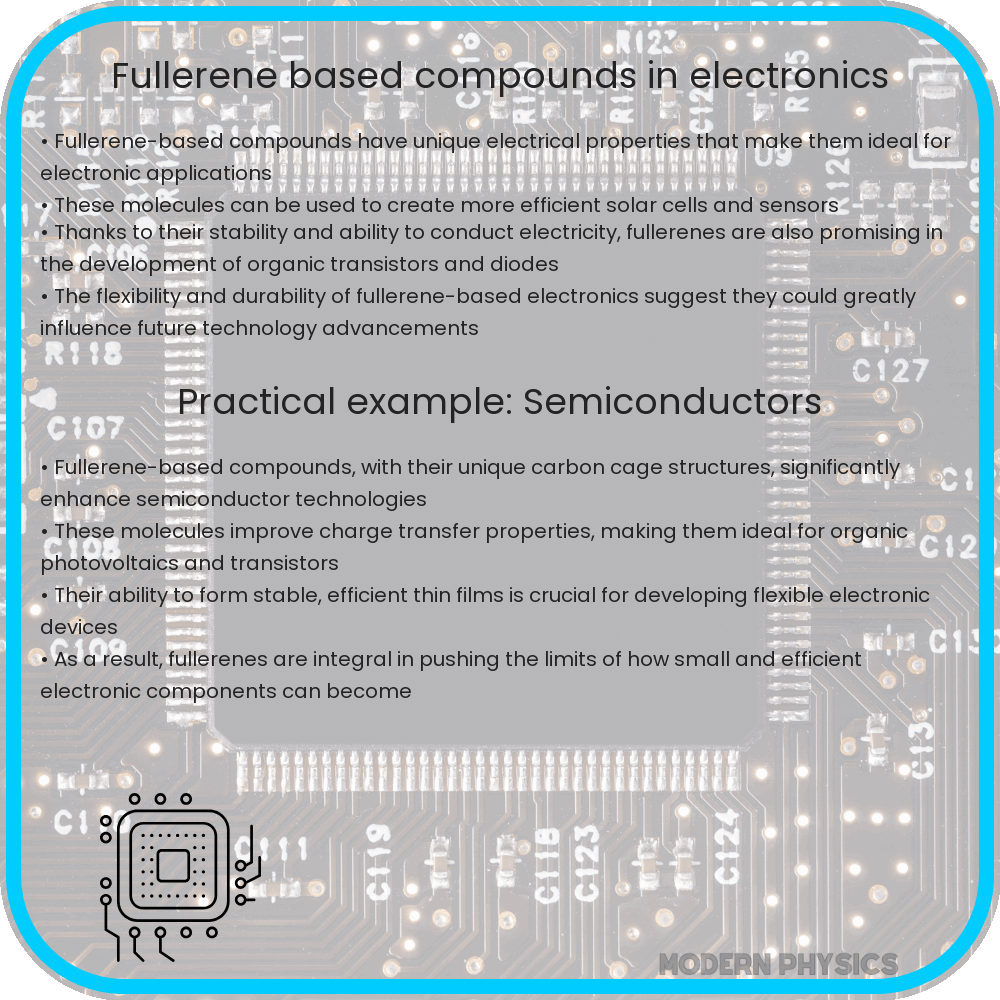
Fullerenes, often described as the third form of pure carbon next to diamond and graphite, are molecular compounds composed entirely of carbon in the form of a hollow sphere, ellipsoid, or tube. Discovered in 1985, fullerenes have unique properties that make them potentially useful in various electronic applications, including organic photovoltaics (OPVs), field-effect transistors (FETs), and superconducting materials. This article explores how fullerene compounds enhance the efficiency, stability, and design of electronic devices.
Enhancing Efficiency with Fullerene Compounds
One of the promising applications of fullerene compounds is in the field of organic photovoltaic cells (OPVs). Fullerenes are excellent electron acceptors due to their ability to easily accept electrons and transport them across the cell. This property significantly improves charge separation and reduces recombination, thereby increasing the overall conversion efficiency of solar cells. For instance, the incorporation of fullerene derivatives like PCBM (phenyl-C61-butyric acid methyl ester) in the active layer of OPVs has been shown to enhance power conversion efficiencies remarkably.
In addition to solar energy, fullerenes contribute to higher efficiency in organic light-emitting diodes (OLEDs) and organic field-effect transistors (OFETs). In OLEDs, fullerenes are used to improve electron mobility, which enhances the luminescence efficiency and operational stability of the diodes. Similarly, in OFETs, fullerene derivatives serve as electron transport layers or active layers, facilitating balanced charge transport and thus boosting device performance.
Stability Improvements Courtesy of Fullerene Derivatives
Electronic devices, specifically those based on organic materials, often suffer from stability issues due to the susceptibility of organic molecules to environmental factors such as heat, light, and oxygen. Here, fullerene compounds lend a helping hand—enhancing the thermal and photostability and thus extending the life of the devices. Fullerenes encapsulate other sensitive materials and act as effective barriers against oxidative degradation.
Moreover, fullerene structures can be functionalized with various groups to improve their solubility and tune their electronic properties. This functionalization not only facilitates the processing of fullerenes within different layers of electronic devices but also boosts their stability against mechanical stress.
Design Flexibility Offered by Fullerenes
Fullerenes are highly versatile compounds when it comes to design and engineering of new devices. Their hollow, spherical geometry offers unique structural and electronic properties that are not easily replicable with other materials. In electronics design, fullerenes can be used as components of thin film coatings, interlayers, or active layers, each configuration exploiting different aspects of fullerene’s properties. For example, the use of fullerene interlayers can effectively control the morphology of the photoactive layer in solar cells, leading to enhanced charge collection and transport.
The malleability of fullerenes to be chemically altered or functionalized makes them highly adaptable for various applications, enabling designers to tailor-make electronic materials that fit specific device architectures or performance requirements. This aspect of fullerenes allows for broad experimentation and innovation in the field of electronic design.
Fullerenes in Superconductivity and Energy Storage
Another intriguing application of fullerenes is in the area of superconductivity. Certain fullerene compounds, when doped with alkali metals, exhibit superconducting properties at relatively high temperatures. This has opened possibilities for their use in energy-efficient power transmission and advanced magnetic sensors. Moreover, the structure and composition of fullerenes potentially allow for compact energy storage solutions, an essential component in the development of renewable energy technologies and electric vehicles.
In energy storage systems, such as batteries and supercapacitors, fullerenes contribute to enhanced charge retention and rapid charge-discharge cycles due to their excellent conductivity and stable electrochemical properties. This improves the overall performance and lifespan of the energy storage devices.
Environmental Impact and Future Prospects
One of the key benefits of integrating fullerenes in electronic devices is their potential environmental advantage. Given their robustness and efficiency, devices made with fullerene components often require less material and consume less energy, which can lead to reduced environmental impact compared to traditional electronic components.
Looking to the future, continuous advancements in the synthesis and functionalization of fullerenes are expected to drive further innovation in electronics. With ongoing research aimed at understanding and optimizing the interaction of fullerenes with other materials and their properties under different conditions, the potential applications of fullerenes in electronics seem boundless.
Conclusion
The introduction of fullerenes into the electronics industry has marked a significant advancement in the development of more efficient, stable, and specially designed electronic devices. From enhancing the performance of solar cells and OLEDs to improving the longevity and efficiency of organic electronic materials, fullerenes offer a broad range of beneficial properties. Additionally, their application in superconductivity and energy storage provides a glimpse into the potential future innovations that could revolutionize the field. As research continues to unfold, the role of fullerenes in electronics is expected to expand, paving the way for more sustainable, efficient, and adaptable electronic technologies.