
Learn how Frequency Modulation (FM) improves sound quality, clarity, and range in radio broadcasting and acoustics, and how it compares to Amplitude Modulation (AM).
Understanding Frequency Modulation: Enhancing Sound Quality, Clarity, and Range in Acoustics
Frequency Modulation (FM) is a technique used in various applications, particularly in radio broadcasting, to enhance the sound quality, clarity, and range of audio signals. By delving into the principles of FM, its effect on acoustics, and comparing it with other methods like Amplitude Modulation (AM), we can appreciate the advantages it offers in sound transmission.
What is Frequency Modulation?
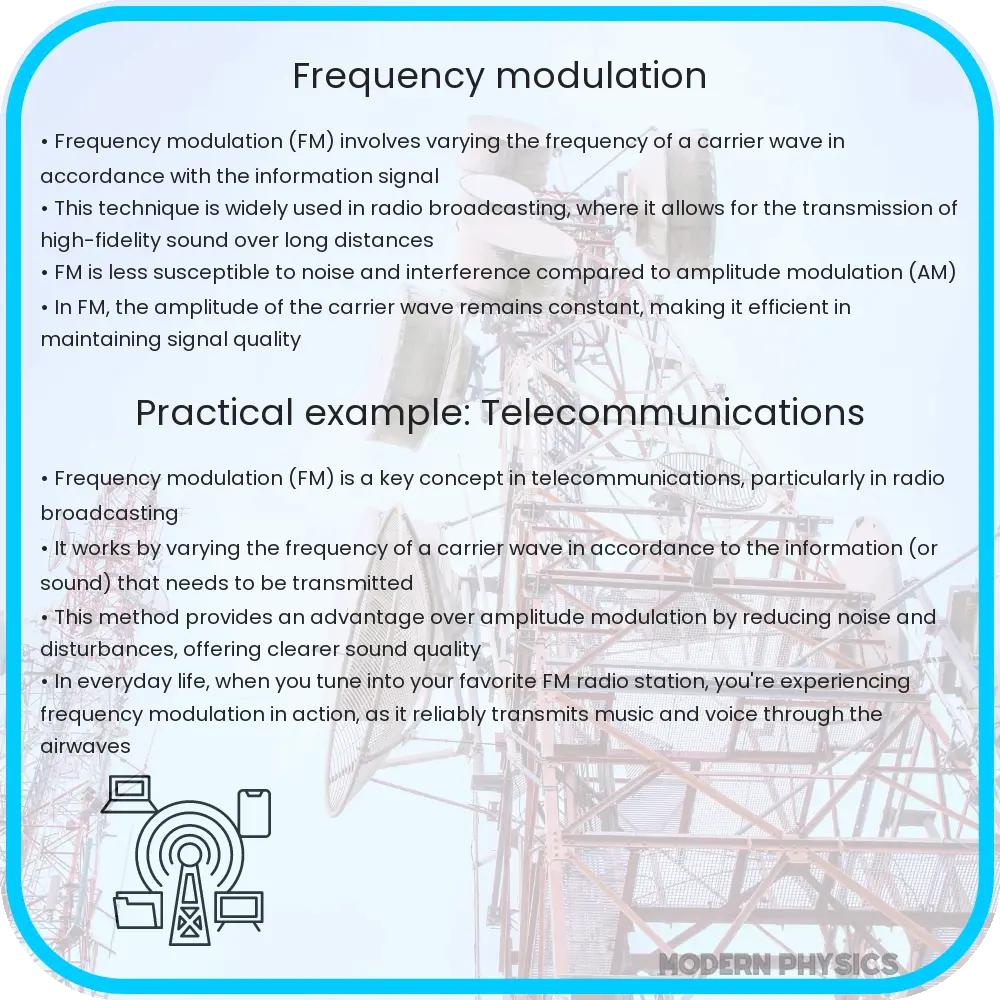
Frequency modulation involves varying the frequency of a carrier wave in accordance with the information signal that is being transmitted. This is different from amplitude modulation, where the amplitude of the carrier wave is varied, keeping the frequency constant. The general equation for a frequency-modulated signal can be expressed as:
s(t) = Ac * cos(2πfct + β * sin(2πfmt))
where:
- Ac is the amplitude of the carrier wave,
- fc is the carrier frequency,
- fm is the frequency of the modulating signal,
- β is the modulation index, which represents the extent to which the carrier frequency is varied.
Advantages of Frequency Modulation
FM is renowned for its improved sound quality and immunity to noise compared to AM. This aspect makes FM especially valuable in areas with high electromagnetic interference. Below are several key advantages:
- Less Susceptible to Noise: Unlike AM, FM signals have the capability to overcome noise and interference because the information is encoded in the frequency variation, which is less affected by noise.
- Higher Sound Quality: FM broadcasting is capable of supporting a higher bandwidth, allowing it to carry more data. This translates to better sound quality, capable of capturing subtle differences in music and voice.
- Improved Range: FM signals maintain their integrity over longer distances than AM signals, making FM a better choice for radio broadcasts that require broad coverage.
Frequency Modulation in Acoustics
In the context of acoustics, FM plays a crucial role in transmitting clean and clear audio signals. Acoustic signals — whether in open spaces, broadcasting systems, or recording studios — benefit immensely from the clarity that FM provides. The modulation helps in minimizing losses due to environmental interferences, such as echoes and other sounds that may distort the original signal.
Furthermore, the application of FM extends beyond traditional broadcasting. It is used in sound engineering, particularly in scenarios where the fidelity of the sound reproduction is paramount. For instance, in wireless audio systems like microphones and in instruments where maintaining the integrity of the sound is essential for quality performances.
By exploring the technical dynamics of FM in acoustics, it is clear how its application has had a transformative effect on the way sound is managed, transmitted, and received in various environments. This foundational knowledge not only enhances our understanding but also underpins technological advancements in audio systems.
Comparing FM with AM in Practical Scenarios
Understanding the practical differences between Frequency Modulation (FM) and Amplitude Modulation (AM) can further illuminate why FM tends to be the preferred choice for modern broadcasting. While AM is simpler and was historically significant for early radio broadcasts, FM offers distinct advantages in real-world applications:
- Better Frequency Response: FM can reproduce a wider range of frequencies, from 30 Hz to 15 kHz, which closely matches the human hearing range and allows for a better listening experience.
- Reduced Signal Degradation: AM signals can degrade significantly with distance and environmental conditions, whereas FM signals maintain a consistent quality over similar circumstances.
- Utilization in Stereo Broadcasting: FM’s ability to transmit in stereo—an essential feature for modern radio broadcasts—is far superior to AM.
These practical aspects make FM more suitable for consistently high-quality audio in diverse broadcasting scenarios, reinforcing its ubiquitous presence in radio and audio devices.
Conclusion
Frequency Modulation has revolutionized the realm of acoustics and broadcasting. By varying the frequency of the carrier wave as opposed to its amplitude, FM ensures that sound signals are less susceptible to noise and interference, thereby significantly enhancing the quality and range of audio transmission. With its advantages such as higher sound quality, less susceptibility to noise, and improved range, FM has become the backbone of modern audio broadcasting systems. Whether through traditional radio, acoustic systems in open or enclosed environments, or sophisticated wireless audio setups, Frequency Modulation continues to be a pivotal technology in shaping our audio experiences. The study and understanding of FM not only enrich our technical knowledge but also remind us of the continuously evolving nature of sound transmission technologies that constantly strive to improve how we create, transmit, and enjoy sound.
In conclusion, the resilient characteristics and superior performance of FM make it an invaluable technology in the acoustic and broadcasting domains. As technology progresses, the exploration and understanding of such techniques will undoubtedly lead to further enhancements, ensuring clear, high-quality sound transmission in an era where audio plays a central role in communication and entertainment.