
Explore the Frenkel-Kontorova Model’s role in understanding nonlinearity, dynamics, and chaos in physics, and its applications in solid state physics.
Understanding the Frenkel-Kontorova Model: Nonlinearity, Dynamics, and Order
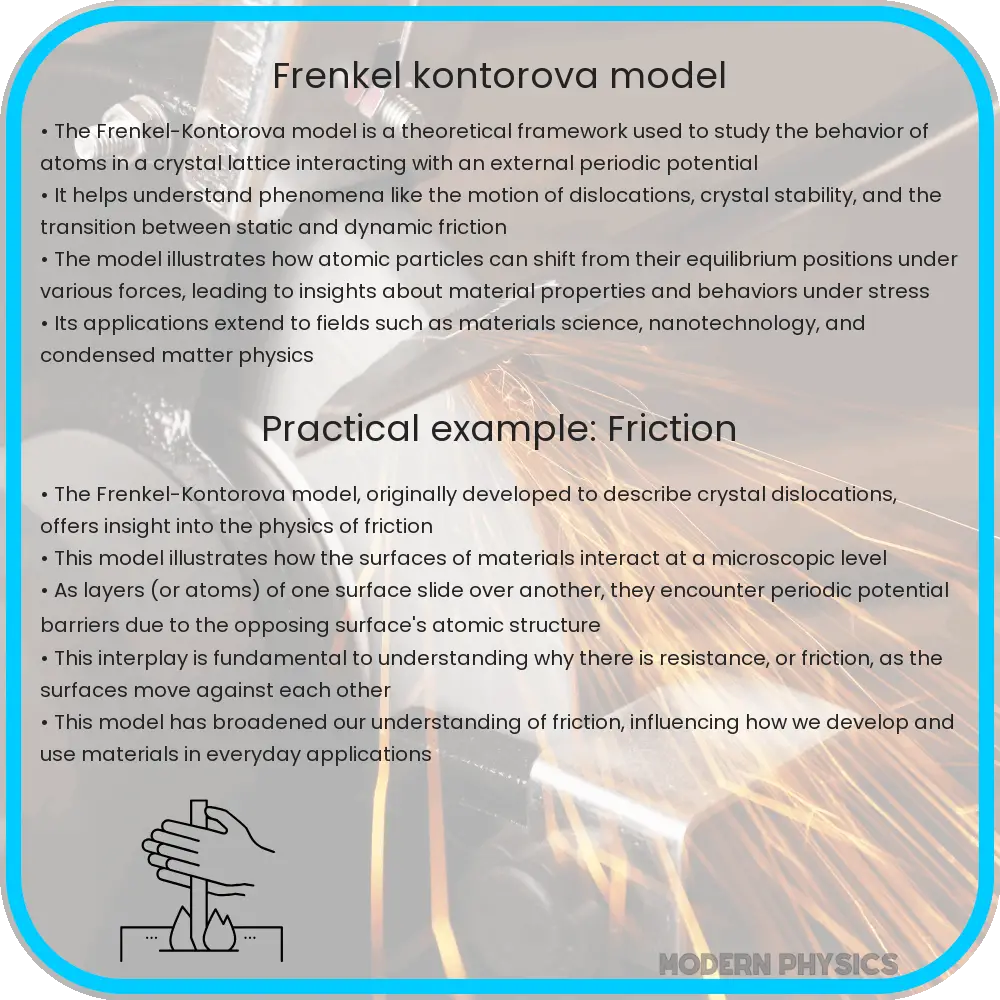
The Frenkel-Kontorova (FK) Model is a seminal concept in the field of theoretical physics, particularly in the study of nonlinear dynamics and crystal lattice structures. This model, introduced by Yakov Frenkel and Tatiana Kontorova in the 1930s, provides a framework for understanding various phenomena in solid state physics, including the behavior of dislocations in crystals, charge density waves, and friction at the atomic scale.
The Basis of the Frenkel-Kontorova Model
At its core, the FK Model is a simple yet powerful tool for illustrating the interplay between periodic potential and particle dynamics in a one-dimensional lattice. It considers a chain of atoms connected by springs (representing the interatomic forces) and placed in a periodic potential, which simulates the crystal lattice. The balance between the elastic forces of the springs and the external periodic potential leads to rich dynamical behavior and complex patterns.
Nonlinearity in the FK Model
One of the key aspects of the FK Model is its inherent nonlinearity. Nonlinear dynamics, contrary to linear systems, exhibit behaviors like chaos, solitons, and bifurcations. In the FK Model, this nonlinearity manifests in the form of complex, often unpredictable, motion of atoms within the lattice, which cannot be accurately described by linear approximations.
Applications in Solid State Physics
The FK Model has profound implications in solid state physics. It helps in understanding the behavior of dislocations, which are irregularities within the crystal lattice. These dislocations play a crucial role in determining the mechanical properties of materials. Additionally, the FK Model is instrumental in studying charge density waves, which are periodic modulations of the electron density in a conductor, affecting its electrical properties.
Implications in Other Areas of Physics
Beyond solid state physics, the FK Model finds relevance in other areas such as friction at atomic scales. The model’s ability to capture the dynamics of atoms in a lattice makes it a valuable tool for studying the fundamental aspects of friction and wear at the nanoscale. This understanding is crucial for the development of nanotechnology and materials science.
The FK Model also provides insights into broader concepts like the transition between order and chaos. By analyzing how the system evolves from regular, predictable behavior to chaotic dynamics, scientists gain a deeper understanding of the nature of order and chaos in physical systems.
Exploring Dynamics and Chaos in the FK Model
The dynamical properties of the FK Model are pivotal in understanding how systems transition from order to chaos. This transition is characterized by the appearance of strange attractors, bifurcations, and a sensitive dependence on initial conditions, hallmark features of chaotic systems. In the FK Model, these characteristics can be observed as the system parameters, such as the strength of the periodic potential or the natural length of the springs, are varied. This makes the FK Model a classic example for studying the onset of chaos in a deterministic system.
Quantum Extensions of the FK Model
Recent advancements have extended the FK Model into the quantum realm. The quantum FK Model considers quantum mechanical effects, such as tunneling and superposition, which are essential for understanding phenomena at atomic and subatomic scales. This quantum version has significant implications in areas like superconductivity and quantum computing, where quantum mechanical properties play a critical role.
Educational and Research Implications
In educational settings, the FK Model serves as an excellent introduction to complex systems, nonlinearity, and chaos theory. For researchers, it remains a fertile ground for exploring theoretical concepts and developing computational methods. The model’s simplicity and richness make it an ideal system for numerical simulations and analytical studies, providing insights into more complex real-world systems.
Conclusion
The Frenkel-Kontorova Model stands as a cornerstone in the study of nonlinear dynamics, solid state physics, and chaos theory. Its simplicity in concept belies the complexity of the phenomena it can model and explain. From understanding the behavior of atomic lattices and dislocations in materials to exploring the boundaries between order and chaos, the FK Model continues to be a valuable tool in both theoretical and applied physics. As we venture into the quantum realm, the extensions of this model promise to shed light on even more intricate and fundamental aspects of the physical world. The FK Model, thus, not only encapsulates a rich history of scientific inquiry but also paves the way for future discoveries in the ever-evolving landscape of physics.