
Explore the concept of frame dragging in astrophysics, a phenomenon predicted by General Relativity that affects space-time around rotating celestial bodies.
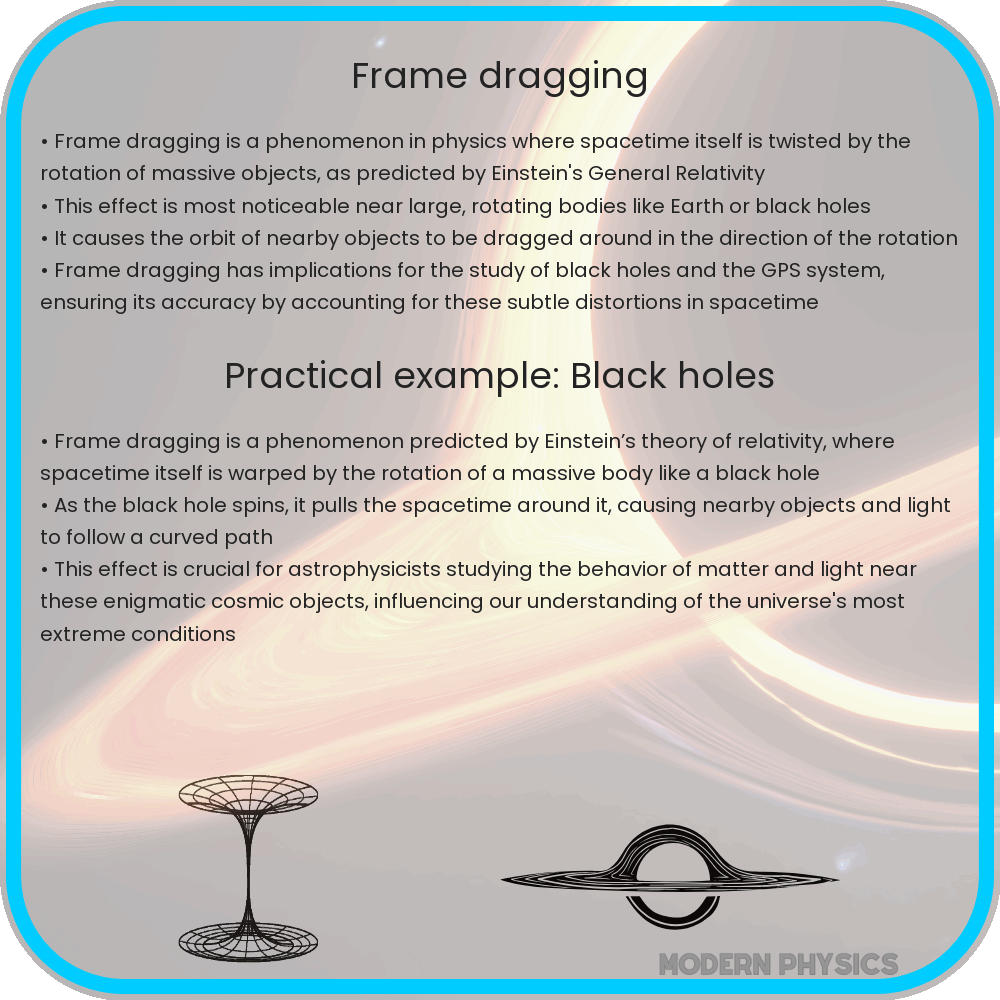
Understanding Frame Dragging in Astrophysics
Frame dragging is a fascinating and complex phenomenon predicted by Einstein’s theory of General Relativity. This effect occurs in the realm of astrophysics, involving space-time and gravitational interactions. It is also known as the Lense-Thirring effect, named after physicists Josef Lense and Hans Thirring who first predicted it in 1918.
In essence, frame dragging describes how rotating bodies, like Earth or massive celestial objects such as black holes, can ‘drag’ along the fabric of space-time in their vicinity. Imagine space-time as a two-dimensional sheet. When a large object sits on this sheet, it creates a depression, representing the gravitational pull. Now, if this object starts spinning, it twists the sheet around it. This twist in the space-time fabric is what scientists refer to as frame dragging.
Implications of Frame Dragging
Frame dragging has profound implications for our understanding of the universe. It affects the orbits of satellites around Earth, the movement of stars around galactic centers, and the behavior of matter near rotating black holes. Specifically, near a rotating black hole, frame dragging can lead to a phenomenon known as the ergosphere, where the space-time continuum is dragged to such an extent that objects cannot remain in a stationary position.
This effect is not merely theoretical. It has been observed and measured, most notably by the Gravity Probe B experiment, launched by NASA in 2004. The experiment involved four ultra-precise gyroscopes aboard a satellite orbiting Earth. The results, published in 2011, confirmed the predictions of General Relativity and the existence of frame dragging with remarkable precision.
The study of frame dragging is crucial for improving our understanding of the universe. It has practical applications in satellite navigation systems, such as GPS, and is essential for astrophysical research, particularly in studying the dynamics around rotating black holes and other celestial bodies.
Exploring the Effects of Frame Dragging
The effects of frame dragging extend beyond the theoretical. They are a critical aspect of the space-time continuum that influences the behavior of objects in space, particularly in high-gravity environments. For instance, in the vicinity of rotating black holes, the frame dragging can be so intense that it significantly alters the path of in-falling matter and light. This phenomenon contributes to the unique observations we can make about these cosmic giants, such as the warping of light and the behavior of accretion disks.
Additionally, frame dragging has implications for time dilation, a concept also rooted in General Relativity. As satellites or objects move within the distorted space-time caused by a rotating body, the time experienced by these objects can differ compared to a stationary observer. This is crucial for the accuracy of the Global Positioning System (GPS), as it requires extremely precise time measurement to function correctly. Scientists must account for the effects of Earth’s rotation (and thus frame dragging) on the space-time around it to ensure GPS provides accurate location data.
Challenges and Future Research
Despite its confirmed existence, measuring frame dragging accurately remains a challenge due to the subtle nature of its effects, especially around less massive bodies like Earth. Future missions and experiments aim to observe frame dragging around other astronomical objects, providing deeper insights into the dynamics of space-time. These studies are crucial for testing the limits of General Relativity and enhancing our understanding of gravitational phenomena.
Moreover, ongoing research into frame dragging could have profound implications for the development of new technologies, such as spacecraft navigation systems, and for the theoretical foundation of quantum gravity, a field that seeks to reconcile General Relativity with quantum mechanics.
Conclusion
Frame dragging represents one of the more intriguing predictions of Einstein’s General Relativity, illustrating the dynamic nature of space-time around rotating masses. Its study not only confirms our current understanding of the universe but also pushes the boundaries of modern physics. As technology advances, so too will our ability to observe and measure this subtle yet profound cosmic dance. Frame dragging remains a pivotal concept in astrophysics, offering insights into the very fabric of the universe and continuing to challenge and inspire scientists around the globe.