
Explore the fascinating world of Flavor Physics, covering groundbreaking discoveries, methods, and theoretical frameworks that shape our understanding of particle physics.
Introduction to Flavor Physics
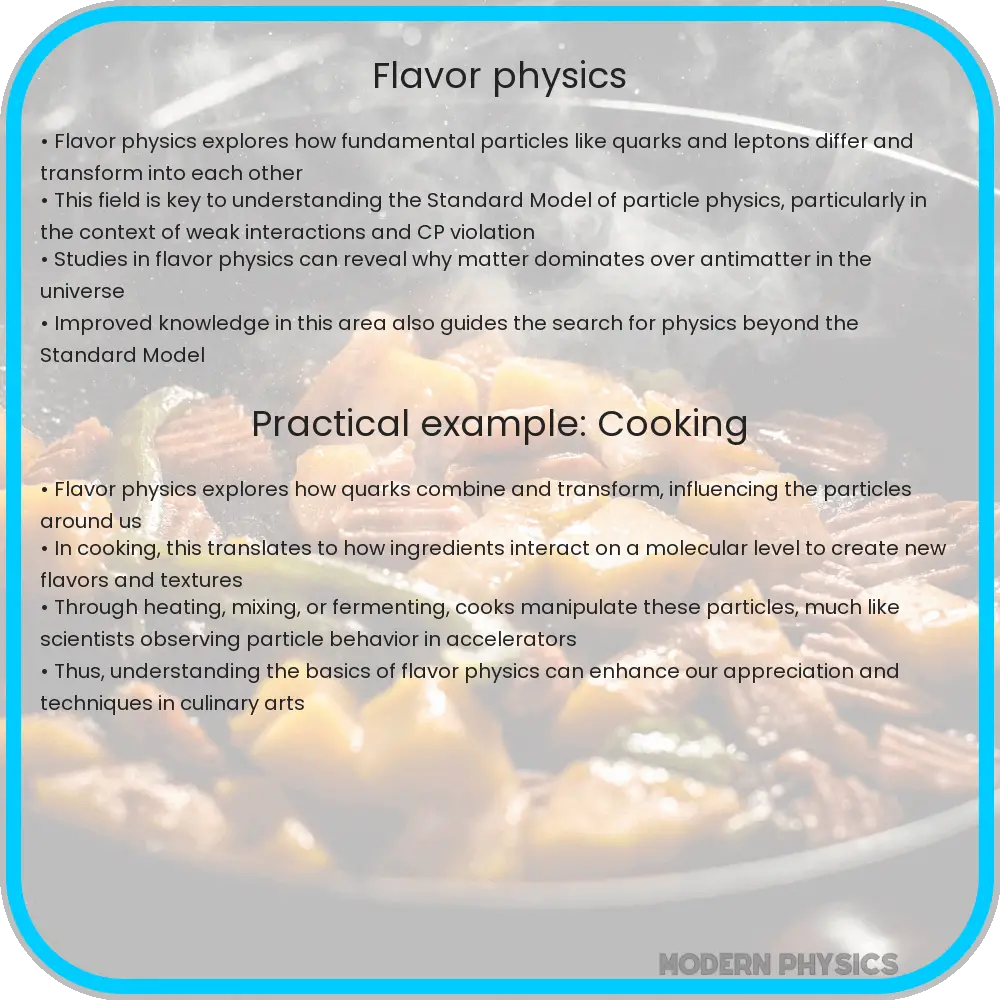
Flavor Physics is a subfield of particle physics that focuses on understanding the properties and transformations of quarks and leptons, the fundamental building blocks of matter. This field explores the reasons behind the existence of different “flavors” or types of these particles and how they interact and convert into each other through various forces of nature.
Discoveries in Flavor Physics
The study of flavor physics has led to numerous groundbreaking discoveries. One of the most notable is the discovery of quark mixing, explained by the Cabibbo-Kobayashi-Maskawa (CKM) matrix. This mathematical model describes how quarks can change their types (or “flavors”) through the weak nuclear force, leading to phenomena such as particle decay. Another significant discovery is the neutrino oscillation, which shows that neutrinos, previously thought to be massless, actually have a tiny mass and can change from one type to another as they travel through space.
Methods in Flavor Physics
Experiments in flavor physics often involve particle accelerators and detectors, where particles are accelerated to high energies and made to collide. The results of these collisions help scientists study the properties of quarks and leptons. Techniques such as deep inelastic scattering and flavor tagging are crucial for these investigations. Additionally, theoretical physics provides mathematical models and predictions that guide experimental efforts and help in interpreting results.
Theoretical Frameworks
The Standard Model of particle physics serves as the foundational theoretical framework in flavor physics. It describes the strong, weak, and electromagnetic fundamental forces and classifies all known subatomic particles. Within this framework, the CKM matrix for quarks and the Pontecorvo-Maki-Nakagawa-Sakata (PMNS) matrix for neutrinos are critical for understanding flavor mixing and oscillations. Moreover, extensions to the Standard Model, such as Supersymmetry and Grand Unified Theories, propose solutions to its limitations and aim to provide a more comprehensive understanding of flavor physics.
Challenges and Future Directions in Flavor Physics
Despite its successes, flavor physics faces several challenges. One major issue is the matter-antimatter asymmetry observed in the universe, which the Standard Model cannot fully explain. This has led to research into Charge-Parity (CP) violation, a phenomenon that could help explain why the universe is predominantly composed of matter. Additionally, the search for rare decays and the precise measurement of mixing parameters continue to be areas of intense study, as they could reveal new physics beyond the Standard Model.
Another challenge is the neutrino mass hierarchy and the exact nature of neutrino mixing. These unresolved questions are central to understanding the role of neutrinos in the universe. Advanced experiments, such as neutrino oscillation studies and searches for neutrinoless double beta decay, are crucial for addressing these mysteries.
Technological Advancements and Collaborations
The advancement of experimental techniques and equipment plays a critical role in flavor physics. High-luminosity accelerators, ultra-sensitive detectors, and sophisticated computational tools are essential for analyzing complex data and achieving high-precision measurements. Furthermore, global collaborations among research institutions and laboratories facilitate the sharing of resources, expertise, and data, accelerating the pace of discovery in this field.
Conclusion
Flavor physics remains one of the most dynamic and intriguing areas of particle physics, bridging theoretical concepts with experimental evidence. The field continues to challenge our understanding of the fundamental constituents of the universe and their interactions. With ongoing experiments and future projects, such as the Large Hadron Collider upgrades and new neutrino observatories, flavor physics is poised to answer some of the most pressing questions in physics and potentially uncover new physics beyond the Standard Model. As we stand on the brink of these scientific frontiers, the collaboration between theorists and experimentalists, along with advancements in technology, will be crucial in unraveling the mysteries of flavor physics and contributing to our ultimate quest for a unified understanding of the fundamental forces and particles of the universe.