
Explore the origins, evidence, and implications of the flat universe theory, a fascinating aspect of cosmology that shapes our understanding of the cosmos’s geometry and fate.
Origins of the Flat Universe Theory
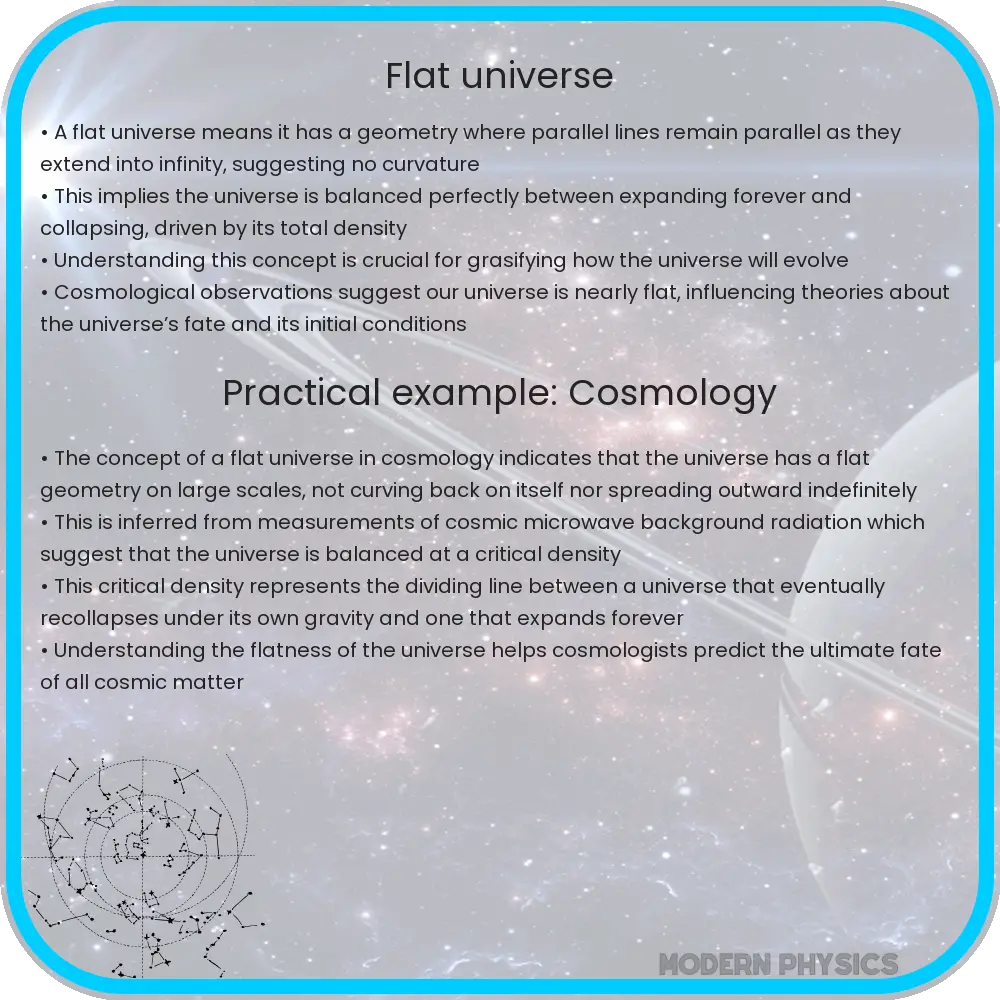
The concept of a flat universe, in the context of cosmology, stems from the geometric interpretation of space dictated by the General Theory of Relativity. Unlike the flat Earth theory, which is scientifically debunked, the flat universe theory pertains to the shape of the universe itself. Early 20th-century physicists, including Albert Einstein, introduced the idea that the shape of the universe could be open, closed, or flat, depending largely on its total density and energy content.
The precise origins of the flat universe theory are rooted in the observations of the cosmic microwave background (CMB) radiation, a relic from the early universe’s hot, dense state. Data collected by the COBE (Cosmic Background Explorer) and later by the WMAP (Wilkinson Microwave Anisotropy Probe) and Planck satellite missions provided strong evidence for a universe that is very close to geometrically flat.
Evidence Supporting the Flat Universe Theory
The most compelling evidence for a flat universe comes from detailed measurements of the CMB. The distribution of temperature fluctuations in the CMB provides a snapshot of the early universe, allowing astrophysicists to calculate the curvature of space. The critical density of the universe, denoted as ρcrit, corresponds to a flat geometry. Observations show that the total density of the universe is remarkably close to this critical value.
Further evidence stems from the distribution of large-scale structures, such as galaxies and clusters of galaxies, and their gravitational interactions. These observations, combined with the rates of cosmic expansion measured through supernovae and redshifts of distant galaxies, reinforce the flat universe scenario.
Implications of a Flat Universe
The implications of living in a flat universe are profound for both cosmology and the fundamental understanding of physics. If the universe is flat, it means it will likely continue to expand forever, though at an ever-decreasing rate. This scenario has significant implications for the ultimate fate of the cosmos. Moreover, a flat universe suggests that the total energy of the universe is perfectly balanced, a condition that has deep philosophical and scientific implications regarding the initial conditions of the Big Bang.
Exploring the Mathematical Framework
The mathematical underpinning of the flat universe theory is deeply embedded in the Friedmann-Lemaître-Robertson-Walker (FLRW) metric, which describes a homogeneous, isotropic expanding or contracting universe. In a flat universe, this metric simplifies calculations and predictions about the universe’s evolution. The geometry affects how light travels, the formation of cosmic structures, and the universe’s ultimate fate. In this context, Einstein’s field equations play a crucial role, relating the universe’s curvature to its energy and momentum content through the cosmological constant, Λ.
Additionally, the inflationary model of the early universe, proposed by Alan Guth and others, provides a mechanism that could lead to a flat universe. According to this model, a rapid exponential expansion shortly after the Big Bang could flatten any initial curvature, analogous to how a balloon becomes less curved as it expands.
Criticisms and Alternative Theories
Despite the strong evidence supporting the flat universe theory, it is not without its criticisms and competitors. Some alternative theories propose a universe with a slight curvature, either open or closed, which would lead to different cosmic scenarios. Moreover, the exact nature of dark matter and dark energy, which constitute the majority of the universe’s total density, remains a mystery and a subject of intense research and debate. These elements are crucial for the flat universe theory, as they significantly influence its purported flatness.
Conclusion
The concept of a flat universe represents one of the most intriguing aspects of modern cosmology, intertwining the fate of the cosmos with the geometry of spacetime itself. The evidence supporting this theory, primarily derived from CMB measurements and large-scale structure observations, suggests that we live in a universe that is remarkably balanced at the edge of curvature. This balance has profound implications, from the eternal expansion of the universe to our understanding of its initial conditions and overall composition. However, as with all scientific theories, the flat universe theory is subject to revision and debate, especially as new observations and technologies emerge. In the realm of cosmology, the quest to understand the shape and fate of the universe continues to push the boundaries of human knowledge and imagination.