
Explore the world of Fiber Bragg Grating technology: its working, applications, future potential, and impact in various industries.
Understanding Fiber Bragg Grating: Precision, Efficiency, and Innovation
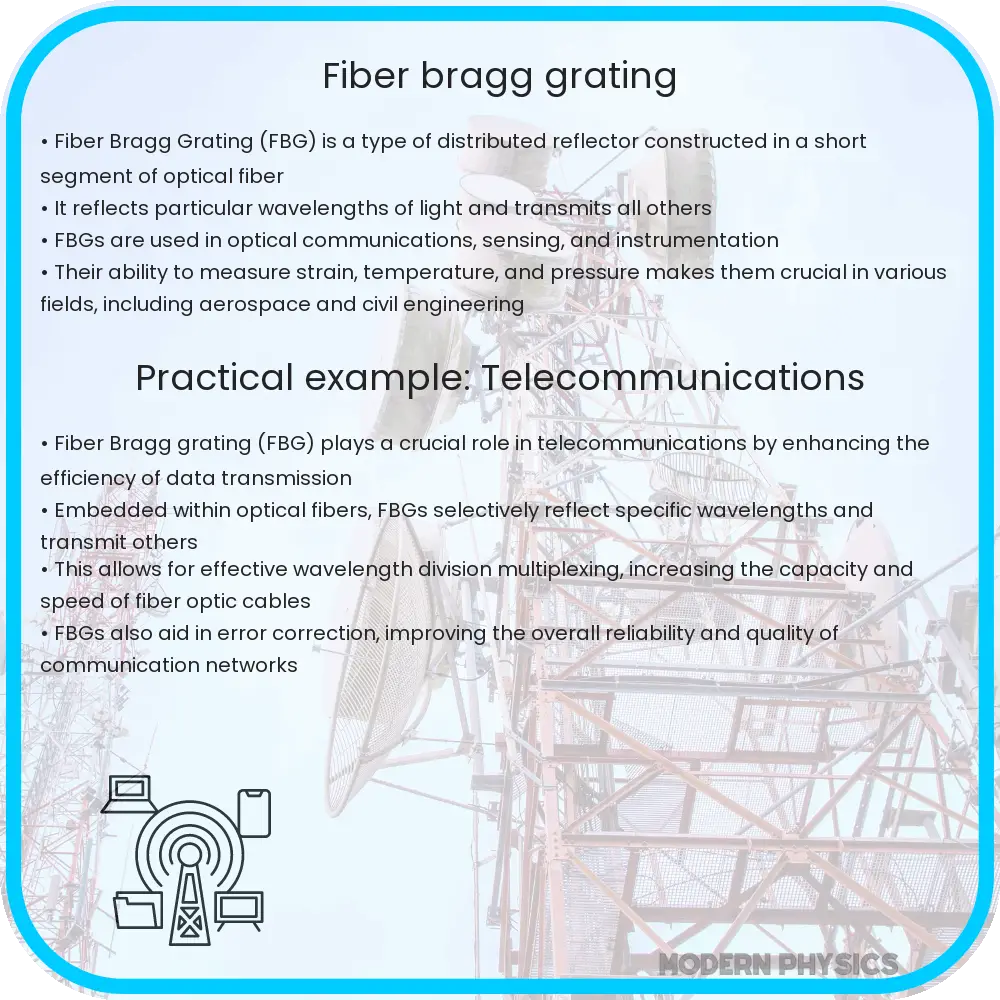
Fiber Bragg Grating (FBG) represents a significant breakthrough in optical fiber technology. It is a type of distributed Bragg reflector constructed in a short segment of optical fiber that reflects particular wavelengths of light and transmits all others. This technology has revolutionized numerous fields, including telecommunications, structural health monitoring, and even medicine.
How Fiber Bragg Gratings Work
The principle behind FBG is relatively straightforward yet ingenious. An FBG is created by adding a periodic variation to the refractive index of the fiber core. This is typically achieved through the exposure of the fiber to intense ultraviolet (UV) light. The UV light modifies the core’s refractive index, creating a grating that reflects specific wavelengths of light. The key equation governing the FBG operation is given by:
λB = 2neffΛ
where λB is the Bragg wavelength, neff is the effective refractive index of the fiber core, and Λ is the period of the grating.
Applications of Fiber Bragg Gratings
One of the most prominent applications of FBG is in optical communication systems. Here, FBGs are used as filters, reflectors, and wavelength division multiplexers, significantly enhancing signal clarity and transmission capacity. Their ability to selectively reflect certain wavelengths while transmitting others is crucial in managing optical signals.
Additionally, FBGs have found extensive use in sensor technology. They are used in strain, temperature, pressure, and acoustic sensors. Their high sensitivity and accuracy make them ideal for monitoring structural health in buildings, bridges, and aircraft. In the medical field, FBGs are used in biomedical sensing, providing minimally invasive ways to monitor various physiological parameters.
Another innovative application of FBG is in Fiber Lasers. FBGs are used as reflectors in the laser cavity, offering high precision in wavelength selection. This makes fiber lasers with FBG highly efficient and accurate, suitable for applications in material processing, medicine, and research.
Finally, FBGs have a crucial role in the development of smart materials and structures. Integrated into materials, they can provide real-time data on the condition and performance of various structures, paving the way for more efficient and safer engineering solutions.
In conclusion, Fiber Bragg Grating technology is a cornerstone in the advancement of optical fiber applications. Its versatility, efficiency, and precision open up a world of possibilities across various industries, marking it as a significant technological innovation.
The Future of Fiber Bragg Grating Technology
The potential of Fiber Bragg Grating (FBG) technology extends far beyond its current applications. As research and development in this field continue, we are likely to see even more innovative uses, particularly in areas demanding high precision and efficiency. One promising direction is the integration of FBG with nanotechnology. Nanoscale FBGs could lead to highly sensitive sensors capable of detecting minute changes in environmental conditions or in the structural integrity of materials.
Challenges and Opportunities
Despite its numerous advantages, FBG technology faces some challenges. One of the main issues is the sensitivity of FBGs to temperature fluctuations, which can affect their accuracy. However, this challenge also presents an opportunity for innovation. Researchers are actively exploring ways to make FBGs less susceptible to temperature changes or even to use this feature for advanced temperature sensing applications.
Another area of focus is improving the manufacturing process of FBGs. Current fabrication methods, mainly based on UV light exposure, require precise control and are relatively time-consuming. Advances in laser technology and photonic crystal fibers offer avenues for more efficient production of FBGs with potentially higher quality and lower costs.
Environmental and Societal Impact
Beyond their technical applications, FBGs also have a positive environmental and societal impact. Their use in monitoring systems can enhance safety in public infrastructure, reducing the risk of catastrophic failures. In telecommunications, FBGs contribute to more energy-efficient and higher-capacity networks, which is crucial in an increasingly data-driven world. Furthermore, their application in renewable energy systems, such as wind turbines, helps optimize performance and reliability, promoting sustainable energy solutions.
Conclusion
In conclusion, Fiber Bragg Grating technology stands at the forefront of optical fiber innovation. Its precision, efficiency, and versatility make it indispensable in various fields, from telecommunications to structural health monitoring. As the technology evolves, it is set to address current challenges and unlock new possibilities, contributing significantly to advancements in science and engineering. The future of FBG is bright, holding the promise of enhanced safety, efficiency, and sustainability in numerous sectors, ultimately benefiting society as a whole.