
Ferroelasticity refers to the unique property of certain materials to exhibit spontaneous elastic strain under mechanical stress or thermal variation.
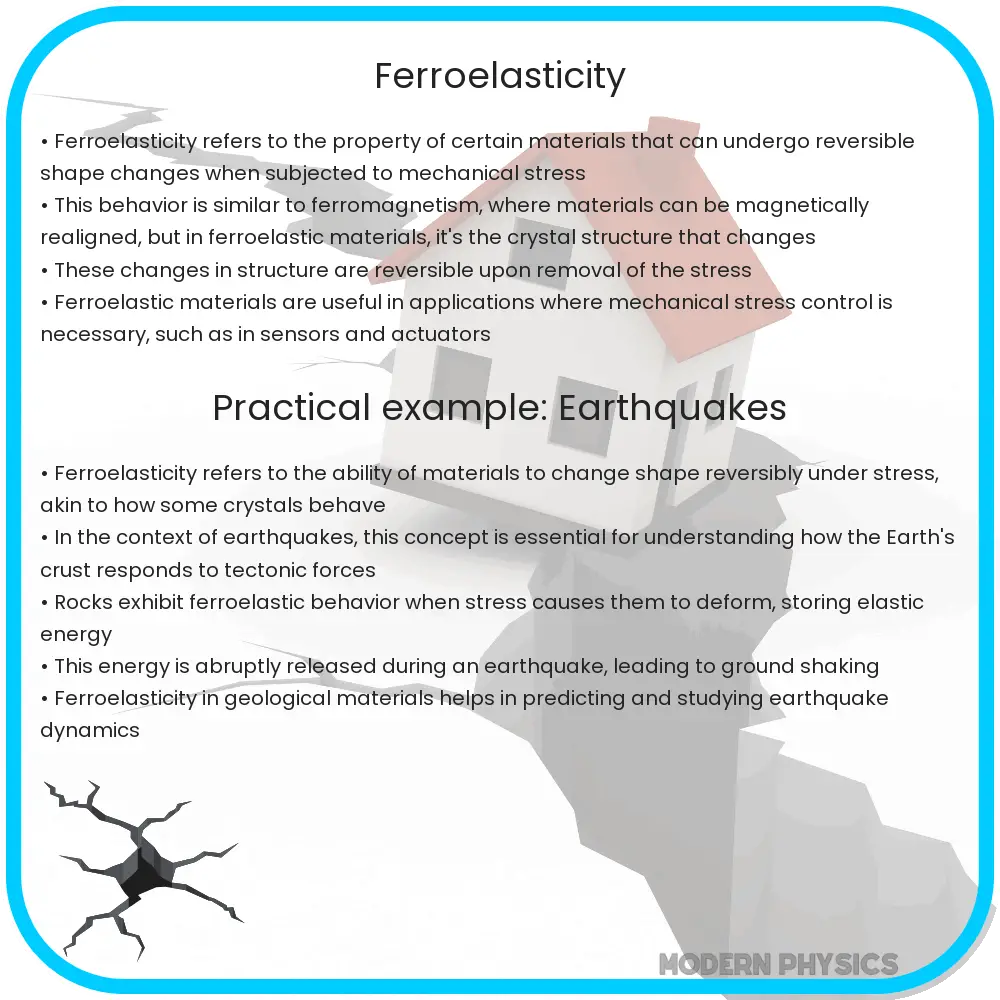
Introduction to Ferroelasticity
Ferroelasticity is a unique phenomenon observed in certain solid materials, where they exhibit spontaneous elastic strain when subjected to a mechanical stress or a thermal variation. This property is akin to ferromagnetism in magnetic materials but instead of magnetic fields influencing the arrangement of magnetic domains, in ferroelastic materials, it is the mechanical stress or strain that leads to the reorientation of structural domains.
Understanding the Fundamentals
At the heart of ferroelasticity lies the concept of domains — regions within a material where the crystal structure is uniformly oriented. A ferroelastic transition involves a change in the crystal structure that is reversible. For a material to be ferroelastic, it must possess more than one orientation state of equilibrium, which are energetically equivalent. The transformation between these states involves a shift in the arrangement of atoms in the lattice, leading to a macroscopic strain.
The reversible switching between these states can be induced by external mechanical stress, which aligns the domains in a preferred orientation to minimize the free energy of the system. This behavior is characterized by a hysteresis loop, similar to that seen in ferromagnetic materials, indicating the energy losses typically associated with the domain switching process.
Key Properties of Ferroelastic Materials
Ferroelastic materials exhibit several distinctive properties:
- Reversible Strain: Upon removal of the applied stress, the material returns to its original state, showcasing a reversible mechanical deformation.
- Anisotropy in Mechanical Properties: These materials may exhibit different properties in different crystallographic directions due to the orientation of domains.
- Memory Effect: Ferroelastic materials can remember their mechanical deformation history due to domain configuration, which can be returned to a previous state by reversing the external stress.
Applications of Ferroelastic Materials
The unique properties of ferroelastic materials have led to their use in a variety of applications:
- Actuators and Sensors: The ability of ferroelastic materials to produce mechanical motion in response to applied stress makes them ideal candidates for use in actuators and sensors.
- Surgical Tools: In medical technology, the reversible deformation capability of ferroelastic materials can be utilized in developing surgical tools that are adaptable to various in-situ conditions.
- Smart Structures: Ferroelasticity can be exploited in the creation of smart structural components capable of absorbing shocks or adapting to load changes dynamically.
Ferroelastic materials are not just limited to typical mechanical applications; their reversible deformation characteristics under small mechanical stress are highly valued in the development of technologies that require precision and reliability.
Recent Advances in Ferroelastic Material Research
Research in ferroelastic materials has expanded significantly in recent years, driven by the demand for more sophisticated and adaptive materials in technology and industry. Scientists are exploring nanoscale ferroelastic phenomena, which are crucial for the development of devices at the micro and nanoscale. Furthermore, the integration of ferroelastic materials with other functional materials has opened up new avenues for multi-functional composite materials.
One of the cutting-edge research areas involves the study of ferroelastic materials under extreme environmental conditions, such as high temperatures and pressures, to understand their structural stability and potential for use in harsh environments. This is particularly relevant for aerospace and deep-sea applications.
Challenges and Future Directions
Despite the promising properties and applications, ferroelastic materials face certain challenges that need to be addressed to broaden their practical applications. One of the main challenges is the fatigue under repeated mechanical stress, which can lead to the permanent alteration of their properties. Additionally, the synthesis of high-quality ferroelastic materials with controlled domain structures is still a complex and often costly process that can hinder their widespread application.
Looking ahead, the future of ferroelastic materials seems promising with ongoing advancements in material science and nanotechnology. Researchers are focused on overcoming existing challenges and enhancing the properties of these materials. The development of more durable, efficiently producible ferroelastic materials could revolutionize multiple industries, leading to smarter, more adaptive technologies.
Conclusion
In conclusion, ferroelastic materials offer significant benefits due to their unique mechanical properties, including reversible strain, anisotropy, and memory effects. Their application ranges from actuators and sensors to smart surgical tools and structural components, showcasing their versatility and potential. With ongoing research tackling existing challenges and exploring new possibilities, ferroelastic materials are poised to make a substantial impact across various fields. Their development will continue to drive innovations in material science, promising not only to enhance current technologies but also to enable the creation of new ones.
As research progresses, understanding and exploiting the full potential of ferroelastic materials will be crucial. By continuing to bridge the gap between material properties and practical applications, scientists and engineers will unlock new opportunities, leading to groundbreaking advancements in technology and improved solutions for real-world challenges.