
Explore Fermi-Walker Transport in curved spacetime: Unraveling its role in astrophysics, gravitational wave detection, and general relativity.
Understanding Fermi-Walker Transport in Curved Spacetime
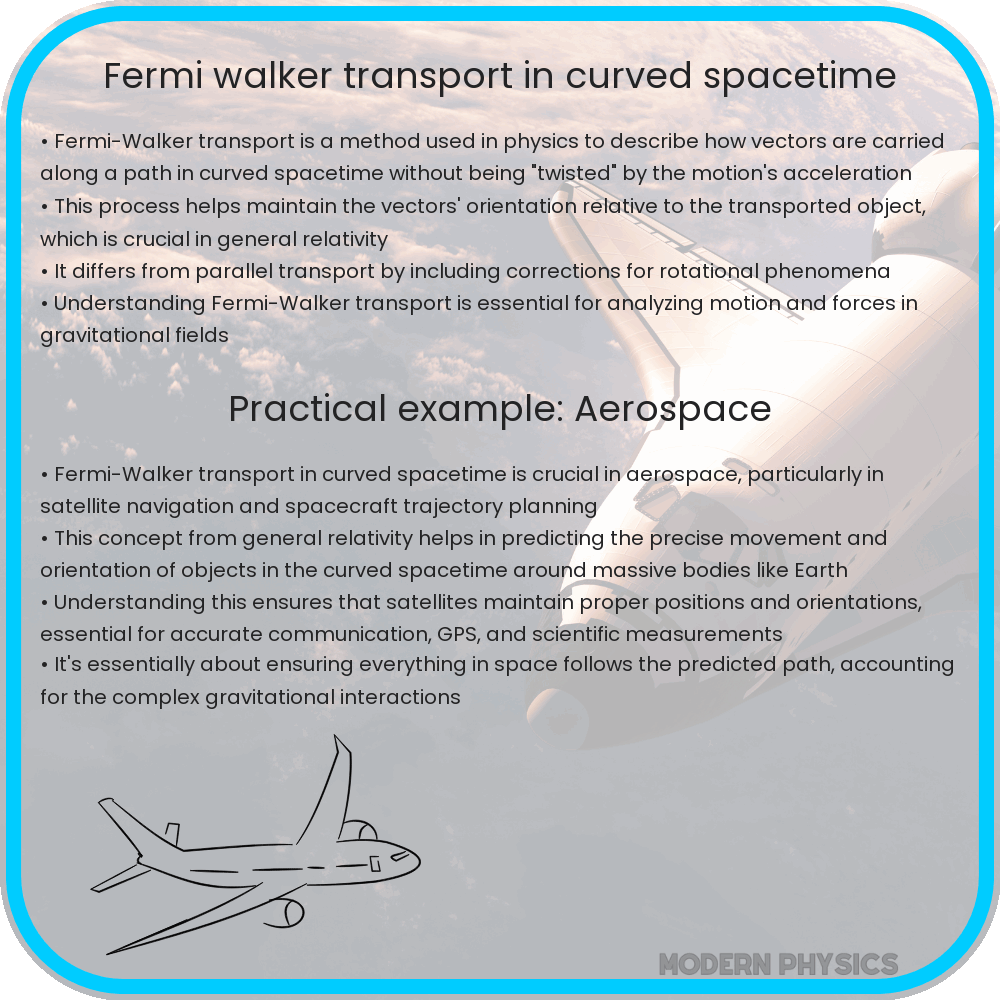
The concept of Fermi-Walker Transport plays a crucial role in the exploration and understanding of curved spacetime, a fundamental aspect of Einstein’s General Theory of Relativity. This mathematical construct provides insights into how vectors can be transported along a path in a curved spacetime without being ‘twisted’ by the curvature itself.
The Basis of Curved Spacetime
Curved spacetime is a core idea in general relativity, representing the warping of the fabric of space and time by massive objects. This warping influences the motion of objects and the flow of time, an effect profoundly demonstrated by the famous equation E = mc2. Understanding curved spacetime is essential for explaining phenomena such as black holes, gravitational lensing, and the expansion of the universe.
Fermi-Walker Transport: The Basics
At its core, Fermi-Walker Transport is a method of moving vectors along a curve in spacetime while preserving their length and keeping them non-rotating relative to the curve. This process is vital for examining the properties of spacetime and the motion of objects within it. In the realm of curved spacetime, it is not straightforward to define what it means for a vector to remain parallel as it moves. Fermi-Walker Transport provides a solution by allowing the transportation of vectors in a way that respects the spacetime curvature.
Practical Implications in Astrophysics and Cosmology
Fermi-Walker Transport finds its practical applications in astrophysics and cosmology, aiding in the modeling of orbits around black holes and the behavior of spinning objects in curved spacetime. It helps astrophysicists to understand the precession of orbits in strong gravitational fields and to model the trajectories of stars and galaxies in the evolving universe.
Stay tuned for the next section, where we will delve deeper into the mathematical formulation of Fermi-Walker Transport and explore its implications in modern physics and astronomy.
Mathematical Formulation of Fermi-Walker Transport
The mathematical foundation of Fermi-Walker Transport is grounded in differential geometry and tensor calculus. Consider a vector \( V^\mu \) being transported along a curve with a tangent vector \( U^\mu \). The Fermi-Walker derivative of \( V^\mu \) along \( U^\mu \) is given by:
\[ \frac{DF^\mu}{d\tau} = \frac{dV^\mu}{d\tau} + \Gamma^\mu_{\nu\sigma} U^\nu V^\sigma – (A^\mu U_\nu – A_\nu U^\mu)V^\nu \]
Here, \( \Gamma^\mu_{\nu\sigma} \) are the Christoffel symbols representing spacetime’s connection coefficients, \( A^\mu \) is the four-acceleration of the curve, and \( \tau \) is the proper time along the curve. This equation ensures the vector’s non-rotational transport relative to the curve.
Implications in Gravitational Wave Detection
One of the fascinating applications of Fermi-Walker Transport is in the field of gravitational wave detection. Gravitational waves, ripples in spacetime caused by massive accelerating objects, require precise models of spacetime curvature for their detection and analysis. Fermi-Walker Transport aids in modeling the path of test particles and laser beams in interferometers like LIGO and Virgo, crucial for detecting these elusive waves.
Challenges and Future Perspectives
While Fermi-Walker Transport provides a robust framework, it also presents challenges, particularly in complex spacetime geometries associated with extreme gravitational fields. Future theoretical and computational advancements are expected to refine these models, enhancing our understanding of the universe’s most mysterious phenomena.
Conclusion
Fermi-Walker Transport is a pivotal concept in the realm of curved spacetime, offering deep insights into the behavior of vectors in the presence of gravity. From aiding in the understanding of black hole dynamics to playing a key role in the detection of gravitational waves, this mathematical tool has become indispensable in modern astrophysics and cosmology. As we continue to explore the universe, the principles of Fermi-Walker Transport will undoubtedly remain at the forefront of our quest to understand the intricate fabric of spacetime.