
Explore the latest in Fermi Surface Analysis tools, their precision, efficiency, and integration in material science and industrial applications.
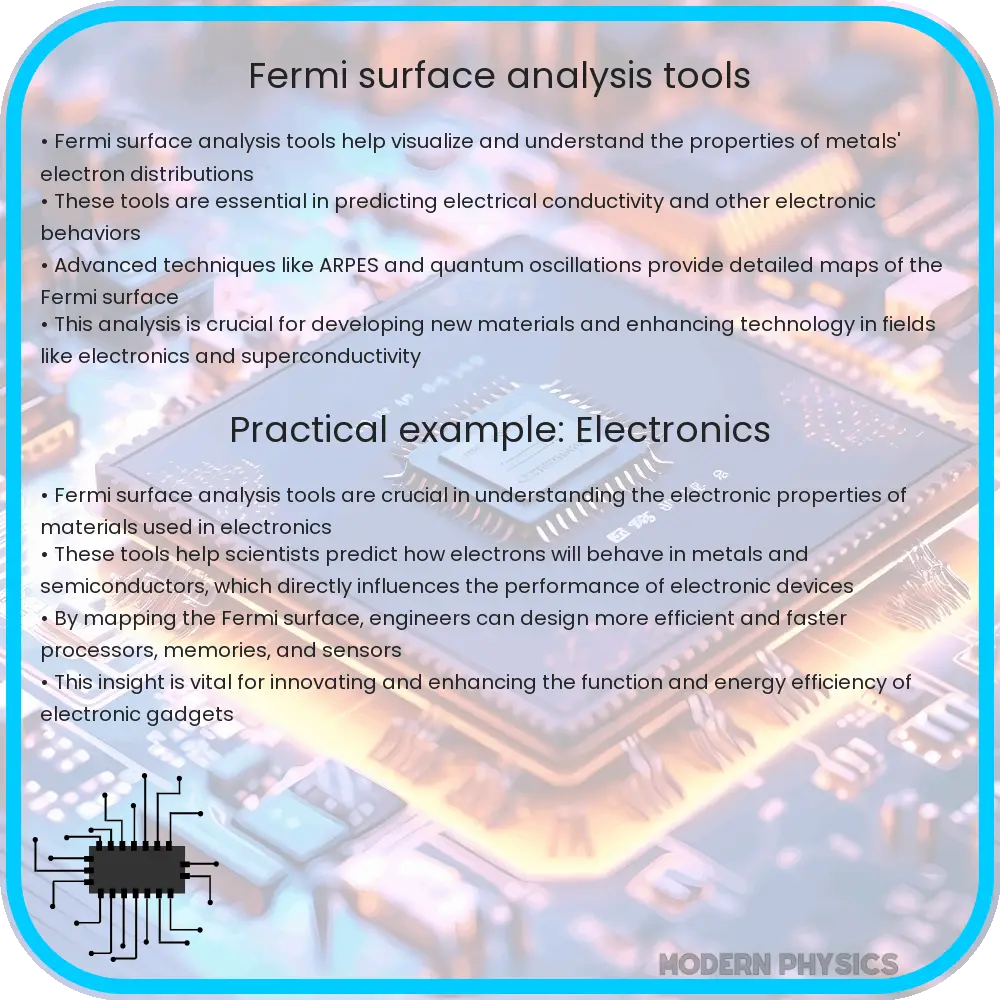
Fermi Surface Analysis Tools: Revolutionizing Material Science
The study of Fermi surfaces is an essential aspect of understanding the electrical, thermal, and magnetic properties of metals and alloys. With the advent of advanced Fermi surface analysis tools, researchers can now delve deeper into the quantum world, unveiling the intricacies of electron behavior in different materials. These tools stand out for their precision, efficiency, and seamless integration into various research methodologies.
Precision in Fermi Surface Mapping
At the heart of Fermi surface analysis is the need for precision. High-resolution angle-resolved photoemission spectroscopy (ARPES) is a leading technique in this realm. ARPES allows scientists to observe the energy and momentum of electrons in a material, providing a direct method of studying the Fermi surface. This technique is especially crucial in the analysis of high-temperature superconductors and other complex materials, where understanding electron interactions is key to unlocking their properties.
Efficiency in Data Acquisition and Processing
Modern Fermi surface analysis tools are designed for efficient data acquisition and processing. Time-resolved ARPES, for instance, uses ultrafast laser pulses to probe the electron dynamics in materials. This method is not only rapid but also offers a non-contact means of studying electron behavior, preserving the integrity of delicate samples. The efficiency of these tools is further enhanced by sophisticated software that can handle large datasets, perform complex calculations, and visualize results in intuitive ways, making the interpretation of data more accessible and insightful.
Integration with Complementary Techniques
Integration with other scientific methods is a pivotal aspect of contemporary Fermi surface analysis tools. Techniques like Quantum Oscillation and Compton Scattering are often used in conjunction with ARPES to provide a more comprehensive view of a material’s electronic structure. Quantum Oscillation, for example, gives information about the Fermi surface’s topology and electron mass, while Compton Scattering offers insights into the electron momentum distribution. Combining these techniques with ARPES allows for a multi-dimensional understanding of materials, essential in fields like nanotechnology, superconductivity, and semiconductor research.
Enhancing Material Discovery and Development
The advancement in Fermi surface analysis tools is not just a boon for basic science; it has profound implications for technology and industry. By understanding the electronic properties of materials at a fundamental level, scientists can engineer new materials with desired properties for electronics, energy storage, and quantum computing. This knowledge is crucial for the development of more efficient solar cells, batteries, and other energy-related technologies.
The intersection of precision, efficiency, and integration in Fermi surface analysis tools marks a new era in materials science. These tools not only enhance our understanding of complex materials but also pave the way for innovative applications in various technological domains.
Emerging Trends in Fermi Surface Analysis
Recent advancements in Fermi surface analysis are increasingly focusing on integrating artificial intelligence and machine learning algorithms. These technologies are being used to predict material properties and identify patterns in complex datasets, which were previously unattainable. The integration of AI not only speeds up the research process but also opens up new possibilities in the prediction and design of novel materials with tailored properties.
Challenges and Future Directions
Despite the remarkable progress in Fermi surface analysis tools, challenges remain. One of the primary issues is the need for ultra-high vacuum and low-temperature conditions in techniques like ARPES, which limits their applicability in studying materials under real-world conditions. Future research is directed towards developing methods that can probe electronic structures at ambient conditions, thereby broadening the scope of materials that can be studied effectively.
Another area of ongoing development is the enhancement of resolution. As materials science ventures into the realm of nanostructures and 2D materials, there is a growing demand for tools that can provide atomic-scale resolution. Efforts are underway to refine existing techniques and develop new methodologies to meet these needs.
Global Impact and Industrial Applications
The impact of Fermi surface analysis tools extends beyond the confines of academic research. In the industrial sector, these tools are instrumental in the design and development of advanced electronic devices. Semiconductor industries, for instance, rely heavily on understanding electronic properties at the quantum level to develop faster and more efficient chips. Similarly, the emerging field of quantum materials, which holds promise for next-generation computing and sensing technologies, is heavily dependent on the insights provided by these analysis tools.
In the realm of energy, the ability to tailor materials for specific electronic properties is key to developing more efficient photovoltaic cells and energy storage systems. The automotive industry also benefits, particularly in the development of advanced materials for electric vehicles and battery technology.
Conclusion
The evolution of Fermi surface analysis tools represents a significant leap in our understanding of material properties at the quantum level. These tools have not only enhanced scientific research but also have substantial industrial and technological implications. As we move forward, the continuous refinement and integration of these tools with emerging technologies like AI will further revolutionize the field. The future of materials science, powered by advanced Fermi surface analysis, holds immense potential for groundbreaking discoveries and innovations that will shape the technological landscape of tomorrow.