
Explore the speed of light and its applications in technology, from optical fibers and GPS to photonics dynamics, laser technology, and quantum computing.
Understanding the Speed of Light
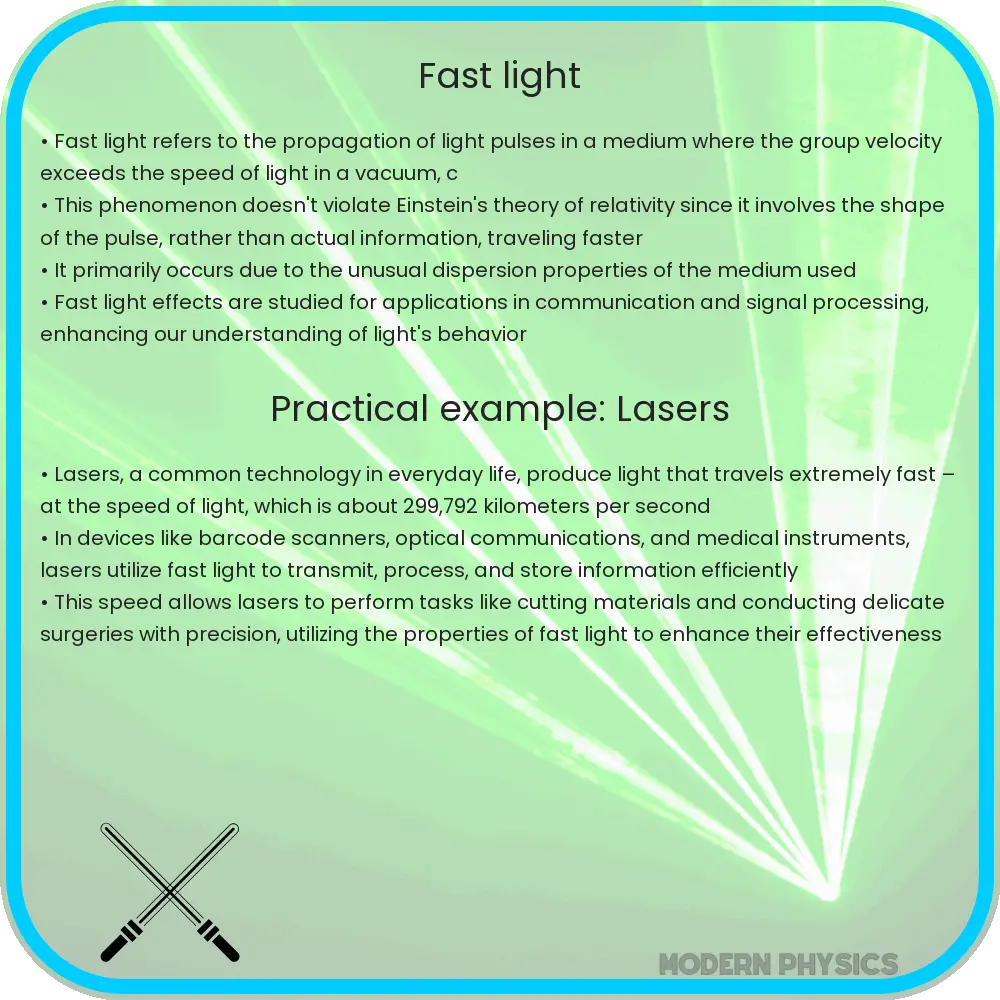
The speed of light, denoted as c, is a fundamental constant of nature that plays a critical role in various scientific fields, including physics, astronomy, and photonics. It is defined as approximately 299,792 kilometers per second (km/s) in a vacuum. This astonishing speed enables light to travel around the Earth approximately 7.5 times in just one second, illustrating the incredibly fast nature of light.
Applications of Light Speed in Technology and Science
Understanding and utilizing the speed of light has led to significant advancements in technology and science. One of the primary applications is in telecommunications, where the transmission of data over optical fibers relies on the principles of light propagation. This technology has revolutionized the way we communicate, offering high-speed internet and data transfer rates that were unimaginable a few decades ago.
- Global Positioning System (GPS): The accuracy of GPS technology depends on the precise measurement of light speed. Satellites transmit signals at the speed of light to receivers on Earth, allowing us to calculate distances with remarkable precision.
- Astronomy and Space Exploration: Astronomers rely on the speed of light to measure vast distances in the universe, such as the distance between stars and galaxies. This measurement is crucial for understanding the scale of the universe and the objects within it.
- Photonics and Quantum Computing: In the field of photonics, the manipulation and control of light at its fundamental speed are leading to breakthroughs in computing, especially in the development of quantum computers. These devices promise to vastly exceed the processing power of traditional computers by leveraging the properties of light particles (photons).
Photonics Dynamics: The Study of Light at Work
Photonics dynamics refers to the study of how light interacts with matter and the various phenomena that emerge from these interactions. This field encompasses a wide range of topics, including laser technology, optical computing, and photonic crystals. Understanding the dynamics of light enables scientists and engineers to design new materials and devices that can control, generate, and manipulate light in novel ways, opening up new possibilities in technology, medicine, and communication.
Advancements in Laser Technology and Optical Computing
Laser technology, a cornerstone of photonics, utilizes the principles of light speed and photonics dynamics to produce focused beams of light. These beams have applications in various fields such as medicine for surgeries, in manufacturing for cutting and shaping materials, and in communication technology as carriers of vast amounts of data. Similarly, optical computing represents a paradigm shift in computing technology, aiming to use photons for computing processes. This approach could lead to computers that are not only faster but also more energy-efficient than current electronic computers.
Photonic Crystals: Manipulating Light at the Nanoscale
Photonic crystals are materials designed to have a periodic optical nanostructure that affects the motion of photons in much the same way that ionic lattices in solid-state crystals affect electrons. By manipulating the structure of photonic crystals, researchers can control the flow of light within materials, leading to the development of highly efficient light-based devices, including sensors, lasers, and even potentially invisibility cloaks by directing light around objects.
Challenges and Future Directions
Despite the significant advancements in the field of photonics and the applications of light speed, challenges remain. These include the miniaturization of photonic devices to integrate with existing technology, improving the efficiency and speed of optical computing, and developing new materials that can manipulate light in novel ways. Researchers are also exploring the quantum properties of light to unlock new technologies in quantum computing and quantum communication.
Conclusion
The exploration of light speed and photonics dynamics has led to groundbreaking advancements in science and technology. From the development of high-speed internet through optical fibers to the potential of quantum computing, the manipulation and understanding of light have opened up new horizons in many fields. As we continue to unravel the mysteries of light and its interactions with matter, we stand on the brink of a new era of technological innovation. The future of photonics promises to bring even more revolutionary changes to our world, enhancing our capabilities in communication, computing, medicine, and beyond. Embracing these advancements, we move closer to a future where the speed of light is not just a limit but a gateway to new possibilities.
Is this conversation helpful so far?