
Explore the Faraday Rotator’s role in optics, covering its principles, applications in isolation and polarization, and future technological advancements.
Understanding Faraday Rotators: The Intersection of Magnetism and Optics
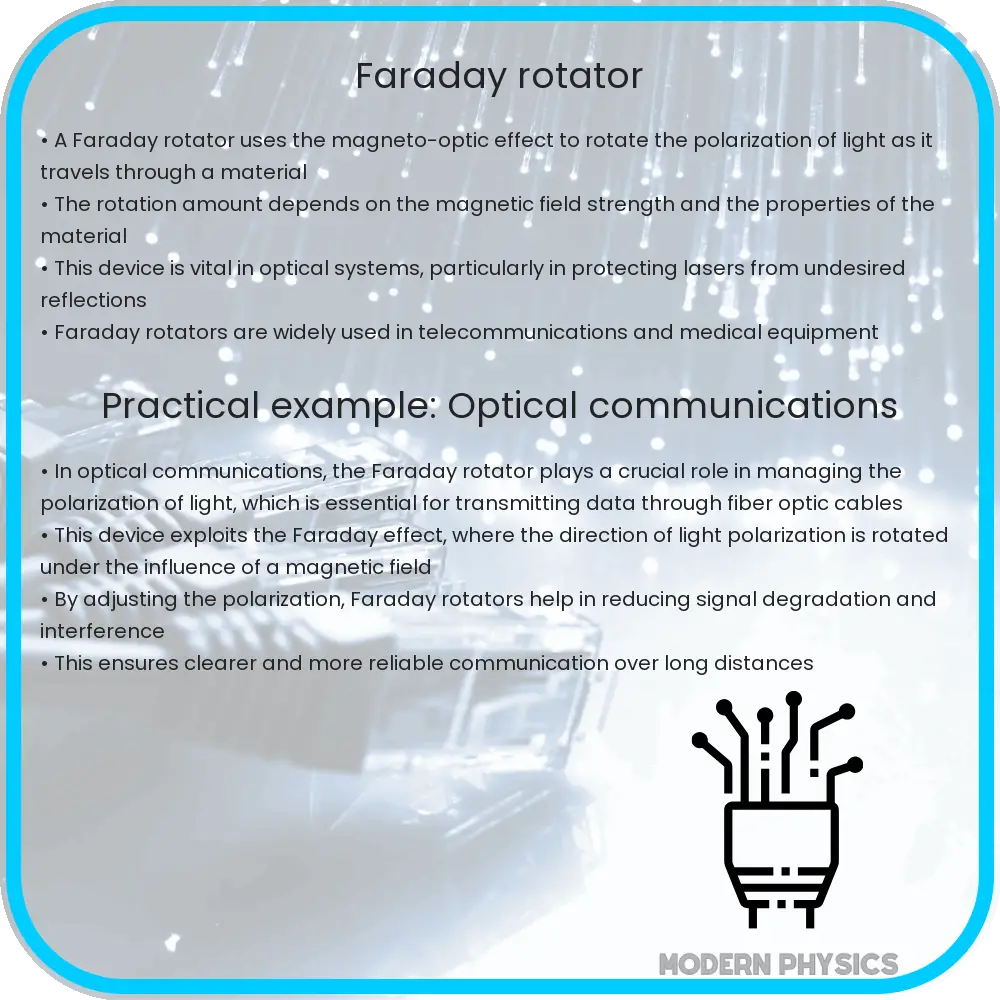
The Faraday Rotator is a fascinating device that embodies the complex interplay between magnetic fields and light. This unique instrument finds its roots in the Faraday Effect, a phenomenon first observed by Michael Faraday in 1845. This effect reveals how a magnetic field can influence the polarization of light, a fundamental aspect of electromagnetic theory. Faraday Rotators are critical in various applications, particularly in protecting laser systems from back reflections and ensuring unidirectional light flow in optical circuits.
The Principle Behind Faraday Rotators
At the heart of a Faraday Rotator is the Faraday Effect. When a beam of linearly polarized light passes through a material (like certain types of glass or crystal) in the presence of a magnetic field aligned in the direction of light propagation, its plane of polarization rotates. The degree of rotation is directly proportional to the strength of the magnetic field and the Verdet constant of the material, a property that quantifies the material’s response to the magnetic field. The rotation is given by the formula θ = VBL, where θ is the angle of rotation, V is the Verdet constant, B is the magnetic field strength, and L is the length of the material through which light passes.
Optical Isolation and Its Significance
One of the most critical applications of Faraday Rotators is in optical isolation. Optical isolators are devices that allow light to pass in only one direction. They are essential in protecting sensitive laser components from damaging back reflections. This is achieved by using a Faraday Rotator combined with polarizers. The rotator rotates the polarization of the forward-traveling light, which then passes through a polarizer. However, any light reflecting back will have its polarization rotated again, making it orthogonal to the original direction and thus blocked by the polarizer.
Polarization Control in Optical Systems
Faraday Rotators also play a pivotal role in controlling polarization in optical systems. By adjusting the strength of the magnetic field or the length of the material, the angle of rotation can be finely tuned, allowing for precise control over the polarization state of the light. This capability is invaluable in applications like fiber optic communications, where polarization control is crucial for signal integrity and reducing cross-talk.
In summary, Faraday Rotators are a cornerstone in the realm of optical engineering, merging the worlds of magnetism and light. Their ability to manipulate light’s polarization under the influence of a magnetic field has paved the way for innovations in optical isolation and polarization control, critical in modern optical technologies.
Advanced Applications of Faraday Rotators
Faraday Rotators extend beyond basic optical isolation and polarization control. They are integral in more advanced applications like optical gyroscopes used in inertial navigation systems. These gyroscopes rely on the Sagnac effect, where rotation causes a shift in the interference pattern of light traveling in opposite directions. Here, Faraday Rotators ensure that the light maintains its polarization state despite multiple reflections and rotations, thus enhancing the gyroscopes’ accuracy.
Material Considerations in Faraday Rotators
The effectiveness of Faraday Rotators is heavily dependent on the materials used. Materials with high Verdet constants are preferred for stronger rotation effects. Rare-earth doped glasses, like terbium gallium garnet (Tb3Ga5O12), are commonly used due to their high Verdet constants and low light absorption. The choice of material also affects the device’s temperature sensitivity and wavelength dependency, critical factors in precision optical applications.
Challenges and Future Directions
Despite their utility, Faraday Rotators face challenges, particularly in miniaturization for integration into compact optical systems. The need for strong magnetic fields and the bulkiness of high Verdet constant materials are significant hurdles. Future research is directed towards finding materials with higher Verdet constants at smaller scales and developing techniques to generate strong magnetic fields without large magnets. These advancements could revolutionize optical systems, leading to more efficient and compact devices.
Conclusion
The Faraday Rotator stands as a testament to the intricate relationship between light and magnetism. It’s not just a component; it’s a bridge connecting two fundamental forces of nature, harnessing their properties to advance optical technologies. From protecting laser systems to enabling precise control in fiber optics, its role is indispensable. The challenges it faces in miniaturization and material efficiency open new avenues for research and innovation. As technology progresses, the Faraday Rotator will undoubtedly continue to be a pivotal element in the ever-evolving landscape of optical engineering, pushing the boundaries of what’s possible in manipulating light.