
Excited state dynamics involves studying electron behaviors in molecules as they absorb energy and transition to higher states, critical for many technological applications.
Understanding Excited State Dynamics: Simulation, Speed & Accuracy
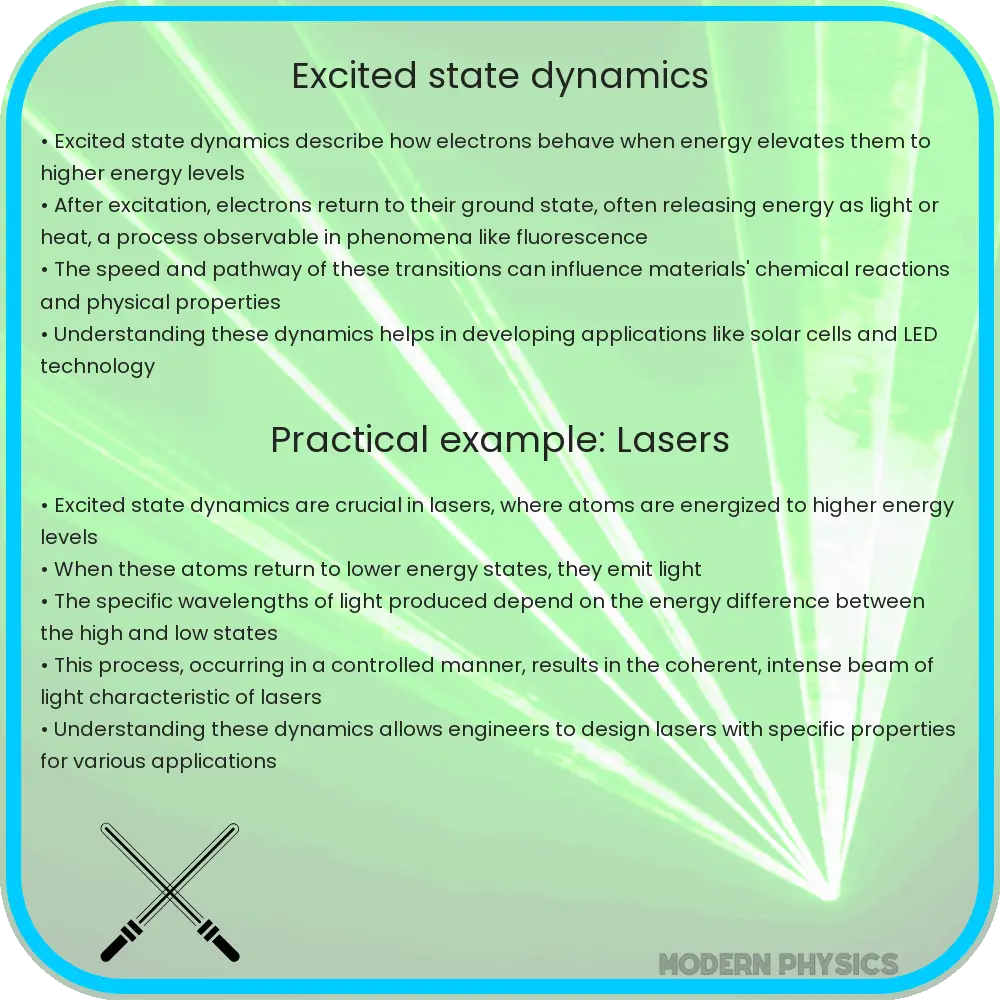
Excited state dynamics is a crucial area in the field of molecular physics and chemistry, dealing with the behavior of electrons in a molecule when energy is absorbed and they are elevated to a higher energy state. Recognizing and predicting these dynamics is essential for designing light-responsive materials, developing solar cells, and many other technological applications. This article explores the role of simulation in understanding these complex phenomena, and the balance between speed and accuracy in such simulations.
The Role of Simulation in Excited State Dynamics
At the heart of studying excited states in molecules is the task of understanding how electrons interact and change states when exposed to energy. According to quantum mechanics, electrons in an atom or molecule occupy the lowest available energy states, known as ground states. When these electrons absorb energy, they “jump” to higher energy levels, known as excited states. The study of these processes requires sophisticated techniques, with simulations playing a pivotal role.
Simulations help researchers visualize and predict how electrons move within the molecular framework over incredibly short time scales, typically in the order of femtoseconds (10-15 seconds). Modeling these transitions accurately requires not only a deep understanding of quantum mechanics but also powerful computational tools.
- Quantum Mechanical Methods: Techniques such as Time-Dependent Density Functional Theory (TD-DFT) and Coupled Cluster methods are commonly employed. TD-DFT, in particular, provides a good trade-off between computational demand and accuracy, making it widely used for studying a range of excited state phenomena.
- Ab Initio Methods: These methods simulate molecular systems using principles from first principles without relying on empirical parameters. They tend to be more accurate but are computationally expensive.
Challenges in Speed and Accuracy
One of the primary challenges in simulating excited state dynamics is the delicate balance between speed and accuracy. Faster simulations can lead to more extensive sampling and help in covering larger systems or longer time scales. However, this often comes at the cost of detailed accuracy, which is paramount for predicting electronic transitions accurately.
Here’s how both speed and accuracy play distinct roles:
- Speed: Achieving faster simulations allows researchers to explore various scenarios and parameter spaces within a reasonable timeframe. Techniques like TD-DFT are optimized to provide faster results by simplifying some of the complex interactions within the electron cloud.
- Accuracy: For technologies relying on specific excited state properties, such as in the design of organic light-emitting diodes (OLEDs) or photovoltaic materials, high accuracy is crucial. This often requires running higher-level computational methods that are significantly slower and demand more resources.
The choice of simulation method largely depends on the specific requirements of the project. For fundamental research, where understanding every minute detail is crucial, more accurate but slower methods may be preferred. In contrast, in applied research or product development contexts, where time and resource constraints are tighter, faster but less detailed methods might be more appropriate.
In conclusion, the simulation of excited state dynamics represents a complex interplay between computational physics, chemistry, and the specific needs of the research or technological application. By wisely choosing the simulation methods and balancing between speed and accuracy, researchers can effectively study and utilize these transient electronic states in various applications.
Applications of Excited State Dynamics Simulations
Understanding excited state dynamics extends beyond academic inquiry and into practical applications that affect everyday technologies. For example:
- Solar Cells: Simulations of excited dynamics help optimize the design of photovoltaic materials to enhance their efficiency in converting sunlight into electricity.
- LEDs: In designing next-generation organic LED (OLED) screens, accurate predictions of excited state behaviors ensure better color purity and energy efficiency.
- Chemical Sensors: Some sensors operate based on changes in material properties under different light exposures, which can be predicted through excited state simulations.
The Future of Excited State Dynamics Simulations
Advancements in computational technology and quantum mechanics continue to push the boundaries of what is possible in simulations. Future developments could include even more accurate and faster computational techniques, enabling the design of novel materials with unprecedented properties. As quantum computing becomes more accessible, it could dramatically speed up these complex calculations, making real-time simulations a possibility.
Moreover, the integration of machine learning techniques with traditional simulation methods could lead to predictive models that adjust and improve based on new data, greatly accelerating the innovation cycle in materials science and chemical engineering.
Conclusion
The exploration of excited state dynamics through simulations offers a fascinating glimpse into the microcosmic world of electrons within molecules. By balancing speed and accuracy, scientists and engineers can tailor simulation approaches to suit specific applications, from improving solar cells to designing more vibrant displays. As computational methods evolve, the potential for discovering new materials and technologies through these simulations is boundless. This continual advancement not only enhances our understanding of the quantum world but also contributes to practical solutions that enhance the technological landscape, impacting various industries worldwide.
In summary, the field of excited state dynamics, essential for the progress of numerous modern technologies, thrives on the intricate dance between computational efficiency and detail-oriented simulation accuracy. Whether for basic scientific research or commercial product development, the thoughtful application of these simulations is key to unlocking new innovations and improving existing technologies.