
Understanding evaporation and transpiration: key processes in the water cycle influencing climate and weather forecasting.
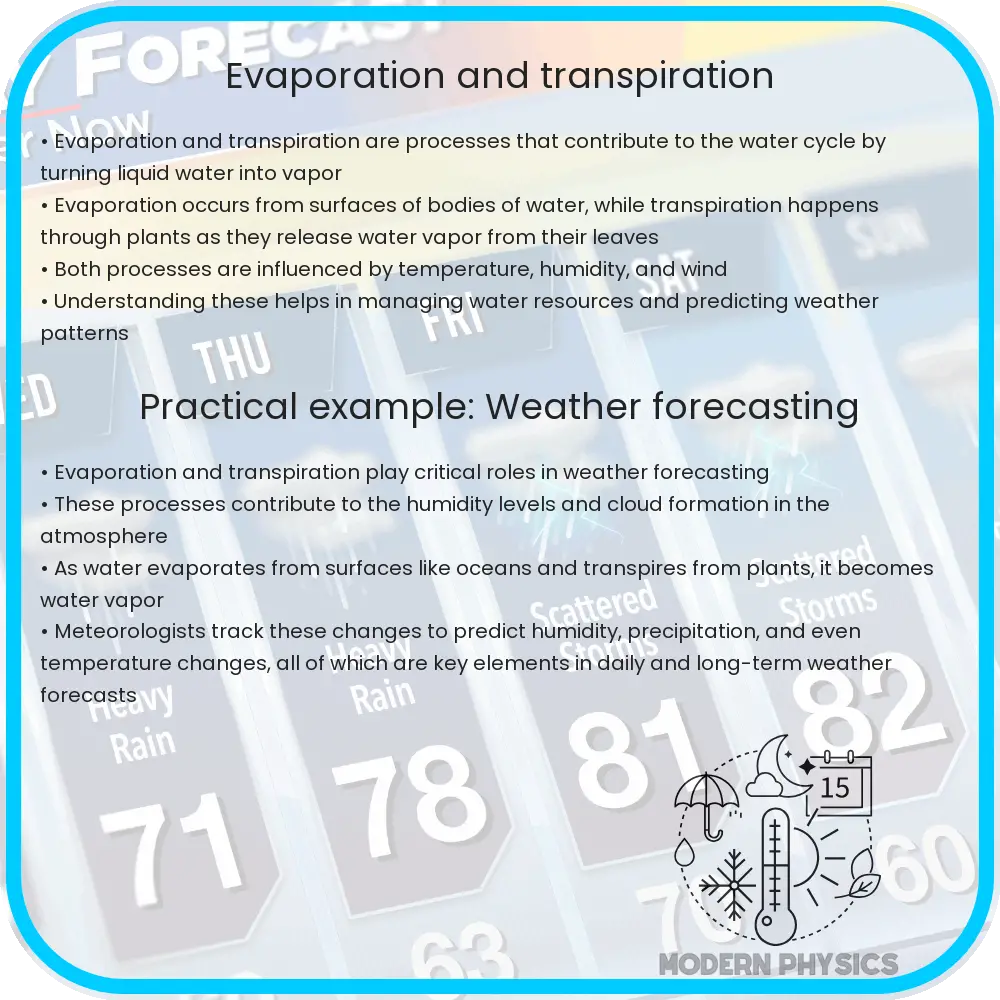
Understanding Evaporation and Transpiration in the Water Cycle
Evaporation and transpiration are key processes in the water cycle, which have significant impacts on our climate and weather forecasting. Both processes involve the conversion of water from liquid to vapor, but they occur in different contexts and have distinct characteristics. Understanding these processes is crucial for predicting weather patterns, managing water resources, and studying climate change.
Evaporation: The Invisible Journey of Water
Evaporation is the process where water changes from a liquid to a gas or vapor state. This occurs when the surface water heats up by solar radiation, causing the water molecules at the surface to move faster and escape into the air as vapor. Major factors influencing evaporation include temperature, humidity, wind speed, and solar radiation. Higher temperatures and wind speeds increase evaporation rates, while higher humidity decreases it.
- Temperature: Warmer conditions provide the energy needed for water molecules to transition to the gaseous state.
- Humidity: Lower humidity levels in the air make it easier for water vapor to evaporate from the surface.
- Wind Speed: Wind removes water vapor from the surface, enabling more liquid water to evaporate.
- Solar Radiation: Direct sunlight increases the rate of evaporation by heating up water surfaces.
Transpiration: Nature’s Breathing Mechanism
Transpiration is a similar process that involves the emission of water vapor from plant leaves. Plants absorb groundwater through their roots and transport it through vessels up to the leaves. This water is vital for photosynthesis and temperature regulation within the plant. In the leaf, some of this water is utilized to form glucose in photosynthesis, while the rest is exhaled as vapor through tiny openings called stomata.
- Stomata Function: These are small pores in the leaf surface that regulate both CO2 intake and water vapor output.
- Environmental Influence: Factors such as light intensity, ambient temperature, and soil moisture levels can affect the rate of transpiration.
The Role in Climate and Weather Forecasting
Understanding evaporation and transpiration is essential for effective weather prediction and climate modeling. These processes contribute to cloud formation and precipitation patterns. For instance, areas with high evaporation rates, like oceans and large lakes, often lead to higher humidity levels and potentially more precipitation in the surrounding regions. Similarly, large forested areas can influence local and regional climates through the process of transpiration, which adds significant amounts of water vapor to the atmosphere.
With advancing technology, meteorologists and scientists now incorporate data regarding evaporation and transpiration into predictive models to enhance the accuracy of weather forecasts. These models help anticipate rain patterns, storm formations, and even longer-term climate variations, which are crucial for agricultural planning, water resource management, and disaster preparedness.
Practical Implications in Daily Life and Environmental Policy
The knowledge of evaporation and transpiration does not only benefit meteorologists and scientists but also plays a crucial role in everyday decisions and environmental policies. For instance, understanding these processes can help farmers decide the best times for irrigation to maximize water usage efficiency and crop yield. Additionally, urban planners use this knowledge to design cities that are more resilient to floods and heatwaves by considering the natural water cycle in their planning and development strategies.
- Agriculture: Efficient water management practices are informed by understanding when and how much water evaporates from soil and transpires from plants.
- Urban Planning: Knowing the locations prone to high evaporation can influence the design and placement of infrastructure to mitigate flood risks and enhance air quality.
The Future of Research and Technology in Understanding Water Cycle Processes
As the impact of climate change becomes more prevalent, research into the mechanisms of evaporation and transpiration is ever more critical. Scientists are developing more sophisticated tools and techniques to measure these processes at finer scales. For example, satellite imagery and drones are used to assess water cycle dynamics over vast areas, providing invaluable data that can be used to improve climate models.
- Technological Advancements: Innovations like remote sensing and AI are revolutionizing the way we understand and predict patterns in the water cycle.
- Climate Adaptation Strategies: Detailed data on evaporation and transpiration help formulate better policies to adapt to changing climatic conditions, protecting ecosystems and human communities alike.
Conclusion
The fascinating journey from understanding the simple, yet intricate, processes of evaporation and transpiration to applying this knowledge in practical scenarios illustrates the profound interconnectedness between natural phenomena and human activities. By continuously enhancing our understanding and integrating these natural processes into our planning, we not only safeguard our environment but also pave the way towards a sustainable future. Thus, the study of these vital components of the water cycle is not just about scientific curiosity but is essential for the betterment of life on Earth, influencing everything from daily weather forecasts to long-term climate resilience.