
Explore escalator kinematics, safety, and design innovations. Learn about efficient technologies and sustainable practices shaping urban mobility.
Understanding the Kinematics of Escalators
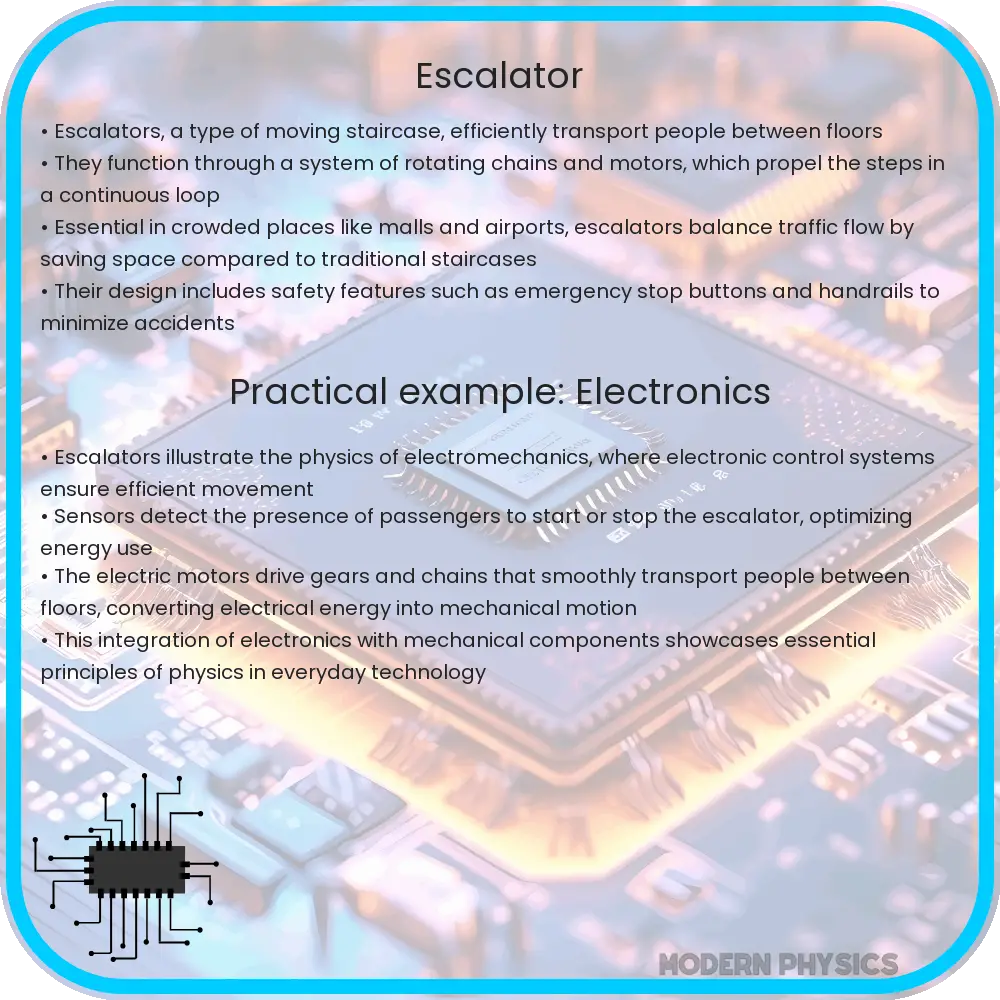
Escalators, a ubiquitous feature in modern urban landscapes, offer a seamless means of transporting individuals between different levels of a building. While often taken for granted, the kinematics—the study of motion without considering its causes—of escalators is a fascinating subject that combines principles of physics and engineering.
The core of escalator kinematics revolves around a system of rotating chain loops driven by motors. Each loop carries a series of steps that are specially designed to remain level while the loop moves, providing a stable platform for passengers. The velocity of the escalator, typically ranging from 0.5 to 0.75 meters per second, is carefully calibrated to balance efficiency with safety. This speed ensures a smooth transition for passengers stepping on and off.
Safety Measures in Escalator Design
Safety is paramount in escalator design. To prevent accidents, several features are integrated into modern escalators. Emergency stop buttons are easily accessible and stop the escalator immediately when pressed. Additionally, safety sensors detect objects trapped between the steps or handrail, triggering an automatic stop to the system.
Handrails move synchronously with the steps, providing stability for passengers. The steps themselves have grooves and are made of anti-slip materials to reduce the risk of falls. At the start and end of the escalator, comb plates mesh with the steps, guiding shoes away from gaps and minimizing the risk of shoe entrapment.
Design Considerations for Enhanced Efficiency
Efficiency in escalator design not only pertains to energy consumption but also to passenger flow and maintenance requirements. Modern escalators are equipped with variable-speed drives that adjust the speed according to the passenger load, optimizing energy use. LED lighting and standby modes further reduce power consumption when the escalator is not in active use.
For high-traffic areas, the width of the escalator and the design of the entrance and exit areas are crucial. Wider escalators or multiple parallel units accommodate more passengers, reducing congestion and improving flow. Maintenance access and modular components are also essential for efficient upkeep and repair, ensuring minimal downtime and consistent performance.
- Kinematics: Understanding the motion and speed of escalators.
- Safety: Integrating emergency stops, sensors, and anti-slip features.
- Design: Focusing on energy efficiency, passenger flow, and ease of maintenance.
Advanced Technologies in Escalator Design
Innovations in technology have greatly enhanced escalator design and efficiency. One notable advancement is the use of regenerative drives, which capture and reuse energy generated by the escalator, especially when moving downwards with a load. This technology not only reduces power consumption but also lessens the heat emitted by the escalator, contributing to a more comfortable environment.
Smart sensors and IoT (Internet of Things) integration allow for real-time monitoring and predictive maintenance. These technologies enable operators to anticipate and address potential issues before they result in breakdowns, thereby improving reliability and reducing maintenance costs over time.
Environmental Impact and Sustainable Practices
Environmental considerations are increasingly important in escalator design. Manufacturers are exploring the use of eco-friendly materials and sustainable practices in production. The aim is to reduce the carbon footprint of escalators, both in terms of manufacturing processes and operational energy use.
Recycling and reusing parts at the end of an escalator’s lifecycle is also a growing trend. By designing escalators with disassembly and recycling in mind, manufacturers contribute to a circular economy, reducing waste and the need for raw materials.
Conclusion: The Future of Escalator Technology
The world of escalator technology is one of constant evolution, driven by advancements in engineering, safety standards, and environmental consciousness. The integration of kinematics, safety measures, and innovative design elements ensures that escalators not only provide efficient vertical transportation but also do so in a manner that prioritizes passenger safety and environmental sustainability.
As we look to the future, we can expect escalators to become even more energy-efficient, intelligent, and responsive to the needs of an increasingly urbanized world. The ongoing incorporation of advanced technologies and sustainable practices is set to redefine our experience with this indispensable mode of transportation, making it safer, more efficient, and more in harmony with our environmental aspirations.
In conclusion, escalators are more than just moving stairs. They are a testament to human ingenuity and a symbol of our continuous quest for improvement in urban mobility. As these systems evolve, they will undoubtedly continue to play a crucial role in shaping our public spaces and enhancing our daily lives.