
Explore the fascinating world of entangled photon pair generation, its efficiency, applications in quantum optics, and the latest advances shaping our future.
Understanding Entangled Photon Pair Generation
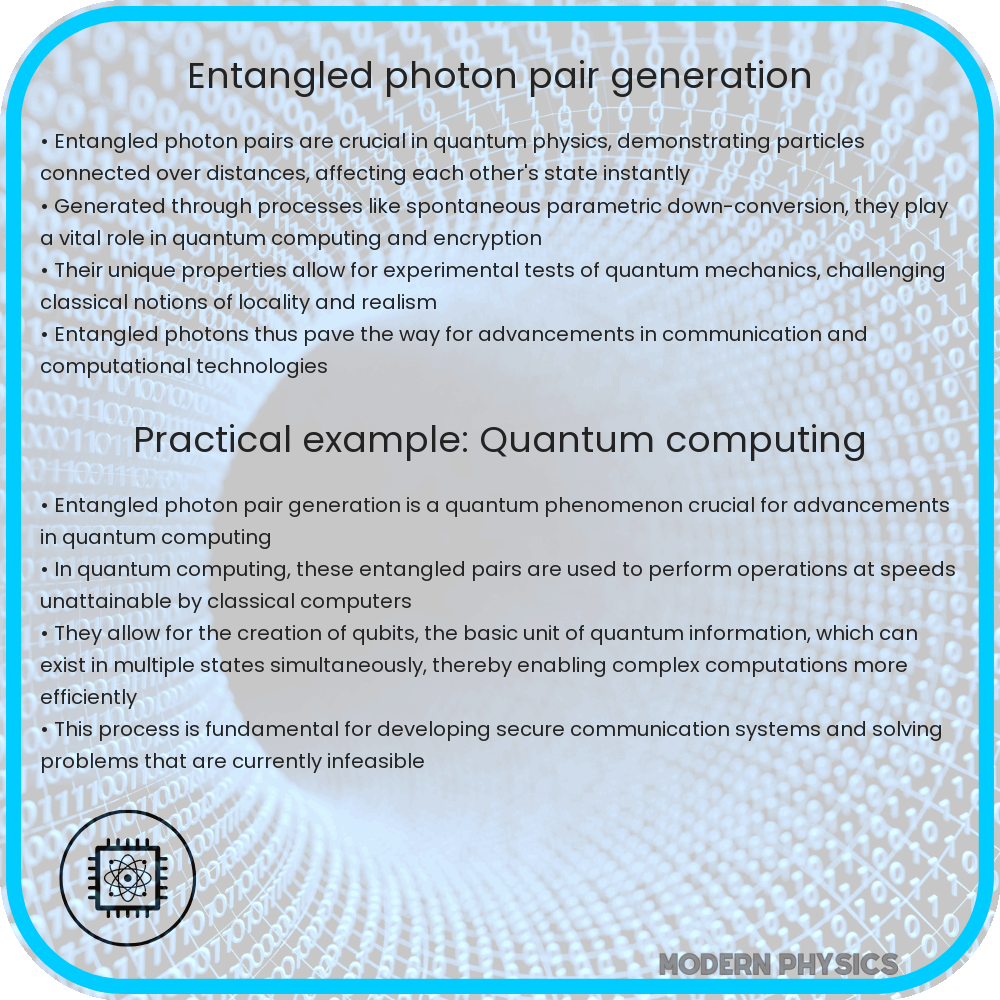
Entangled photon pairs play a pivotal role in quantum optics, serving as the backbone for advancements in quantum communication, quantum computing, and quantum cryptography. The generation of these entangled pairs is not only a fascinating subject in the realm of quantum mechanics but also a critical technological milestone for the future of secure communications and computational capabilities beyond classical limits.
Efficiency in Photon Pair Generation
The efficiency of entangled photon pair generation is a crucial metric that determines the practicality and scalability of quantum technologies. Techniques such as Spontaneous Parametric Down-Conversion (SPDC) and Four-Wave Mixing (FWM) are at the forefront of this endeavor. These methods exploit nonlinear optical processes to convert photons from a higher energy state to a pair of lower energy states, inherently linked in their quantum properties. The challenge lies in maximizing the pair generation rate while minimizing losses and unwanted photon pairs, a task that requires precise control over the optical materials and pump laser characteristics.
Applications in Quantum Optics
Entangled photon pairs have a broad spectrum of applications in quantum optics, ranging from fundamental tests of quantum mechanics to practical technological applications. They are essential in performing Bell test experiments, which confirm the non-locality of quantum mechanics and the violation of classical physics principles. In technology, they enable quantum key distribution (QKD) protocols, offering theoretically unbreakable encryption for secure communication channels. Moreover, these photon pairs are instrumental in quantum teleportation experiments, transferring the quantum state of a particle across distances without physical movement of the particle itself.
Recent Advances in Quantum Optics
Recent advances in quantum optics have focused on increasing the generation efficiency and the quality of entanglement of photon pairs. Innovations in materials science, such as the use of novel nonlinear crystals and photonic crystal fibers, have led to more efficient and tunable photon pair generation processes. Additionally, the integration of entangled photon sources with on-chip silicon photonics has opened new pathways for scalable quantum computing and communication systems. This integration promises a future where quantum-enhanced technologies become part of everyday life, offering unprecedented computational power and security.
Challenges and Future Directions
Despite the significant progress in generating entangled photon pairs and their applications, several challenges remain. One of the primary hurdles is the need for robust and scalable sources that can operate at room temperature and integrate seamlessly with existing technology. Additionally, improving the fidelity of entanglement and the ability to generate entanglement over long distances are areas requiring further research. Scientists and engineers are also tackling the challenge of developing efficient detectors that can accurately measure entangled photons without destroying their quantum state.
Enhancing Quantum Communication Networks
As the field of quantum optics evolves, the development of global quantum communication networks becomes a more tangible goal. These networks, based on entangled photon pairs, would revolutionize data security by enabling quantum encryption across vast distances. Current efforts are focused on extending the range of quantum key distribution (QKD) and reducing the reliance on trusted nodes, aiming for direct satellite-based quantum communication for global reach.
Quantum Computing Breakthroughs
In the domain of quantum computing, entangled photons offer a promising avenue for realizing quantum bits (qubits) that can perform complex computations far beyond the capability of classical computers. The manipulation of entangled photon pairs to perform quantum logic operations is a key research area, with the ultimate goal of building a scalable, fault-tolerant quantum computer. This endeavor could lead to breakthroughs in various fields, including cryptography, drug discovery, and complex system simulation.
Conclusion
The generation and application of entangled photon pairs stand at the cutting edge of quantum optics, embodying the profound potential of quantum mechanics to transform technology and society. The ongoing advancements in efficiency, the broadening of applications, and the tackling of existing challenges signify a vibrant and rapidly evolving field. As researchers continue to unravel the complexities of quantum entanglement and harness its capabilities, the prospects for quantum-enhanced technologies look increasingly promising. From unbreakable encryption to superfast computing, the future shaped by entangled photons is poised to redefine the boundaries of science and technology, ushering in a new era of innovation and discovery.