
Explore the revolutionary potential of electrostatic tethers in space technology, enhancing efficiency, control, and dynamics of spacecraft.
Understanding Electrostatic Tethers for Spacecraft: An Overview
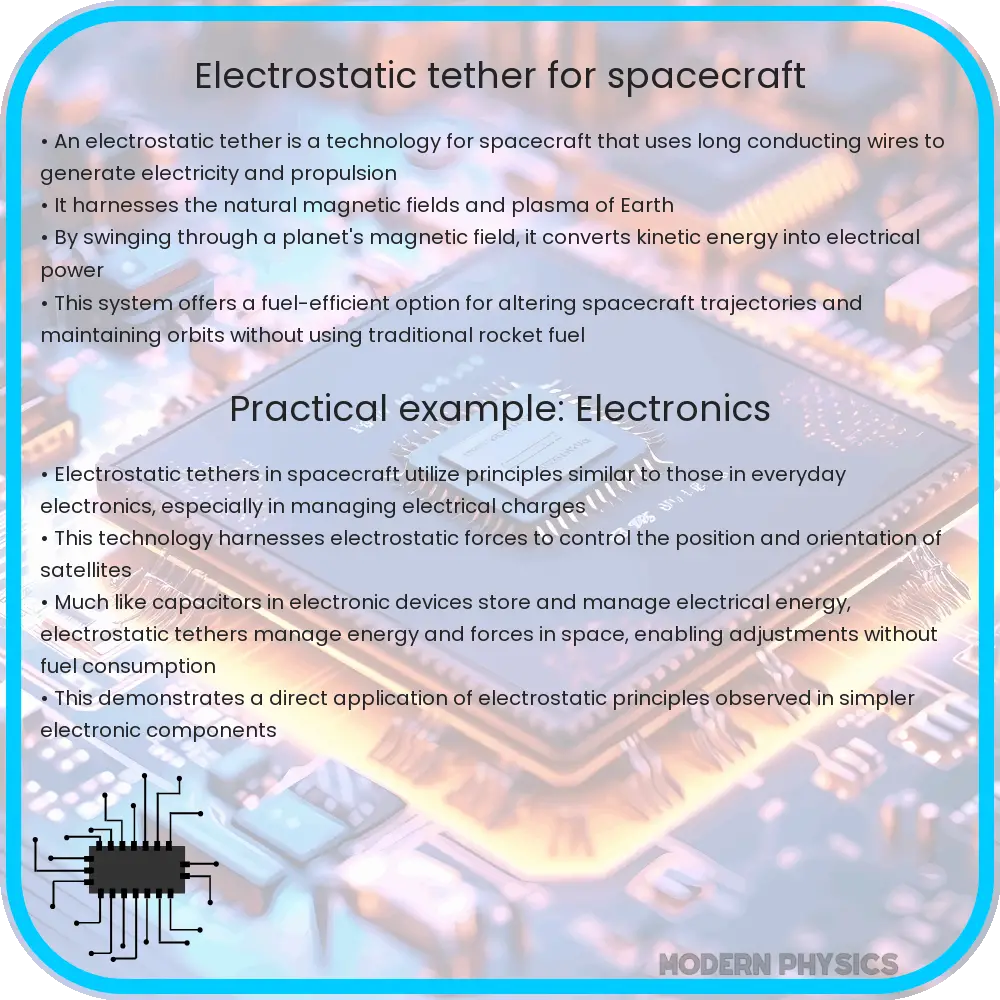
Electrostatic tethers represent a groundbreaking advancement in space technology, offering a novel method for propulsion and energy generation in space. These tethers, leveraging the principles of electrostatics, have the potential to revolutionize the way spacecraft are controlled and maneuvered, while also addressing energy efficiency concerns.
Efficiency of Electrostatic Tethers
The efficiency of electrostatic tethers lies in their ability to convert kinetic energy into electrical energy and vice versa. This is achieved through the interaction of the tether with the Earth’s magnetic field and ionosphere, enabling spacecraft to change orbits without expending conventional propellants. Such efficiency not only reduces the need for fuel but also extends the operational lifespan of spacecraft.
Control and Dynamics of Electrostatic Tethers
Control and dynamics are crucial aspects of electrostatic tether systems. These tethers can be used to adjust the altitude and inclination of a spacecraft’s orbit. By applying a voltage to the tether, it interacts electromagnetically with the Earth’s magnetic field, exerting a force on the spacecraft. This process, known as electrodynamic propulsion, allows for precise adjustments in the spacecraft’s trajectory.
Applications and Future Prospects
Electrostatic tethers hold immense potential for various applications in space exploration and satellite technology. They could be used for debris mitigation, by lowering defunct satellites into the atmosphere for burn-up. Additionally, they offer an efficient method for spacecraft to perform station-keeping maneuvers, reducing the reliance on chemical propellants. The potential for energy harvesting from the Earth’s magnetic field also opens up new possibilities for long-duration space missions.
Challenges and Solutions
Despite their advantages, electrostatic tethers face several technical challenges. The primary concern is the durability of the tether material in the harsh space environment, particularly against micrometeoroids and space debris. Advances in materials science, such as the development of more resilient and conductive tether materials, are addressing these challenges. Furthermore, the control systems for managing the tether’s dynamics are continuously evolving, incorporating more sophisticated algorithms for better efficiency and maneuverability.
Overall, electrostatic tethers signify a significant step forward in space technology, offering sustainable and efficient solutions for spacecraft propulsion and energy management. As research and development continue, their applications in space exploration and satellite operations are expected to expand, marking a new era in space technology.
Technological Advancements in Electrostatic Tethers
Recent technological advancements have significantly improved the viability of electrostatic tethers in space applications. Innovations in materials science have led to the development of stronger and more conductive tethers, capable of withstanding the rigors of the space environment. Additionally, advancements in electrical systems have enhanced the efficiency of energy transfer processes, making electrostatic tethers more reliable and effective.
Integration with Other Space Technologies
Electrostatic tethers are not standalone solutions; they can be integrated with other space technologies for enhanced performance. For instance, combining tethers with solar panels can create a self-sustaining system that generates and utilizes electrical power in space. This synergy could lead to more autonomous and long-lasting spacecraft, reducing the need for frequent maintenance missions.
Global Collaboration and Research
The development of electrostatic tether technology has seen significant contributions from the global scientific community. Collaborative research efforts among space agencies, universities, and private companies are crucial in overcoming the technical challenges and pushing the boundaries of what’s possible with this technology. International collaboration also ensures the sharing of knowledge and resources, accelerating the development and deployment of electrostatic tethers in space missions.
Economic and Environmental Implications
Beyond the technical aspects, electrostatic tethers could have profound economic and environmental implications. Their ability to reduce fuel consumption and extend spacecraft lifespans can lead to significant cost savings in space missions. Moreover, by enabling the safe deorbiting of space debris, these tethers can help mitigate the growing problem of space pollution, contributing to a more sustainable space environment.
Conclusion
Electrostatic tethers represent a transformative technology in the realm of space exploration and satellite operations. Their efficiency, combined with the ability to control spacecraft dynamics without conventional fuel, positions them as a key component in the future of space travel. While challenges remain, ongoing technological advancements and global collaboration are paving the way for their successful implementation. As we continue to explore and utilize space, electrostatic tethers stand to play a vital role in ensuring sustainable, efficient, and cost-effective space missions. The future of space travel, with electrostatic tethers at its core, holds exciting possibilities for exploration, satellite technology, and beyond.