
Explore the techniques and tools for visualizing electrostatic fields, their applications, and future trends in this comprehensive guide.
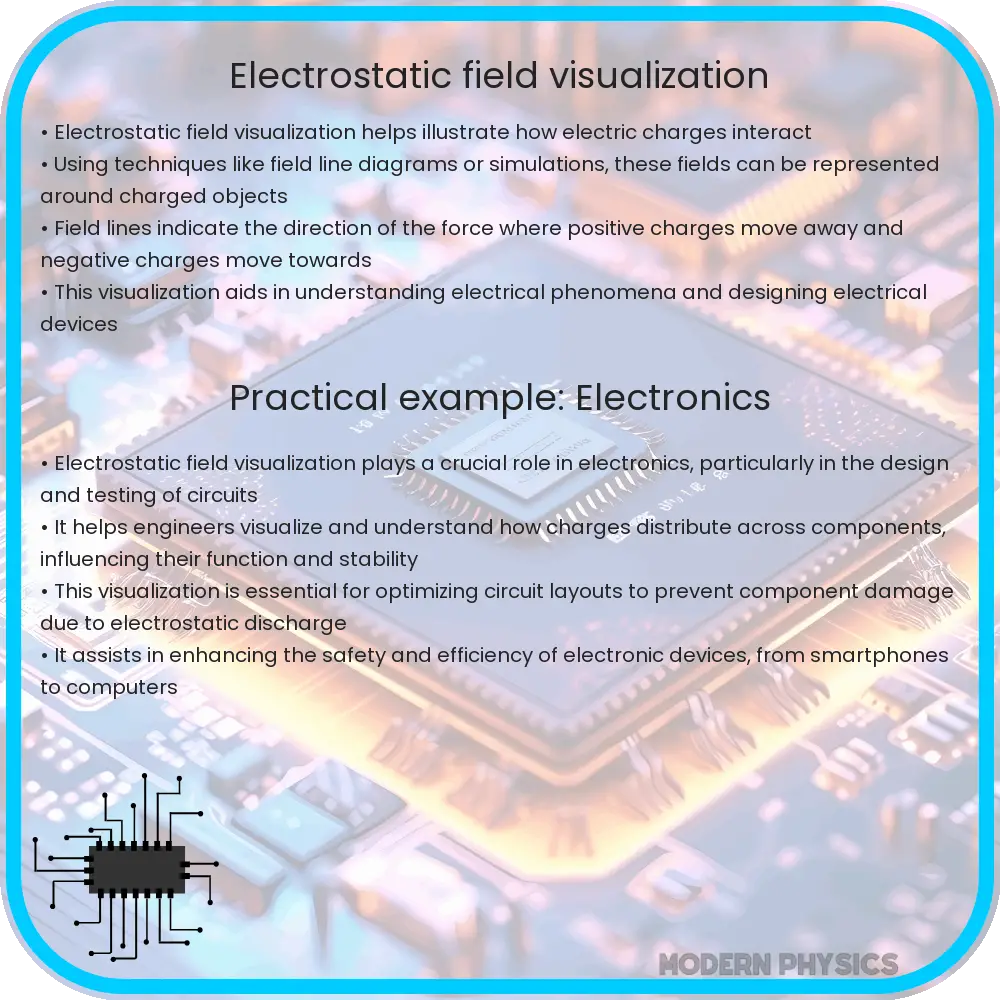
Electrostatic Field Visualization: Understanding the Invisible Forces
Electrostatic fields, invisible yet powerful, are a fundamental aspect of physics, playing a crucial role in various applications from industrial processes to everyday electronic devices. Understanding and visualizing these fields not only enhances our grasp of physical phenomena but also aids in the design and analysis of electrical equipment. This article delves into the techniques and tools used in electrostatic field visualization, offering insights for enthusiasts and professionals alike.
Basic Concepts of Electrostatics
At the heart of electrostatics lies the concept of electric charge, denoted by ‘q’. Charges can be positive or negative, and it’s their interaction that creates an electrostatic field. This field, represented by the symbol ‘E’, is a vector field indicating the force a charge would experience at any point in space. The strength of this field is measured in Newtons per Coulomb (N/C).
Visualization Techniques
- Field Lines: One of the most fundamental techniques for visualizing electrostatic fields is through field lines. These lines, emanating from positive charges and ending at negative charges, represent the direction of the field. The density of these lines indicates the field’s strength.
- Computer Simulations: Advanced computer simulations use numerical methods to model electrostatic fields. Software tools like COMSOL Multiphysics® and ANSYS® provide dynamic and detailed visualizations, helping in complex analyses and designs.
- Experimental Methods: Techniques such as the use of iron filings or oil-based solutions with suspended particles can offer a physical representation of electrostatic fields. These methods, though less precise, provide a tangible and straightforward way to observe the field patterns.
Tools for Electrostatic Field Analysis
- Electrostatic Voltmeters: These instruments measure the electric potential or voltage in an electrostatic field without disturbing it.
- Field Meters: Field meters are used to measure the strength and direction of an electrostatic field directly.
- Charge Detectors: Devices like Faraday cups can detect and measure the amount of electric charge in a given area.
Electrostatic field visualization not only demystifies the unseen forces around us but also serves as a critical tool in advancing technology. In the next section, we will explore the applications and implications of these techniques in various fields.
Applications of Electrostatic Field Visualization
Electrostatic field visualization has wide-ranging applications across different sectors. In the field of electronics, it assists in designing components like capacitors and printed circuit boards (PCBs), ensuring optimal performance and safety. Environmental engineering benefits from this technology in areas like pollution control, where electrostatic precipitators use fields to remove particles from exhaust gases. In medicine, electrostatic principles are pivotal in imaging techniques and in understanding the behavior of biological cells and tissues.
Implications in Research and Education
Research in electrostatics has led to groundbreaking discoveries and innovations. For instance, studying electrostatic interactions at the molecular level has implications in developing new materials and pharmaceuticals. In educational settings, visualizing electrostatic fields helps in making abstract concepts tangible, thereby enhancing learning and fostering a deeper understanding of physics principles.
Future Trends
The future of electrostatic field visualization is tied to advancements in technology. The integration of virtual reality (VR) and augmented reality (AR) offers immersive ways to explore and interact with electrostatic fields, opening new avenues for education and professional training. Machine learning and AI are set to revolutionize how we analyze and interpret electrostatic data, leading to more accurate predictions and designs.
Challenges and Considerations
Despite its benefits, electrostatic field visualization faces challenges. Ensuring accuracy in simulations and experimental setups is crucial, as inaccurate data can lead to faulty conclusions. Additionally, the complexity of software tools might present a steep learning curve for beginners. Balancing simplicity and precision remains a key challenge for developers and educators alike.
Conclusion
Electrostatic field visualization is a dynamic and evolving field, bridging the gap between theoretical physics and practical applications. Its significance spans various industries, from environmental engineering to healthcare. As technology advances, new tools and methods will continue to emerge, enhancing our ability to visualize and manipulate these invisible forces. Understanding and harnessing electrostatic fields not only deepens our scientific knowledge but also paves the way for innovative solutions to modern-day challenges. In embracing these developments, we open the door to a future where the unseen forces of nature are no longer a mystery, but a well-understood aspect of our everyday lives.