
Explore the Electrostatic Field Mapping Kit, an essential tool for education and research in physics, with practical applications in various fields.
Understanding the Electrostatic Field Mapping Kit: A Tool for Precision, Education, and Analysis
The Electrostatic Field Mapping Kit is an essential tool for students, educators, and professionals in the field of physics and engineering. This innovative kit is designed to provide a hands-on experience in studying and understanding electrostatic fields, a fundamental concept in electromagnetism. Electrostatic fields are invisible forces that surround electrically charged particles. They play a crucial role in various scientific and industrial applications, making the study of these fields integral to many areas of research and education.
Electrostatic field mapping involves visualizing and analyzing the patterns formed by electric fields. These fields are typically represented by lines of force emanating from charged objects. The mapping kit allows users to not only observe these lines but also to measure and analyze their properties, offering a deeper insight into the principles of electrostatics.
Components of the Electrostatic Field Mapping Kit
The kit typically includes a set of specialized equipment:
- Conductive Paper: A sheet coated with a thin layer of conductive material, essential for plotting the electric field lines.
- Electrodes: Various shapes and sizes of electrodes are provided to create different electric field configurations.
- Power Supply: A source to provide the necessary electric charge for the experiments.
- Probes: Used to trace the field lines on the conductive paper.
- Voltmeter: An instrument to measure the electric potential at different points in the field.
This kit not only enhances conceptual understanding but also develops practical skills in handling and interpreting electrostatic phenomena.
Educational Significance
In educational settings, the Electrostatic Field Mapping Kit serves as an invaluable resource. It brings abstract concepts to life, enabling students to visualize and interact with electrostatic fields. Through hands-on experiments, students can explore fundamental principles such as Coulomb’s Law, which describes the force between two charges. The law is mathematically expressed as \( F = k \frac{{q_1 q_2}}{{r^2}} \), where \( F \) is the force, \( q_1 \) and \( q_2 \) are the charges, \( r \) is the distance between the charges, and \( k \) is Coulomb’s constant.
By varying the configuration of electrodes and measuring the resultant field patterns and potentials, students gain a deeper understanding of these principles. The kit also aids in developing critical thinking and analytical skills, as students hypothesize, experiment, and interpret the results of their electrostatic field experiments.
For advanced studies, the Electrostatic Field Mapping Kit can be used to analyze complex phenomena such as electric field intensity, potential gradients, and equipotential lines. This makes it an essential tool not only for education but also for research and industrial applications where precision and analysis are crucial.
Advanced Applications and Analysis
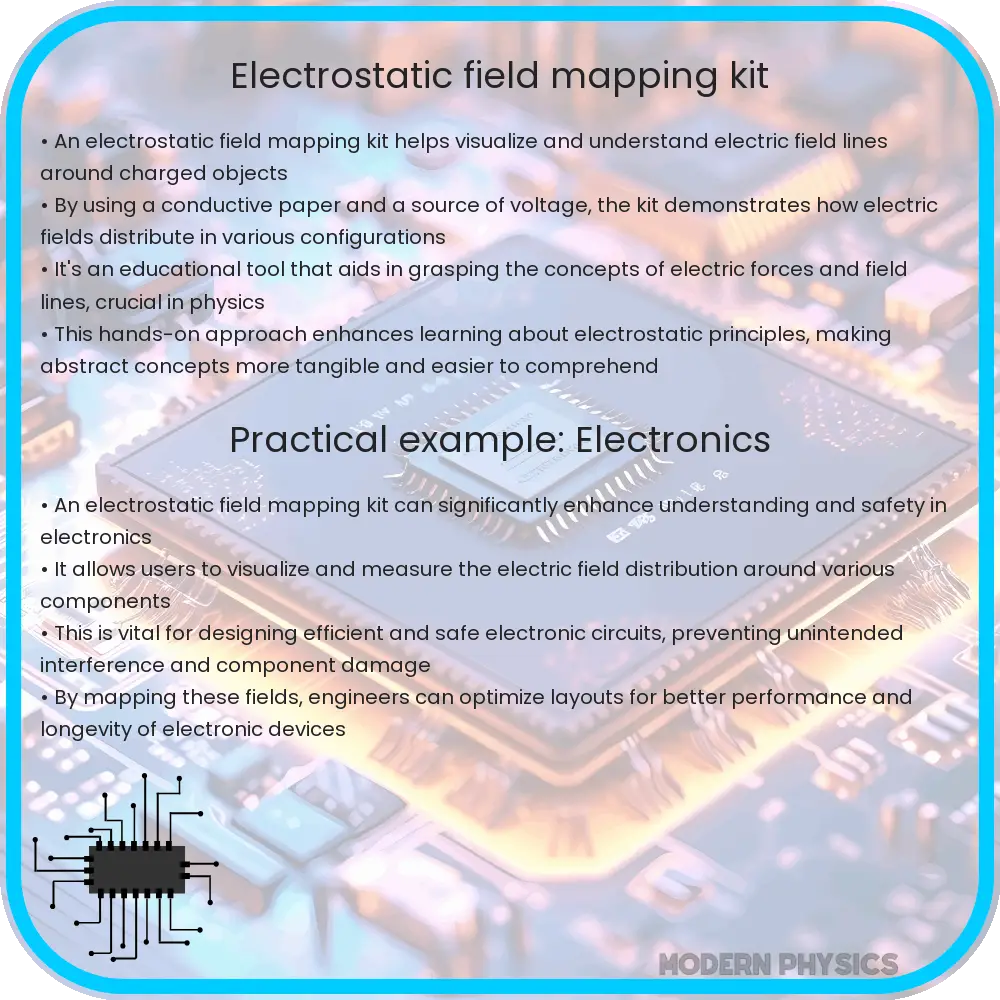
The Electrostatic Field Mapping Kit is not limited to educational purposes; it has advanced applications in research and industrial settings. For instance, in the field of electronics, understanding the behavior of electrostatic fields is crucial in designing and optimizing circuits and components. The kit can be used to simulate and analyze the effect of electrostatic fields on different materials and configurations, aiding in the development of more efficient and safer electronic devices.
In materials science, the kit helps in understanding the electrical properties of various materials, particularly dielectrics and conductors. By mapping the electrostatic fields around different materials, researchers can study their permittivity and conductivity, which are critical factors in material selection for electrical and electronic applications.
Environmental science also benefits from electrostatic field mapping. It can be used to study the effect of atmospheric electric fields on weather patterns, pollution dispersion, and even ecological systems. This understanding is vital for environmental monitoring and developing strategies to mitigate the adverse effects of pollution and climate change.
Conclusion
The Electrostatic Field Mapping Kit is a versatile and powerful tool that transcends its educational role, finding applications in diverse fields such as electronics, material science, and environmental studies. Its ability to provide hands-on experience and visual representation of electrostatic fields makes it an invaluable resource for both students and professionals. The kit not only fosters a deeper understanding of fundamental physics principles but also aids in practical applications and research, contributing to advancements in various scientific and industrial domains. With its comprehensive components and wide range of applications, the Electrostatic Field Mapping Kit is indeed an essential tool for precision, education, and analysis in the study of electrostatic fields.
In conclusion, whether for a classroom setting or advanced research, the Electrostatic Field Mapping Kit serves as a bridge between theoretical knowledge and practical application, making it a cornerstone tool in the exploration and understanding of the fascinating world of electrostatics.