
Explore the efficiency and versatility of Electrostatic Coalescers in industries like oil & gas, wastewater treatment, and food processing.
Understanding Electrostatic Coalescers: Principles and Benefits
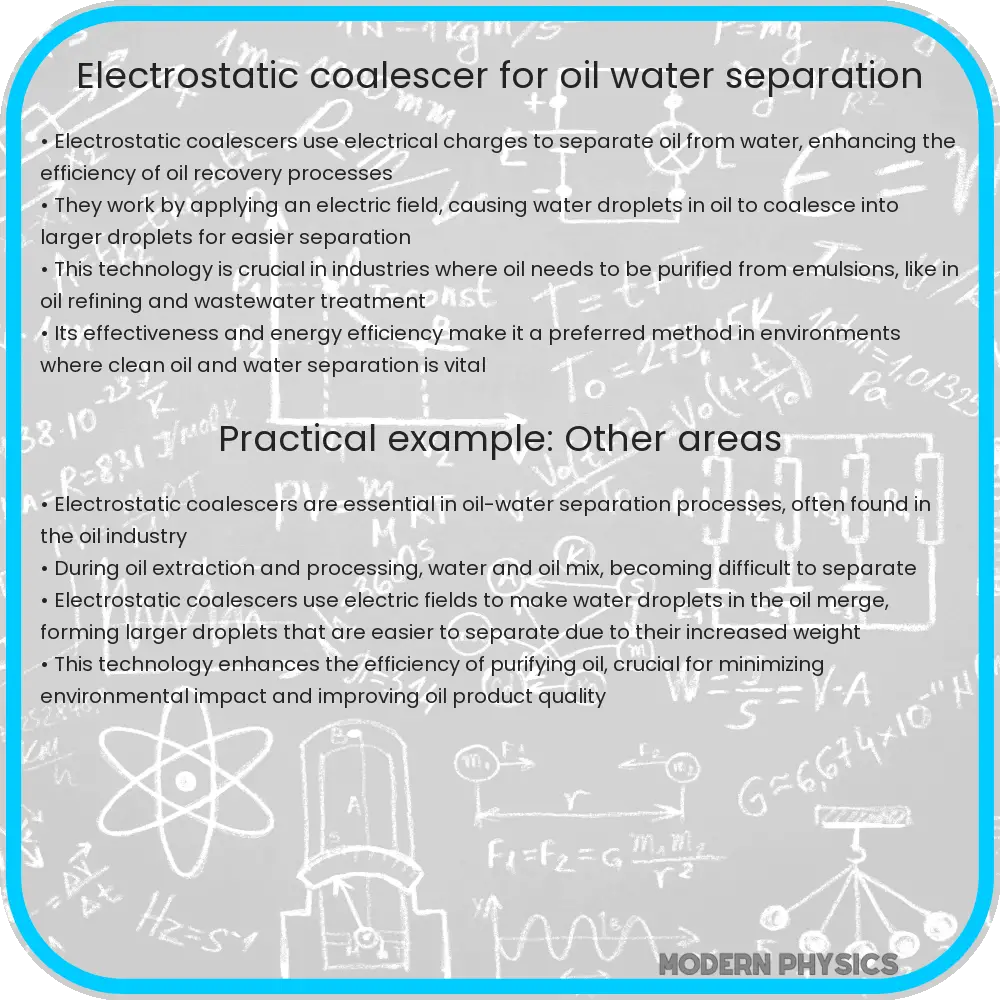
Electrostatic coalescers are advanced technological solutions designed for the efficient separation of emulsions into their constituent parts. Commonly used in the oil and gas industry, these devices play a crucial role in processing crude oil, where water and oil emulsions are a frequent challenge. The principle behind electrostatic coalescers lies in their ability to leverage the power of electrostatic forces to enhance the coalescence, or merging, of small water droplets suspended in oil.
How Electrostatic Coalescers Work
At the core of an electrostatic coalescer’s operation is the application of a high-voltage electric field. When an emulsion passes through this field, the dispersed water droplets become polarized and are induced to move towards each other. This movement is facilitated by the differences in electrical conductivity and permittivity between the oil and water phases. As the droplets collide, they coalesce into larger droplets, which are then more easily separated from the oil due to gravitational forces.
Key Components of an Electrostatic Coalescer
An electrostatic coalescer typically consists of several key components:
- Power Supply: Provides the high voltage necessary to create an electric field.
- Coalescer Vessel: The chamber where the emulsion is exposed to the electric field.
- Electrodes: Positioned within the vessel, these create the electric field when voltage is applied.
- Grids or Plates: Often used to enhance the uniformity of the electric field and to support droplet coalescence.
Advantages of Electrostatic Coalescers
Electrostatic coalescers offer several advantages, making them a preferred choice for many industrial applications:
- Efficiency: They are highly effective in breaking stable emulsions, leading to more efficient separation processes.
- Energy-Efficient: Compared to mechanical or thermal methods, electrostatic coalescers require less energy.
- Reliability: With fewer moving parts, they are less prone to mechanical failure and require less maintenance.
- Economical: Lower operating costs and increased process efficiency lead to reduced overall costs.
- Adaptability: They can be tailored to handle a wide range of emulsions and fluid compositions.
This technology not only ensures a more efficient and cost-effective process but also contributes to the quality of the final product. The enhanced separation achieved by electrostatic coalescers results in cleaner crude oil, which is beneficial for downstream processing and refining operations.
Applications and Environmental Impact of Electrostatic Coalescers
Electrostatic coalescers are not limited to the oil and gas sector. Their versatility extends to a variety of industries, including wastewater treatment, food processing, and pharmaceuticals. In wastewater treatment, they aid in the removal of oil and grease contaminants. In the food and pharmaceutical industries, they are used for purifying and refining products by separating emulsions into their respective oil and water phases.
Enhanced Operational Flexibility and Customization
One of the significant advantages of electrostatic coalescers is their adaptability to specific operational needs. Factors like the type of emulsion, fluid viscosity, and temperature can greatly influence the design and operational parameters of these coalescers. Modern electrostatic coalescers can be customized to accommodate these variables, ensuring optimal performance under diverse conditions.
Environmental Considerations
Environmental sustainability is a crucial aspect of modern industrial operations. Electrostatic coalescers contribute positively in this regard. By improving the efficiency of separation processes, they reduce the energy footprint of industrial operations. Additionally, the improved separation quality ensures that fewer pollutants are released into the environment, aligning with environmental regulations and sustainability goals.
Technological Advancements and Future Outlook
Continuous research and development in the field of electrostatic coalescers are leading to even more efficient designs. Innovations in electrode materials and configurations, as well as advancements in power supply technology, are further enhancing their efficiency and reliability. The future of electrostatic coalescers looks promising, with potential applications expanding into new industries and processes.
Conclusion
Electrostatic coalescers stand out as a pivotal technology in the efficient and economical separation of emulsions. Their ability to handle a wide range of fluids with high efficiency and minimal energy consumption makes them a sustainable choice for various industries. The ongoing technological advancements are set to further enhance their effectiveness and broaden their application spectrum. As industries continue to focus on efficiency and environmental responsibility, electrostatic coalescers will undoubtedly play a significant role in meeting these evolving demands.