
Explore the fundamentals of electron-phonon superconductivity, its key materials, applications, challenges, and future directions in this detailed overview.
Understanding Electron-Phonon Superconductivity
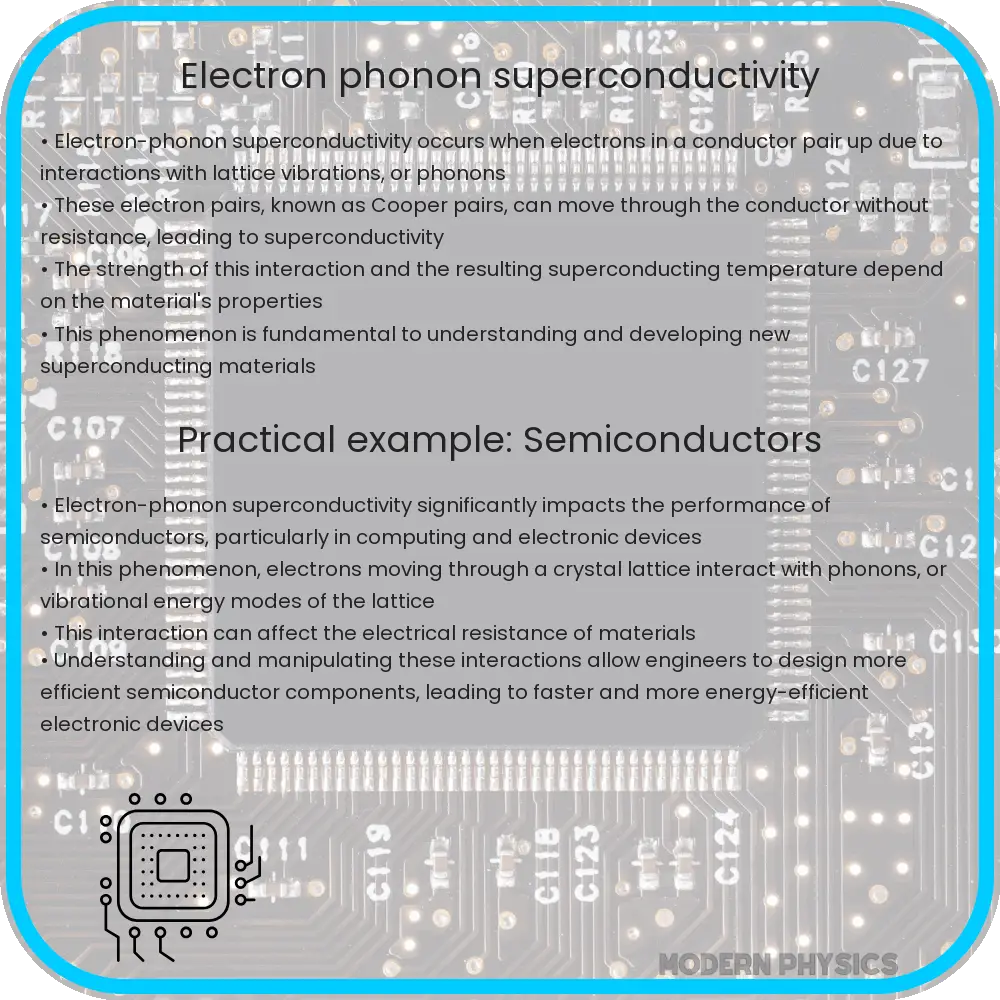
Electron-phonon superconductivity represents a fascinating domain within condensed matter physics, where quantum mechanical effects manifest on a macroscopic scale. This phenomenon is governed by the interaction between electrons and phonons—the quantized vibration modes of a crystal lattice. At the heart of this interaction lies the ability of certain materials to conduct electricity without resistance below a critical temperature.
Theoretical Foundations
The Bardeen-Cooper-Schrieffer (BCS) theory, introduced in 1957, provides the cornerstone for understanding electron-phonon superconductivity. According to BCS theory, electrons in a superconductor can form pairs, known as Cooper pairs, through a phonon-mediated attraction. These electron pairs can move through a crystal lattice without scattering, leading to zero electrical resistance. The theory elegantly explains the isotope effect, where the critical temperature depends on the ion mass of the superconducting material, confirming the role of phonons in superconductivity.
Key Materials
Traditional superconductors, often termed as conventional superconductors, primarily include metals and metal alloys such as niobium (Nb), lead (Pb), and niobium-tin (Nb3Sn). These materials typically exhibit superconductivity at very low temperatures, near absolute zero. The discovery of high-temperature superconductors, such as cuprates and iron-based superconductors, has expanded the list of materials that exhibit superconducting properties at comparatively higher temperatures, although still well below room temperature.
Applications Across Industries
Superconductors have revolutionized numerous fields by enabling technologies that were previously unattainable. In medical imaging, for example, superconducting magnets are essential for the operation of magnetic resonance imaging (MRI) machines, offering unprecedented views inside the human body. In the realm of scientific research, particle accelerators like the Large Hadron Collider (LHC) rely on superconducting magnets to guide and accelerate particles to near the speed of light. Additionally, superconductivity holds the key to efficient power transmission and storage solutions, promising a future of reduced energy losses and enhanced grid stability.
Challenges and Future Directions
Despite the transformative applications of superconductors, significant challenges remain in realizing their full potential. One of the primary hurdles is the requirement of extremely low temperatures for conventional superconductors to exhibit superconductivity. High-temperature superconductors, while operable at higher temperatures, still require cooling far below ambient conditions, necessitating complex and expensive cryogenic systems. Furthermore, the brittle nature and complex chemical composition of many high-temperature superconductors pose difficulties in manufacturing and integration into existing technologies.
Research is ongoing to discover new materials with superconducting properties at higher temperatures, potentially reaching room temperature. Advances in material science, such as the use of pressure to alter the superconducting properties of hydrogen sulfide (H2S) and lanthanum hydride (LaH10), have shown promising results. Theoretical studies and computational modeling continue to provide insights into the mechanisms of superconductivity, guiding experimental efforts to synthesize new superconductors.
Conclusion
Electron-phonon superconductivity remains a field of immense scientific interest and technological potential. The foundational theories, particularly the BCS theory, have paved the way for understanding and harnessing this remarkable phenomenon. While challenges in materials and cooling technologies persist, the ongoing research and development efforts hold the promise of overcoming these barriers. The dream of room-temperature superconductors could revolutionize energy transmission, computing, transportation, and many other sectors, marking a new era in technological advancement. As we continue to explore the depths of quantum mechanics and material science, the future of superconductivity shines bright, promising to unlock capabilities beyond our current imagination.