
Explore how Electron Beam Injection enhances precision, efficiency, and plasma control in industries, advancing material processing and fusion energy research.
Understanding Electron Beam Injection: A Gateway to Enhanced Precision and Efficiency in Plasma Control
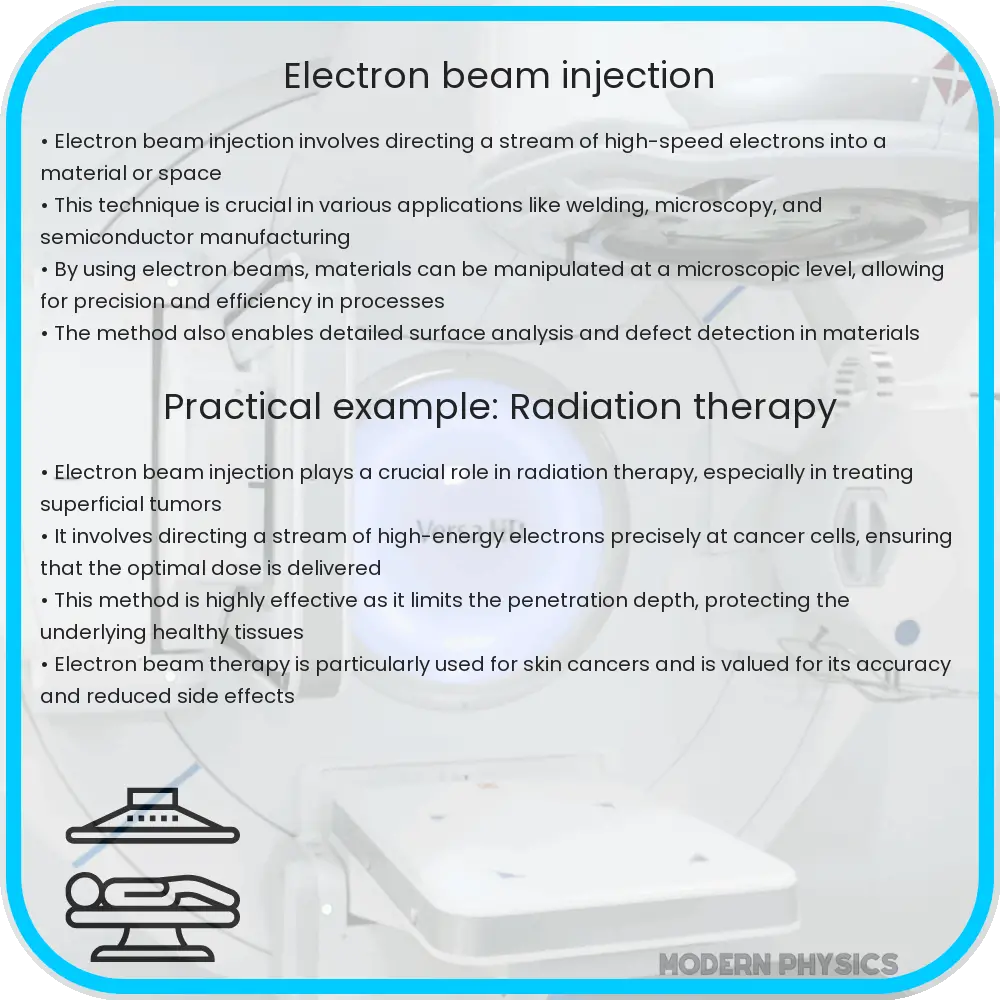
Electron beam injection represents a cutting-edge technology that significantly advances the precision, efficiency, and control within various plasma-based applications. This innovative method involves the focused delivery of high-energy electron beams into a target material or plasma. The process is instrumental in a wide range of scientific and industrial fields, including materials processing, welding, semiconductor fabrication, and even in the development of fusion energy.
Key Advantages of Electron Beam Injection
The precision and control offered by electron beam injection are unparalleled. By manipulating the beam’s energy, focus, and direction, scientists and engineers can achieve a level of material processing and plasma control that was previously unattainable. This precision allows for the enhancement of material properties, the creation of highly specific microstructures, and the controlled modification of plasma characteristics.
- Enhanced Precision: Electron beams can be focused to very fine points, allowing for extremely precise material modifications. This is crucial in applications requiring meticulous detailing, such as microfabrication in the semiconductor industry.
- Increased Efficiency: The ability to precisely control the energy and position of the electron beam leads to higher process efficiencies. Material can be processed more quickly and with less waste, contributing to more sustainable manufacturing practices.
- Improved Plasma Control: In plasma physics, electron beam injection can be used to initiate or control plasma reactions. This is particularly relevant in the development of fusion energy, where precise plasma control is essential for achieving sustained fusion reactions.
Applications and Impact
Electron beam injection is revolutionizing several industries by providing a tool that can modify the physical, chemical, and electrical properties of materials with unprecedented precision. In welding, for example, it allows for the joining of materials with minimal heat input, reducing distortion and improving joint quality. In semiconductor manufacturing, it enables the precise doping of materials, an essential step in creating the complex structures needed for modern electronic devices.
In the realm of plasma control, electron beam injection plays a pivotal role in the study and manipulation of plasma states. This capability is crucial for advancing research in controlled nuclear fusion, a potential source of limitless clean energy. By precisely controlling plasma parameters, researchers can better understand the conditions necessary for achieving and maintaining fusion reactions.
Technological Innovations and Future Prospects
The continuous advancement in electron beam technology heralds a new era of possibilities across multiple domains. Innovations such as increased beam coherence, higher energy efficiency, and the development of portable electron beam devices are opening up new applications and improving existing processes. For instance, the advent of portable electron beam machines enables on-site repairs and modifications in aerospace and construction industries, offering significant time and cost savings.
Moreover, in the field of material science, electron beam injection is facilitating the creation of novel materials with unique properties. These materials have the potential to revolutionize industries by offering better performance, durability, and functionality. The precision of electron beam technology also plays a crucial role in nanotechnology, enabling the fabrication of nanostructures and devices with applications in electronics, medicine, and energy storage.
Challenges and Considerations
Despite its numerous advantages, the implementation of electron beam injection technology faces several challenges. The high equipment cost and the need for specialized training to operate and maintain such systems can be significant barriers for smaller enterprises. Additionally, safety concerns related to the handling of high-energy beams necessitate stringent safety protocols and protective measures.
Another consideration is the technological limitation in certain applications, where the penetration depth of electron beams may not be sufficient, or where the beam could potentially damage sensitive materials. Ongoing research and development efforts are focused on overcoming these challenges, aiming to make electron beam technology more accessible and applicable to a broader range of materials and industries.
Conclusion
Electron beam injection stands as a transformative technology, offering unparalleled precision, efficiency, and control in the manipulation of materials and plasmas. Its applications span across various industries, driving innovation and enabling the development of new materials and processes. Despite facing challenges, the future of electron beam technology looks promising, with ongoing advancements poised to overcome current limitations and open up new possibilities. As we continue to explore and refine this technology, its impact on scientific research and industrial applications is expected to grow, further cementing its role as a key tool in the advancement of modern manufacturing, materials science, and energy production.