
Understanding electromagnetic field theory, which explores how electric and magnetic fields interact to create electromagnetic waves, essential in various technologies.
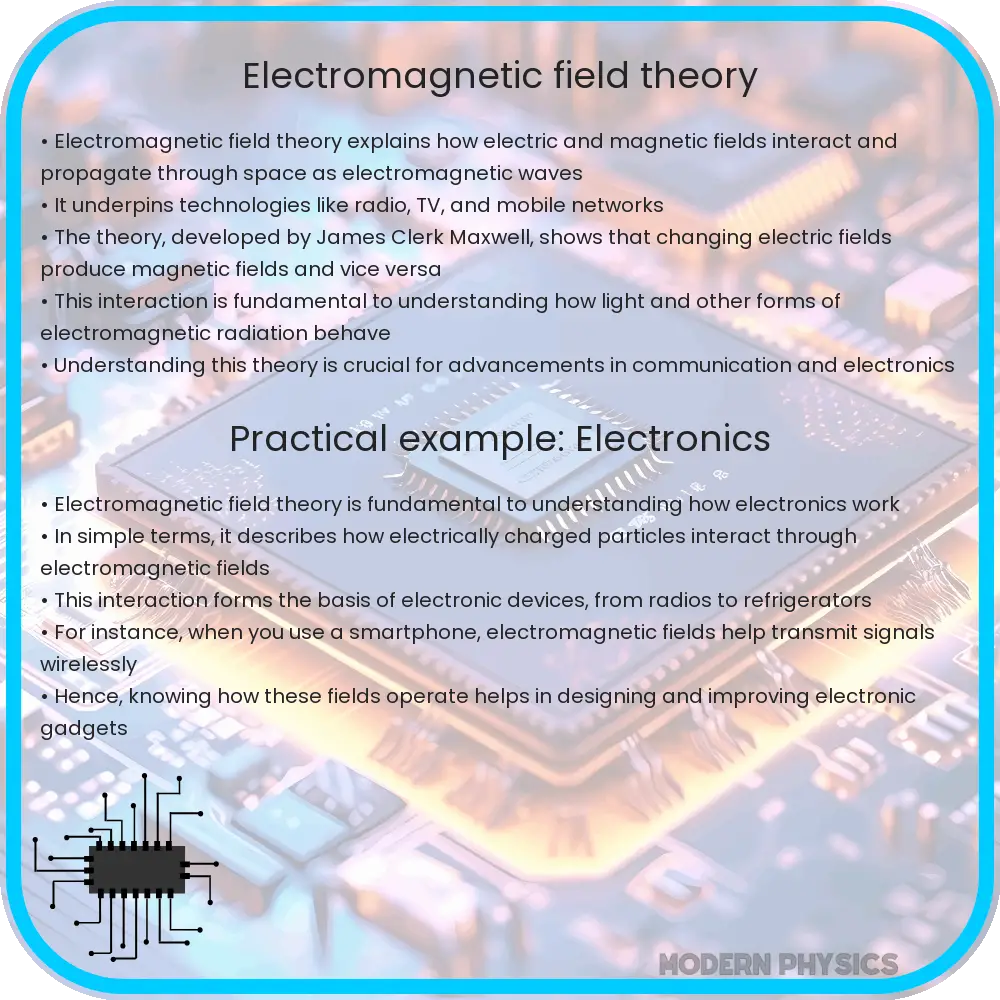
Introduction to Electromagnetic Field Theory
Electromagnetic Field Theory is a foundational concept in physics that deals with the study of electric fields, magnetic fields, and how they interact to form electromagnetic waves. This theory is encapsulated in Maxwell’s equations, which have far-reaching applications across various fields including telecommunications, power generation, and medical imaging.
Understanding Maxwell’s Equations
Maxwell’s Equations consist of four partial differential equations that describe how electric and magnetic fields are generated and altered by each other as well as by charges and currents. These equations are:
- Gauss’s Law for Electricity: \( \nabla \cdot \mathbf{E} = \frac{\rho}{\epsilon_0} \) – This equation states that the electric flux diverging from a volume is proportional to the charge within.
- Gauss’s Law for Magnetism: \( \nabla \cdot \mathbf{B} = 0 \) – This expresses that there are no “magnetic charges” analogous to electric charges, and magnetic field lines are always closed loops.
- Faraday’s Law of Induction: \( \nabla \times \mathbf{E} = -\frac{\partial \mathbf{B}}{\partial t} \) – It describes how a time varying magnetic field generates an electric field.
- Ampère’s Law (with Maxwell’s addition): \( \nabla \times \mathbf{B} = \mu_0 \mathbf{J} + \mu_0 \epsilon_0 \frac{\partial \mathbf{E}}{\partial t} \) – This law suggests that magnetic fields are generated either by electrical currents or by changing electric fields.
Applications of Electromagnetic Fields
Electromagnetic fields are not just theoretical constructs but have practical applications in everyday technology:
- Communication Systems: Radio waves, microwaves, and other forms of electromagnetic radiation are used for transmitting data across distances, underpinning the functioning of television, smartphones, and satellites.
- Medical Applications: Techniques such as Magnetic Resonance Imaging (MRI) rely on magnetic fields and radio waves to create detailed images of the inside of the human body.
- Energy Generation and Transmission: Electromagnetic principles are fundamental in the generation of electric power and its transmission through power lines over vast distances.
The understanding of electromagnetic fields not only deepens our grasp of the physical universe but also enables the development of technologies that transform our everyday lives.
Analyzing Electromagnetic Waves
Electromagnetic waves are solutions to Maxwell’s equations that propagate through space and time without requiring a medium. These waves travel at the speed of light (approximately 299,792 kilometers per second in a vacuum) and include a wide range of wave types such as radio waves, microwaves, ultraviolet, infrared, and visible light.
An electromagnetic wave consists of oscillating electric and magnetic fields which are perpendicular to each other and the direction of propagation. The relationship between the wavelength (λ), frequency (f), and the speed of light (c) is given by:
\[ c = \lambda \times f \]
This fundamental relationship showcases how changes in frequency affect the wavelength of the electromagnetic waves, which is a principle exploited in various technological applications ranging from medical imaging to communication technologies.
Challenges and Innovations in Electromagnetic Field Manipulation
Despite the broad utility and advanced understanding of electromagnetic fields, challenges remain in maximizing efficiency and minimizing environmental impacts. Technological advancements focus on refining electromagnetic manipulation to enhance performances such as wireless power transfer and better electromagnetic shielding methods.
- Wireless Power Transfer: Innovations include the development of more efficient systems for transferring power wirelessly, which may significantly impact how we charge electronic devices in the future.
- Electromagnetic Shielding: With the increasing use of electronic devices, effective shielding techniques are crucial to protect sensitive equipment from electromagnetic interference, ensuring reliable operation of devices in various environments.
Researchers are also exploring the utilization of electromagnetic theory in new materials, like metamaterials, which exhibit properties not found in nature. These materials can manipulate electromagnetic waves in unusual ways, potentially leading to revolutionary changes in optics, telecommunications, and other fields.
Conclusion
Electromagnetic Field Theory provides a powerful foundation for understanding and leveraging the forces that govern much of our modern technology. From the fundamental principles outlined in Maxwell’s equations to their diverse applications in communication, medical technologies, and beyond, the theory continues to be pivotal in propelling technological advancements. As we further our research and address existing challenges, the future holds even broader horizons for the application of electromagnetic fields, shaping innovative solutions that could redefine our interaction with technology. With continued study and exploration, the mysteries still hidden within electromagnetic fields promise to unfold thrilling new chapters of scientific achievement and practical applications.