
Explore the efficiency and innovation of electrogasdynamic systems in energy, aerospace, and environmental engineering for advanced control.
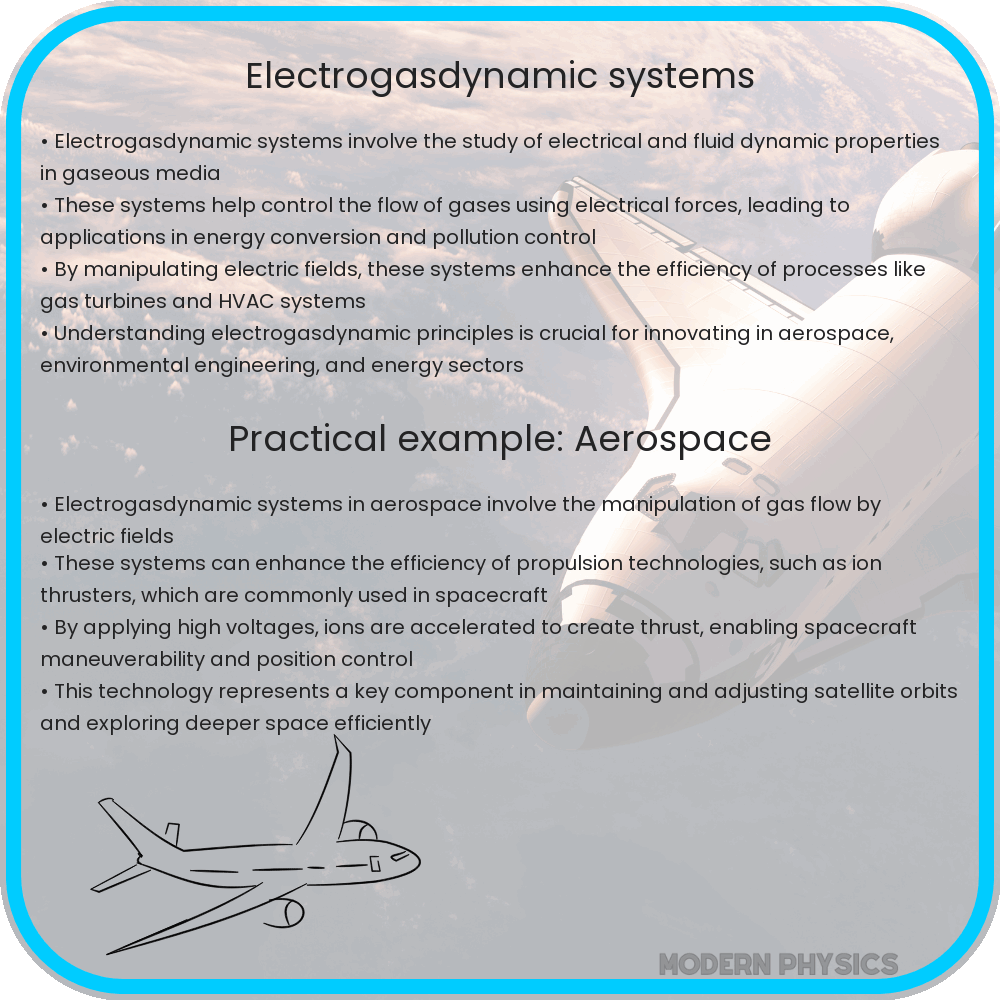
Understanding Electrogasdynamic Systems: A Leap in Efficiency and Innovation
Electrogasdynamic systems represent a groundbreaking approach in the realm of energy conversion and fluid control. By harnessing the interactions between electric fields and gas dynamics, these systems offer unparalleled control and efficiency. This innovative technology is poised to revolutionize various industries, including aerospace, energy, and environmental engineering.
Principles of Electrogasdynamic Systems
At the heart of electrogasdynamic systems lies the principle of electrohydrodynamics (EHD), which involves the motion of fluid mediated by an applied electric field. EHD encompasses both the electrostatic and electrokinetic phenomena where charged particles in a fluid are subjected to an electric field, causing motion and fluid flow. This principle is effectively utilized in electrogasdynamic systems to control and enhance the efficiency of gas flow.
Efficiency Enhancements in Energy Systems
One of the most significant applications of electrogasdynamic systems is in the improvement of energy system efficiencies. These systems are adept at manipulating the flow and mixing of gases, which is crucial in combustion processes. By optimizing the mixing of fuel and oxidizer, electrogasdynamic systems can significantly enhance combustion efficiency, leading to reduced fuel consumption and emissions. This is particularly relevant in power generation and automotive industries, where efficiency and environmental impact are paramount.
Innovative Applications in Environmental Engineering
Electrogasdynamic systems also find promising applications in environmental engineering, particularly in pollution control. They are used in electrostatic precipitators, a type of air cleaner that removes fine particles like dust and smoke from flowing gas using the force of an induced electrostatic charge. This technology is highly effective in trapping particulates and has become a staple in industrial emission control.
Furthermore, the ability of these systems to manipulate small particles and droplets finds applications in aerosol generation and control, which is vital in various environmental and health-related fields. For instance, in aerosol medication delivery, electrogasdynamic systems can be used to generate fine droplets that can be easily inhaled, improving the efficiency of drug delivery to the lungs.
Control and Precision in Aerospace Applications
In the aerospace sector, electrogasdynamic systems offer enhanced control over gas dynamics, which is critical in high-precision environments. These systems can be used to manipulate airflow around aircraft surfaces, potentially leading to more efficient flight dynamics and fuel consumption. This aspect of electrogasdynamic technology holds great promise for the future of aerospace design and operation.
Advancements in Electrohydrodynamic Thrusters
Another exciting development in electrogasdynamic systems is the electrohydrodynamic (EHD) thruster. These thrusters, leveraging the EHD principle, create propulsion by accelerating charged particles or fluids using an electric field. EHD thrusters are particularly appealing for small spacecraft and satellites, where traditional propulsion systems are less effective. Their compact size, absence of moving parts, and low energy consumption make them an ideal choice for precise positioning and maneuvering in space applications.
Challenges and Future Directions
Despite their potential, electrogasdynamic systems face certain challenges. One of the primary issues is the high voltage requirement for generating effective electric fields, which can lead to insulation challenges and electrical breakdowns. Additionally, the miniaturization of these systems for portable applications without compromising efficiency remains a technological hurdle.
Future research in this field is directed towards overcoming these challenges, with a focus on developing materials and designs that can operate effectively at lower voltages and on a smaller scale. Advancements in nanotechnology and material science are expected to play a crucial role in this regard, potentially leading to more robust and versatile electrogasdynamic systems.
Conclusion
Electrogasdynamic systems, with their ability to manipulate gas dynamics through electric fields, are at the forefront of technological innovation in energy efficiency and control. From enhancing combustion efficiency in energy systems to precision control in aerospace and environmental applications, these systems offer a diverse range of applications. The development of EHD thrusters opens new horizons in space technology, providing efficient and precise propulsion for small spacecraft.
While challenges such as high voltage requirements and miniaturization persist, ongoing research and developments in material science and nanotechnology promise to address these issues, paving the way for more advanced and practical electrogasdynamic applications. As these systems continue to evolve, they hold the potential to significantly impact various industries, contributing to more efficient, environmentally friendly, and precise technological solutions.