
Explore the mechanics and benefits of Electrodynamic Suspension (EDS) in transportation, its stability, efficiency, and high-speed capabilities.
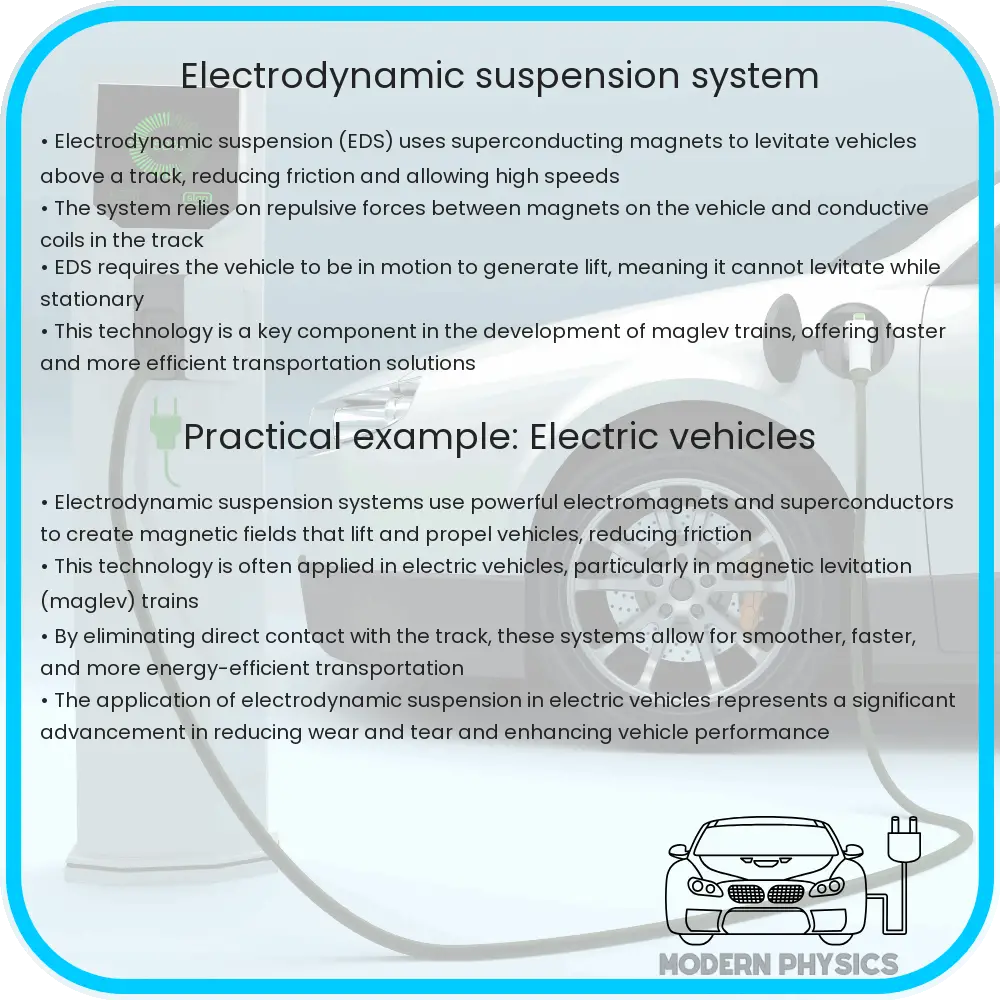
Understanding Electrodynamic Suspension Systems
Electrodynamic Suspension (EDS) is a sophisticated technology pivotal in the development of high-speed transportation, such as maglev (magnetic levitation) trains. EDS operates on the principles of electromagnetism, leveraging the interaction between magnetic fields and electric conductors to create lift and motion. This article delves into the stability, efficiency, and speed aspects of EDS, offering insights into how this technology is revolutionizing modern transportation.
Stability in Electrodynamic Suspension
One of the critical advantages of EDS is its inherent stability. The system utilizes superconducting electromagnets, which produce strong magnetic fields. These fields interact with the conductive tracks, generating a repulsive force that lifts and stabilizes the vehicle above the track. The beauty of this system lies in its self-stabilizing nature: the faster the vehicle moves, the stronger the magnetic interaction, leading to enhanced stability. This phenomenon is governed by Lenz’s Law, which states that an induced current in a conductor will flow in a direction that opposes the change causing it.
Efficiency of Electrodynamic Suspension
The efficiency of EDS is another remarkable feature. Since the system is contactless, there is minimal friction between the vehicle and the track. This drastically reduces the energy lost to heat and wear, making EDS a highly efficient mode of transportation. Additionally, the use of superconductors in EDS systems minimizes electrical resistance, allowing for the efficient transmission of electrical currents. These aspects contribute significantly to the overall energy efficiency of EDS-based transportation systems.
Speed Capabilities of EDS
The speed achievable with EDS is unparalleled. The lack of physical contact between the vehicle and the track allows for extremely high-speed travel, with some maglev trains reaching speeds over 500 km/h (310 mph). This rapid transit capability is not just a product of reduced friction; it is also due to the powerful electromagnetic forces generated by the system. These forces can be precisely controlled and manipulated to accelerate the vehicle smoothly and quickly.
In summary, Electrodynamic Suspension systems offer a trifecta of benefits: stability, efficiency, and high-speed capabilities. This technology is not just a futuristic concept but is already in use in various parts of the world, revolutionizing the way we think about transportation.
Electromagnetic Principles Behind EDS
To understand the mechanics of EDS, a basic knowledge of electromagnetic principles is essential. At its core, EDS is based on the interaction of magnetic fields with electric currents. According to Faraday’s Law of Electromagnetic Induction, a changing magnetic field in a conductor induces an electromotive force (EMF). In the context of EDS, the moving magnetic fields created by the superconducting magnets induce currents in the conductive tracks. These induced currents, in turn, generate their own magnetic fields, which oppose the original magnetic field, creating a repulsive force between the vehicle and the track. This principle is elegantly captured by the formula:
\[ EMF = -N \frac{\Delta \Phi}{\Delta t} \]
where \( EMF \) is the electromotive force, \( N \) is the number of turns in the coil, and \( \Delta \Phi/\Delta t \) represents the rate of change of magnetic flux.
The next section will delve deeper into the applications and future potential of EDS in global transportation networks, highlighting its environmental impact and the challenges it faces.
Applications and Future Potential of EDS
Electrodynamic Suspension systems are not limited to high-speed rail transport. Their potential extends to various other fields, including amusement park rides, automotive testing, and even in advanced aerospace engineering. The scalability and adaptability of EDS make it a promising technology for future transportation projects, including urban transit systems and potentially even for use in inter-city travel.
As urban areas continue to expand, the demand for efficient and fast public transportation systems is on the rise. EDS offers a solution that is not only fast but also environmentally friendly. With its low energy consumption and minimal environmental impact, EDS systems represent a significant step towards sustainable transportation. The future may see EDS integrated into smart city infrastructures, contributing to reduced traffic congestion and lower urban pollution levels.
Challenges and Environmental Impact
Despite its advantages, EDS faces several challenges. The initial cost of constructing EDS-based transportation systems, including the installation of superconducting materials and the construction of specialized tracks, is considerable. Moreover, the requirement for cooling systems to maintain the superconductors at extremely low temperatures adds to the complexity and cost.
However, the environmental impact of EDS is predominantly positive. By reducing reliance on fossil fuels and decreasing greenhouse gas emissions, EDS contributes to the fight against climate change. The technology’s high energy efficiency and low operational costs, in the long run, make it a viable alternative to conventional transportation systems, especially in the context of increasing environmental concerns.
Conclusion
In conclusion, Electrodynamic Suspension systems represent a groundbreaking advancement in transportation technology. Offering unmatched stability, efficiency, and speed, EDS has the potential to revolutionize how we travel. Its applications extend beyond high-speed trains, promising advancements in various sectors. While challenges such as high initial investment and technical complexities exist, the environmental benefits and long-term efficiencies of EDS make it a compelling option for the future of transportation. As the world moves towards more sustainable and efficient transportation solutions, EDS stands out as a beacon of innovation and progress, paving the way for a faster, cleaner, and more efficient future.