
Explore the role of electric field modulation in enhancing precision, control, and efficiency across diverse industries and scientific research.
Understanding Electric Field Modulation: Enhancing Precision, Control, and Efficiency in Electrostatic Applications
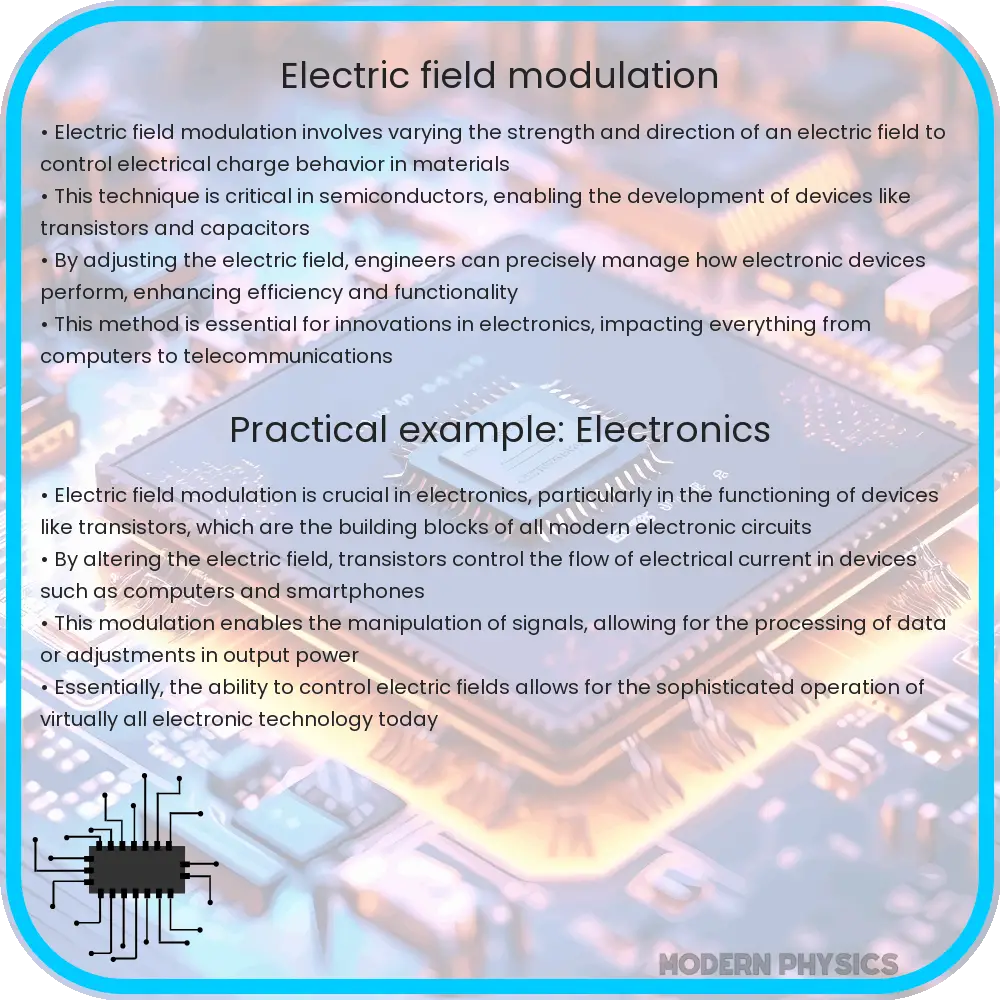
Electric field modulation refers to the process of controlling the strength and distribution of an electric field to influence the behavior of charged particles or materials within that field. This sophisticated technique is pivotal in numerous scientific and industrial applications, from semiconductor manufacturing to particle acceleration. The key advantages of electric field modulation include enhanced precision, improved control, and increased efficiency in electrostatic processes.
Precision in Electric Field Modulation
The precision of electric field modulation lies in its ability to generate specific field patterns and strengths necessary for delicate applications. In microelectronics, for instance, finely tuned electric fields are crucial for the precise placement of ions during doping processes, a step essential for creating semiconductor devices. This level of precision ensures the consistent production of high-quality electronic components.
Control in Electric Field Modulation
Control in electric field modulation is achieved through the use of specialized equipment and software that can adjust the field parameters in real-time. This capability is particularly beneficial in experiments involving particle physics, where controlling the trajectory and speed of charged particles is crucial. Moreover, in industrial processes like electrostatic painting or powder coating, the ability to control the electric field enables uniform application of materials, minimizing waste and improving product quality.
Efficiency in Electric Field Modulation
Efficiency in electric field modulation is evident in its capacity to minimize energy consumption while maximizing output. In electrostatic separation processes used in recycling and waste management, the efficient modulation of electric fields allows for the effective separation of materials with different electrical properties. This not only conserves energy but also enhances the purity and quality of the separated materials.
Applications of Electric Field Modulation
Electric field modulation finds applications in a wide array of fields. In medical technology, for instance, it plays a critical role in techniques such as electrotherapy and electroporation, where electric fields are used to treat muscle pain or to introduce substances into cells. Similarly, in environmental engineering, the modulation of electric fields is instrumental in air purification systems, effectively removing pollutants from the air.
In summary, electric field modulation stands as a cornerstone technology in various industries, underpinning advancements in precision, control, and efficiency. Its applications range from microelectronics fabrication to environmental protection, showcasing its versatility and importance.
Advanced Techniques in Electric Field Modulation
Recent advancements in electric field modulation have opened new horizons in its application. The use of computational modeling and simulation has significantly improved the predictability and accuracy of electric field effects in complex systems. Additionally, the development of nano-scale electrostatic devices has enabled more precise manipulation of electric fields, enhancing their application in nanotechnology and quantum computing.
Challenges and Future Prospects
Despite its numerous applications, electric field modulation faces challenges, particularly in the areas of miniaturization and energy efficiency. As devices become smaller, controlling electric fields with high precision becomes more challenging. Furthermore, there is a growing need for energy-efficient modulation techniques to support sustainable practices in industry and research. Ongoing research focuses on overcoming these challenges, promising even more innovative applications in the future.
Education and Training in Electric Field Modulation
To leverage the full potential of electric field modulation, education and specialized training are essential. Universities and research institutions play a crucial role in providing the necessary knowledge and skills. This education not only encompasses the fundamental principles of electrostatics but also includes hands-on experience with the latest technologies and software used in the field.
Conclusion
Electric field modulation stands as a pivotal technology in modern science and industry, offering unmatched precision, control, and efficiency. Its applications span across diverse fields, from microelectronics and medicine to environmental engineering. With the ongoing advancements in technology, the scope and impact of electric field modulation continue to expand, promising innovative solutions to complex challenges. The future of electric field modulation is bright, with its potential only limited by our imagination and ingenuity. As we continue to explore and refine this technology, it will undoubtedly play a central role in shaping the technological landscape of the 21st century and beyond.