
Explore Einstein’s equations in cosmology: insights into dark energy, universe evolution, and challenges in modern astrophysics.
Einstein’s Equations and the Modern Understanding of the Cosmos
Albert Einstein’s field equations of General Relativity, a cornerstone of modern physics, have profoundly impacted our understanding of the universe. These equations, simple yet elegant, describe the fundamental interaction of gravitation as a result of spacetime being curved by matter and energy. Since their inception in 1915, they have not only passed empirical tests with flying colors but also serve as the bedrock for contemporary cosmological theories.
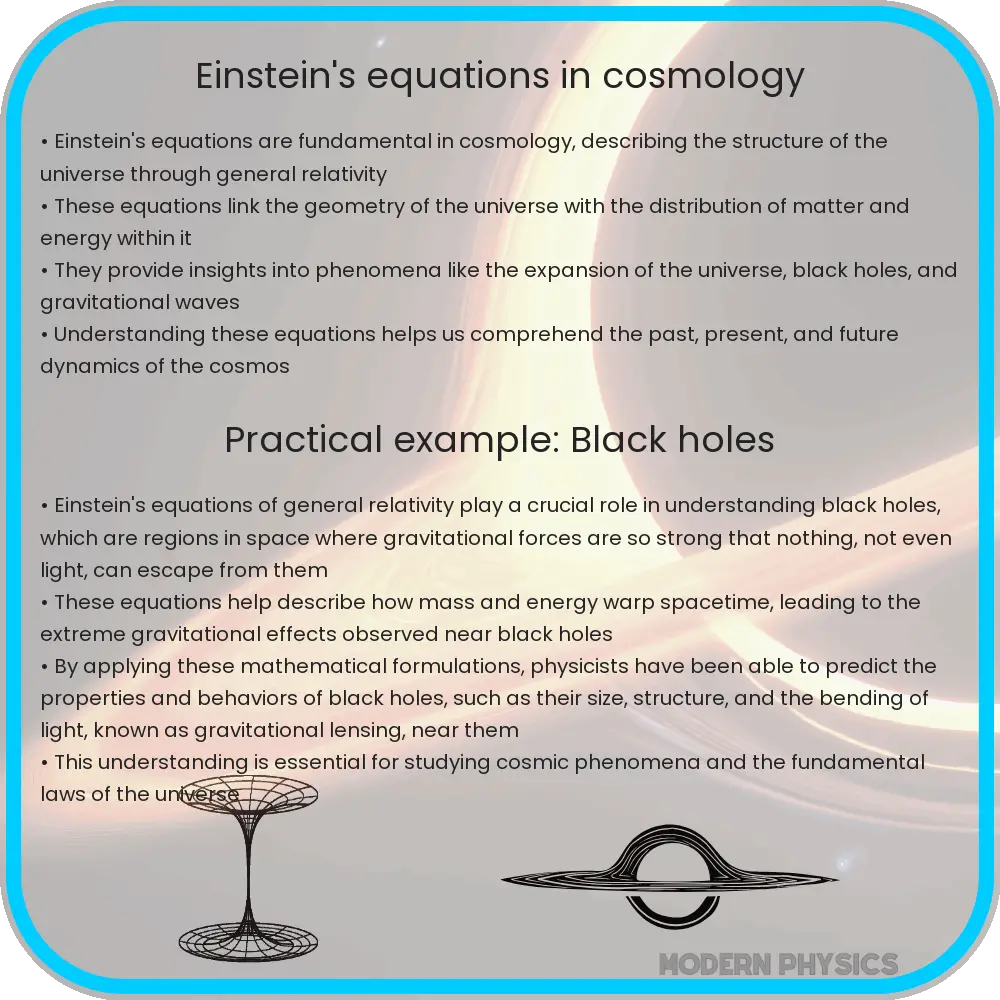
In the context of cosmology, Einstein’s equations reveal much about the evolution and structure of the universe. They are the mathematical backbone in our quest to comprehend phenomena such as black holes, gravitational waves, and the expansion of the universe. Significantly, these equations have been central to the development of the Big Bang theory, offering insights into how the universe evolved from an initial state of high density and temperature.
Dark Energy and the Accelerating Universe
One of the most startling discoveries of modern astronomy, which emerged from the framework of Einstein’s equations, is the acceleration of the universe’s expansion. In the late 1990s, observations of distant supernovae suggested that the universe is not just expanding, but doing so at an accelerating rate. This unforeseen revelation brought about the concept of dark energy, a mysterious form of energy that permeates all of space and accelerates the expansion of the universe.
Dark energy, constituting approximately 68% of the universe, remains one of the greatest enigmas in physics. Einstein’s equations, particularly with the inclusion of the cosmological constant (Λ), play a crucial role in modeling this phenomenon. The cosmological constant, once considered a blunder by Einstein himself, is now seen as a critical component in the understanding of dark energy.
Implications on Cosmic Scale Structures
Moreover, Einstein’s equations have significant implications for understanding the large-scale structure of the universe. They are instrumental in the study of cosmic microwave background radiation, the thermal remnants of the Big Bang, providing clues about the universe’s early stages. These equations also aid in explaining the formation and evolution of galaxies, clusters of galaxies, and the large-scale filaments and voids that make up the cosmic web.
Through the lens of General Relativity and Einstein’s equations, cosmologists continue to unravel the mysteries of the universe. From the intricate dance of galaxies to the elusive nature of dark energy, these equations remain at the forefront of our quest to understand the cosmos.
Challenges and Future Prospects in Cosmology
Despite the monumental successes of Einstein’s equations in describing the large-scale structure of the universe, challenges persist. One major issue is the incompatibility between General Relativity and Quantum Mechanics, the two pillars of modern physics. This discordance becomes especially prominent in extreme conditions, such as those existing in the singularities of black holes or the state of the universe at the very beginning of the Big Bang. Bridging this gap remains a key objective for physicists.
Additionally, the nature of dark energy and dark matter continues to elude scientists. While Einstein’s equations accommodate these phenomena, they offer little insight into their true essence. Dark matter, invisible yet detectable through its gravitational effects, is thought to constitute about 27% of the universe. Its presence is inferred from the rotational speeds of galaxies and gravitational lensing, yet its composition remains unknown.
Future research in cosmology, heavily reliant on advancements in observational technologies, aims to provide deeper insights into these mysteries. Projects like the James Webb Space Telescope and the Event Horizon Telescope are poised to offer unprecedented views of the universe, potentially leading to breakthroughs in our understanding of cosmic phenomena.
Conclusion
Einstein’s equations, a masterpiece of 20th-century physics, continue to be the cornerstone of our understanding of the cosmos. They have not only shaped our comprehension of the universe’s birth and its expansive nature but also posed profound questions that spur contemporary research. As we delve deeper into the cosmos, seeking to unravel the mysteries of dark energy, dark matter, and the fundamental nature of spacetime, Einstein’s legacy remains ever-present. His equations, transcending the realm of theoretical physics, serve as a guiding light in our eternal quest to understand the universe’s grand design. In this endeavor, each discovery and each challenge encountered along the way does not merely add to our knowledge but also honors the revolutionary insights of Albert Einstein.