
Explore the precision, calibration, and efficiency of ebulliometers in industries like winemaking, pharmaceuticals, and education.
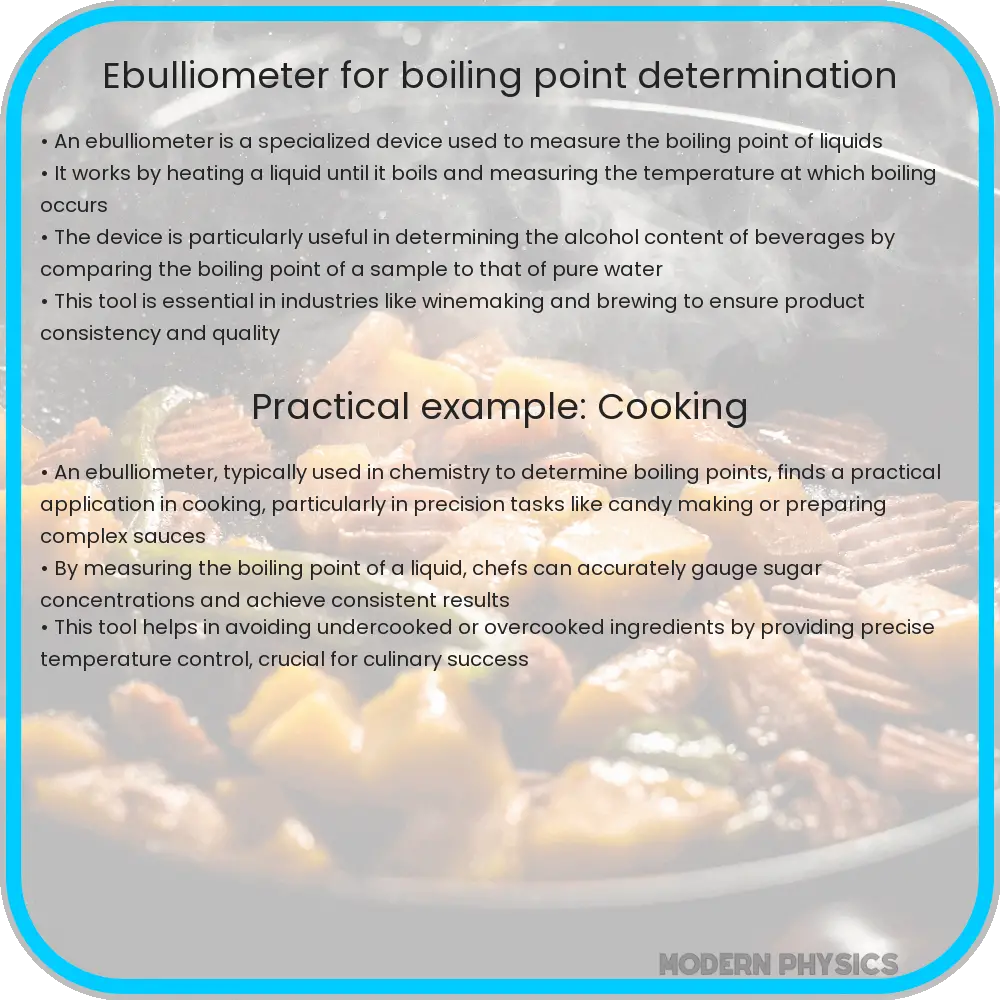
Understanding Ebulliometers: Precision, Calibration, and Efficiency
An ebulliometer is a specialized scientific instrument used primarily in the wine industry for determining the alcohol content of a liquid through boiling point measurement. Its applications, however, extend beyond winemaking, providing valuable insights in various chemical and educational fields. This article delves into the uses of an ebulliometer, focusing on its precision, calibration process, and efficiency.
Precision in Measurement
The primary appeal of an ebulliometer lies in its precision. By measuring the boiling point of a liquid and comparing it to that of pure water, the instrument can accurately determine the alcohol content. This is based on the principle that the boiling point of a solution is directly affected by its alcohol concentration, with higher alcohol levels leading to lower boiling points.
To achieve high precision, the ebulliometer must be used under controlled conditions. Factors like atmospheric pressure, which can influence boiling points, need to be accounted for. Modern ebulliometers often come equipped with sensors and digital readouts that automatically adjust for such variables, enhancing their precision.
Calibration for Accuracy
Calibration is a crucial step in ensuring the accuracy of an ebulliometer. This process involves adjusting the instrument to a known standard, usually a solution with a predetermined alcohol content. Calibration is typically done using a mixture of water and ethanol, where the ethanol concentration is precisely known.
The calibration process often requires the use of a thermometer with a high degree of accuracy. The ebulliometer’s readings are compared against the known values of the calibration mixture. Any discrepancies are then adjusted in the device settings. Regular calibration is essential, especially in professional settings where accuracy is paramount.
Efficiency in Operation
Ebulliometers are celebrated for their efficiency. Traditional methods of alcohol determination, like distillation, can be time-consuming and require more complex setups. In contrast, ebulliometers offer a quicker and more straightforward approach. Their simple design and ease of operation make them an attractive option for rapid alcohol content analysis.
The device’s efficiency does not compromise its accuracy, making it a valuable tool in settings where quick and precise measurements are required. This balance between efficiency and precision is one of the key reasons behind the popularity of ebulliometers in both academic and industrial applications.
Another aspect of their efficiency is the minimal amount of sample required for testing. Unlike other methods that may require larger sample volumes, ebulliometers can work with smaller quantities, reducing waste and the cost of materials used in the testing process.
In the next section, we will explore further applications of ebulliometers, their impact in various industries, and considerations for their maintenance and long-term use.
Extended Applications and Impact in Various Industries
Ebulliometers are not just confined to the wine industry. Their precise measurement capabilities have found relevance in fields such as pharmaceuticals, environmental science, and even in educational settings. In pharmaceuticals, for instance, the determination of alcohol content in various solutions can be crucial for quality control and formulation of medicines. Environmental scientists use ebulliometers to analyze water-alcohol mixtures in studies related to pollution and water quality.
In educational settings, ebulliometers serve as an excellent tool for teaching principles of boiling point elevation and colligative properties. They offer hands-on experience for students learning about the physical properties of solutions, distillation processes, and the principles of thermodynamics.
Maintenance and Long-Term Use
For ensuring longevity and consistent performance of an ebulliometer, regular maintenance is vital. This involves routine cleaning, careful handling of the delicate components like the thermometer and the boiling chamber, and regular calibration checks. Proper storage is also crucial to prevent damage to sensitive parts.
Additionally, users must be aware of the limitations of ebulliometers. While highly efficient for alcohol content analysis, they might not be suitable for solutions with volatile compounds other than alcohol, as these can affect boiling point measurements.
Conclusion
The ebulliometer stands out as a testament to the blend of simplicity and precision in scientific instrumentation. Its ability to provide accurate measurements of alcohol content through boiling point analysis has made it an indispensable tool in the wine industry and beyond. The instrument’s efficiency, ease of use, and minimal sample requirement further enhance its appeal across various fields.
Moreover, the ebulliometer’s role extends to educational purposes, helping students grasp complex scientific concepts through practical application. Regular calibration and maintenance are key to sustaining its accuracy and reliability over time. While its use is somewhat specialized, the ebulliometer’s contributions to science and industry are undeniably significant, reflecting the profound impact of precise measurement tools in various sectors.