
Explore the Dyson Series in QED: its complexity, convergence issues, and impact on quantum physics, with insights into future research directions.
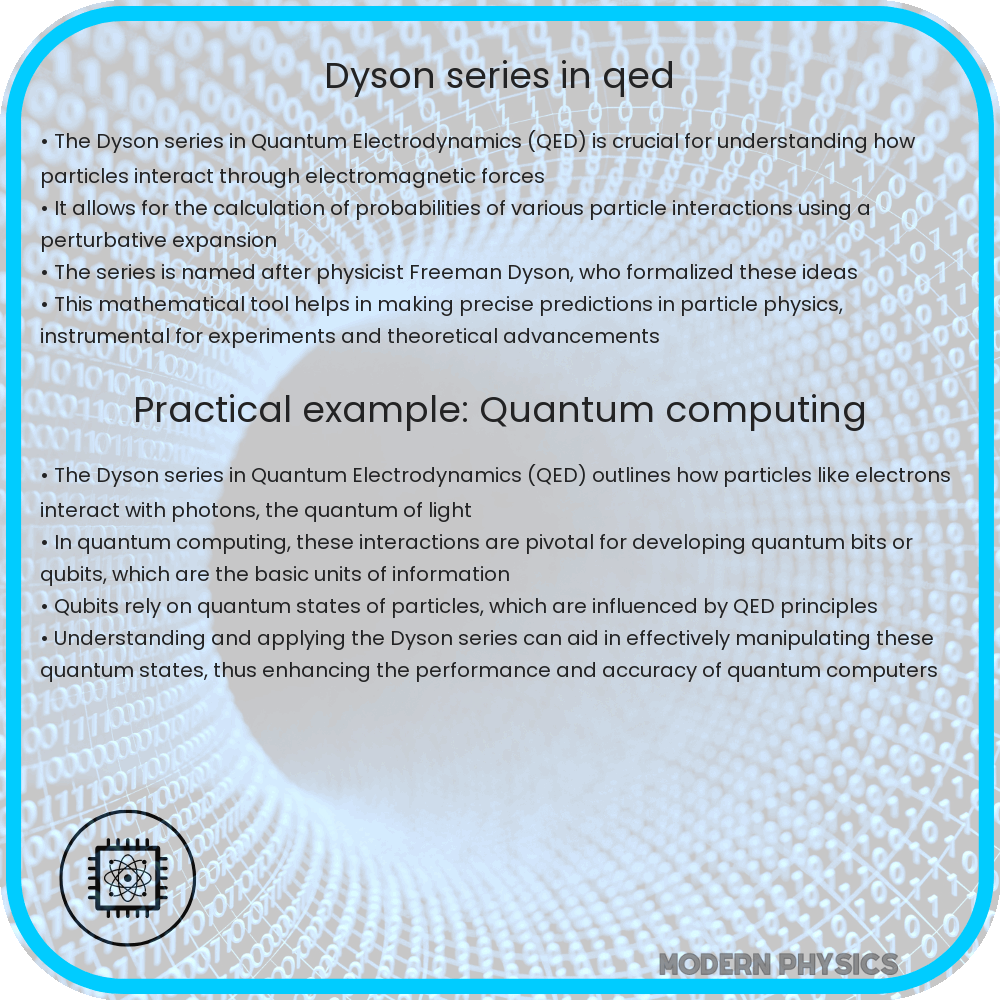
Understanding the Dyson Series in Quantum Electrodynamics (QED)
Quantum Electrodynamics (QED) stands as a cornerstone in the field of quantum physics, elucidating the interactions between light and matter through the interplay of photons and charged particles. A pivotal concept within QED is the Dyson Series, named after the physicist Freeman Dyson. This series is integral to perturbation theory, a technique used to approximate complex quantum systems by breaking them down into simpler, more manageable parts.
The Dyson Series is expressed mathematically as a sum of terms representing different orders of interaction in a perturbative expansion. Each term corresponds to a quantum mechanical process, with higher-order terms accounting for more complex interactions. The series is formulated as:
S = I + ∑n=1∞ (i/h)ⁿ ∫ … ∫ T[H1(t1)H1(t2)…H1(tn)] dt1dt2…dtn
Here, S denotes the S-matrix, describing the initial and final states of a quantum system, I is the identity matrix, H1 represents the interaction Hamiltonian, and T signifies the time-ordering operator.
Complexity and Convergence in the Dyson Series
The complexity of the Dyson Series arises from its non-linear and infinite nature. The series is an infinite sum, and each higher-order term involves an increasing number of integrals and interactions, making analytical solutions challenging. This complexity is a reflection of the intricate quantum processes that occur in nature, often requiring sophisticated computational methods for their analysis.
Concerning convergence, the Dyson Series is typically divergent or at best asymptotic. This means that adding more terms does not necessarily lead to a more accurate result. Instead, the series provides an asymptotic expansion, where a finite number of terms can give an excellent approximation to the physical process, but adding further terms beyond a certain point does not improve the accuracy. This peculiar nature of convergence in the Dyson Series is a topic of ongoing research and debate in theoretical physics.
Impact of the Dyson Series on Quantum Physics
The Dyson Series has had a profound impact on the field of quantum physics, particularly in the study of particle interactions. Its utility lies in breaking down complex quantum processes into simpler elements that can be analyzed and understood. This has allowed physicists to make significant predictions and calculations regarding the behavior of subatomic particles, contributing to our understanding of the fundamental forces of nature.
In QED, the Dyson Series is crucial for calculating the probability amplitudes of various quantum processes, such as electron-positron annihilation or photon scattering. These calculations have led to highly accurate predictions that have been verified experimentally, such as the anomalous magnetic moment of the electron, showcasing the remarkable predictive power of QED.
Challenges and Advancements in Utilizing the Dyson Series
Despite its significant contributions, the Dyson Series in QED is not without challenges. The divergence issue necessitates the use of renormalization techniques. Renormalization involves redefining certain quantities in the theory to eliminate infinities, allowing for finite, physical predictions. This technique, while successful, raises fundamental questions about the nature of quantum field theories and the interpretation of the Dyson Series.
Advancements in computational techniques have also played a critical role in harnessing the power of the Dyson Series. High-performance computing allows for the numerical evaluation of higher-order terms, enabling more accurate predictions in complex scenarios. These computational methods have extended the applicability of the Dyson Series to various fields, including condensed matter physics, quantum chemistry, and nuclear physics.
Future Directions and Implications
The ongoing research in QED and the Dyson Series continues to push the boundaries of our understanding of the quantum world. One area of active research is the exploration of non-perturbative effects, which cannot be captured by the Dyson Series. Addressing these effects is crucial for a more complete description of quantum phenomena, particularly in strong-field regimes.
Moreover, the principles underlying the Dyson Series are being applied to other areas of theoretical physics, such as quantum gravity and string theory. These efforts aim to develop a unified framework for all fundamental interactions, extending beyond the scope of QED.
Conclusion
The Dyson Series in Quantum Electrodynamics represents a monumental achievement in theoretical physics, providing deep insights into the quantum realm. While its complexity and convergence issues present challenges, the series has been instrumental in advancing our understanding of particle interactions. The innovative use of computational methods and the exploration of non-perturbative effects are paving the way for new discoveries and applications. As research continues, the Dyson Series remains a vital tool in the quest to unravel the mysteries of the quantum universe and its fundamental forces.