
Explore the complexities and applications of Dyson-Schwinger Equations in QFT, uncovering their role in modern physics and future research.
Understanding Dyson-Schwinger Equations in Quantum Field Theory
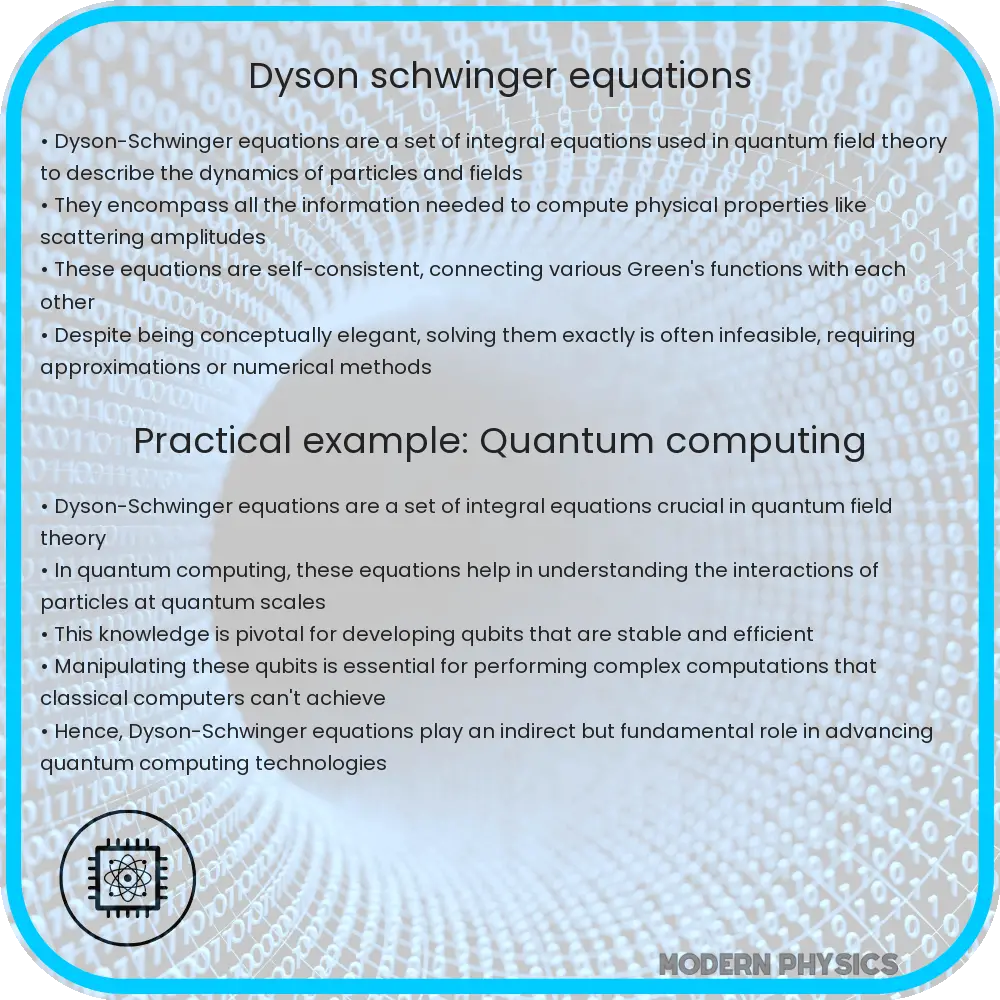
The Dyson-Schwinger Equations (DSEs) are a set of integral equations in Quantum Field Theory (QFT) that provide a deep insight into the dynamics of particles and fields. These equations, named after Freeman Dyson and Julian Schwinger, are instrumental in the analysis and understanding of the non-perturbative aspects of QFT. The DSEs offer a comprehensive framework for exploring the properties of elementary particles such as quarks, gluons, and their interactions in strong force fields.
Core Principles and Applications
At their core, the Dyson-Schwinger Equations are derived from the fundamental principle of QFT, which states that the interactions between particles are mediated by field quanta. The equations encapsulate the self-consistent interaction of particles with their own fields and with the fields of other particles. This self-consistency is crucial for understanding phenomena like confinement and dynamical symmetry breaking, which are pivotal in the standard model of particle physics.
The equations are formulated in terms of Green’s functions, which are correlators of field operators. The Green’s functions describe the probability amplitudes of various field configurations and are directly related to observable quantities in experiments. The DSEs provide a way to calculate these Green’s functions recursively.
Challenges and Computational Techniques
One of the main challenges in working with Dyson-Schwinger Equations is their complexity. The equations are typically an infinite set of coupled integral equations, making them quite difficult to solve exactly. This has led to the development of various approximation methods and numerical techniques. Among these, the most widely used is the truncation of the equation set to a manageable number, which is then solved numerically.
Advanced computational methods, such as lattice QFT and functional methods, have also been employed to tackle the complexities of DSEs. These approaches have provided significant insights into the non-perturbative regimes of QFT, particularly in understanding the structure and dynamics of hadrons.
The Dyson-Schwinger Equations also play a crucial role in exploring beyond
the Standard Model. By offering a deeper understanding of the strong force and its impact on particle dynamics, DSEs contribute to theoretical research in areas like dark matter and quantum gravity. They provide a framework to study particles and forces under extreme conditions, such as those found in neutron stars or in the early universe, where the conventional perturbative methods of QFT are inadequate.
Impact on Modern Physics
The implications of Dyson-Schwinger Equations extend beyond particle physics. They have applications in condensed matter physics, nuclear physics, and even in the emerging field of quantum computing and information. For example, in condensed matter physics, DSEs help in understanding the behavior of electrons in superconductors and other exotic states of matter. Similarly, in nuclear physics, they provide insights into the structure of nucleons and the dynamics of nuclear forces.
Moreover, the mathematical structures arising from DSEs have influenced other areas of mathematics and theoretical physics, such as topology and the study of nonlinear differential equations. The DSEs’ ability to connect different scales of physical phenomena, from the subatomic to the cosmological, underscores their significance in the broader context of theoretical research.
As research progresses, the Dyson-Schwinger Equations continue to be a fertile ground for discovery and innovation. They not only help in refining our current understanding of the universe but also open new avenues for exploring the unknown aspects of fundamental physics.
In conclusion, the Dyson-Schwinger Equations represent a cornerstone of modern theoretical physics. Their comprehensive approach to analyzing the dynamics of particles and fields in QFT makes them an invaluable tool for physicists. While they present formidable challenges due to their complexity, ongoing research and advances in computational physics promise new and exciting developments in our understanding of the quantum world.
Future Directions and Research in Dyson-Schwinger Equations
Looking ahead, the exploration of Dyson-Schwinger Equations (DSEs) in Quantum Field Theory (QFT) holds promising potential for groundbreaking discoveries. Researchers continue to delve deeper into these equations to unlock more of their secrets. One area of significant interest is the further refinement of numerical methods for solving DSEs. As computational power increases, so does the ability to handle more complex calculations, potentially leading to more accurate and comprehensive solutions.
Another exciting direction is the integration of DSEs with other theoretical frameworks. For instance, merging ideas from string theory or loop quantum gravity with DSEs could lead to a better understanding of fundamental forces, especially gravity, at the quantum level. Such interdisciplinary approaches could be key in solving some of the most perplexing mysteries in modern physics, like the nature of dark energy and the unification of quantum mechanics with general relativity.
Collaborative Efforts and Educational Impacts
The study of DSEs is also fostering collaboration across various fields of physics and beyond. These collaborations are not just limited to theoretical work; experimental physicists are increasingly using insights from DSEs to design and interpret experiments, particularly in high-energy particle accelerators like the Large Hadron Collider (LHC). This synergy between theory and experiment is vital for the advancement of physics as a whole.
Furthermore, DSEs are making their way into advanced physics education. As a complex yet fundamental concept in QFT, they offer students a comprehensive view of the field’s challenges and potentials. Educational initiatives are now incorporating DSEs into curricula, preparing the next generation of physicists to continue this important work.
Conclusion
The Dyson-Schwinger Equations are more than just a set of integral equations in QFT; they are a window into the profound and intricate world of particle physics. Their ability to describe the non-perturbative aspects of particle interactions makes them indispensable for both theoretical exploration and practical applications. Despite their complexity, the ongoing advancements in computational techniques and theoretical methods are making these equations more accessible and useful.
As we continue to push the boundaries of what is known, the DSEs stand as a testament to the enduring quest for understanding the fundamental workings of our universe. They embody the spirit of scientific inquiry, challenging us to think deeper, compute smarter, and collaborate more broadly. In the ever-evolving landscape of theoretical physics, the Dyson-Schwinger Equations remain a crucial and dynamic field of study, promising new insights and discoveries for the future of physics.