
Explore the intriguing world of double layers in plasma, a key to unlocking mysteries in space science, energy research, and advanced propulsion systems.
Understanding Double Layers in Plasma
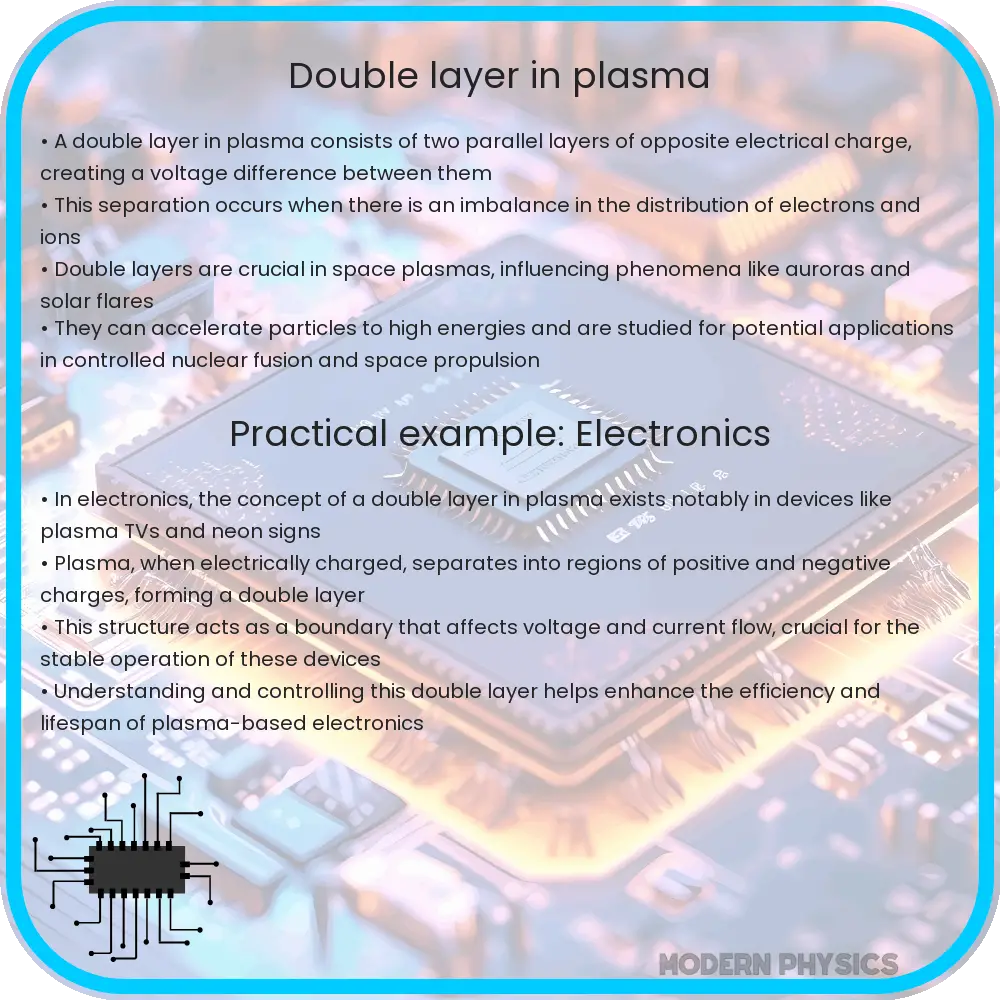
Double layers in plasma, a fundamental concept in plasma physics, represent a structure where a significant potential difference exists over a relatively short distance. This phenomenon results in a region within the plasma that separates two areas with differing electrical potentials, effectively acting as a boundary that can accelerate ions and electrons from one side to the other. Understanding double layers is crucial for comprehending a variety of processes in both space and laboratory plasmas.
Key Concepts and Functions
At its core, a double layer consists of two sheets of charge facing each other, with one being positively charged and the other negatively charged. This structure is created by the motion and separation of charges within the plasma, leading to a region where electric fields are highly concentrated. The primary functions and impacts of double layers in plasma include:
- Energy Conversion: Double layers are capable of converting electrical energy into kinetic energy. This process accelerates charged particles, such as electrons and ions, allowing for significant energy transfer within the plasma.
- Plasma Containment: In laboratory settings, double layers can act as barriers that help contain and control plasma, an essential aspect of research in fusion energy.
- Space Phenomena: In space, double layers play a role in phenomena such as auroras and solar flares, where they contribute to the acceleration of charged particles from the Sun towards Earth.
The formation of double layers is influenced by various factors, including plasma density, temperature, and the presence of electric and magnetic fields. These layers are not static; they can move, fluctuate, and even break down, depending on the surrounding plasma conditions.
Impact on Research and Technology
The study of double layers in plasma has profound implications for both theoretical research and practical applications. In astrophysics, understanding these structures is key to unraveling the mysteries of cosmic phenomena. Meanwhile, in the realm of applied physics, double layers have implications for the development of plasma-based technologies, including propulsion systems for spacecraft and methods for achieving controlled nuclear fusion, a potential source of nearly limitless clean energy.
Challenges and Opportunities in Double Layer Research
Despite their significant potential, researching double layers in plasma presents a set of challenges. The dynamic nature of plasma makes it difficult to create stable conditions necessary for detailed study, especially in laboratory environments. Moreover, the need for sophisticated diagnostic tools to measure and analyze the properties and behaviors of double layers adds another layer of complexity. However, advancements in computational physics and high-resolution imaging techniques are paving the way for deeper understanding and more precise control over these phenomena.
Future Directions
The ongoing exploration of double layers in plasma holds the promise for breakthroughs in various fields. In space science, further studies can enhance our protection against solar storms and improve communication systems by understanding the impact of space weather on satellite technology. For energy research, mastering the control of double layers could be a critical step towards achieving sustainable nuclear fusion, offering a clean and abundant source of energy. Additionally, the principles learned from double layers are being applied to develop more efficient plasma-based propulsion systems, which could revolutionize space travel by making it faster and more cost-effective.
Conclusion
Double layers in plasma are a fascinating and complex phenomenon with wide-ranging implications across multiple scientific disciplines. From enabling the acceleration of particles in space to holding the key for future energy solutions on Earth, the study of these structures offers a glimpse into the fundamental processes that govern the universe. Despite the challenges inherent in plasma research, the potential benefits of understanding and harnessing double layers are immense. As technology advances, so too will our ability to explore and exploit the unique properties of plasma, opening up new frontiers in science and engineering. The journey to unravel the mysteries of double layers is just beginning, promising a future filled with discovery and innovation.