
Explore the revolution in 3D imaging with digital holography, offering unmatched clarity and precision across industries, from medical to security.
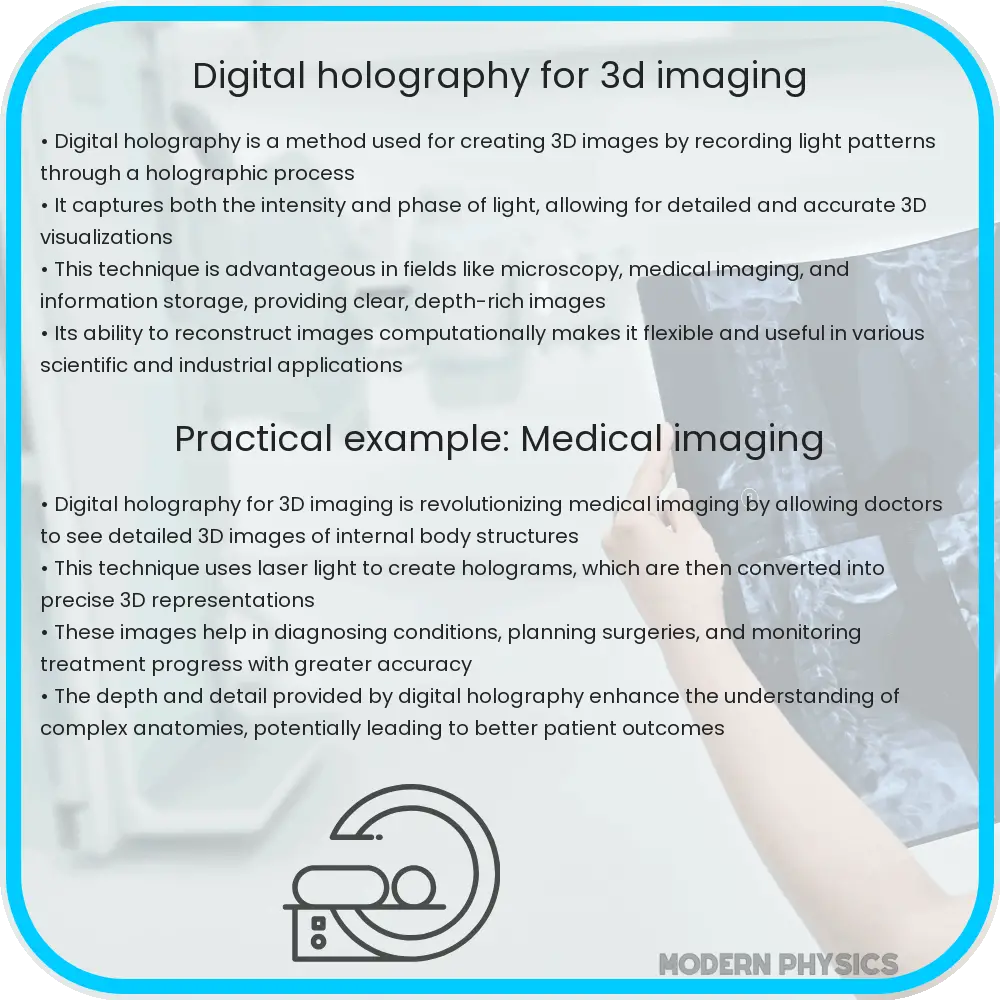
Exploring the Frontier of 3D Imaging: Digital Holography
Digital Holography stands at the forefront of 3D imaging technology, revolutionizing how we capture, reconstruct, and visualize three-dimensional objects and scenes. This cutting-edge technique merges the principles of holography with digital processing, offering unparalleled clarity and precision in the realm of imaging. Unlike traditional photography that records only the intensity of light, digital holography captures both the intensity and phase of light waves, enabling the reconstruction of three-dimensional images.
Understanding the Core of Digital Holography
At its core, digital holography involves recording a hologram digitally, usually with a Charge-Coupled Device (CCD) or a Complementary Metal-Oxide-Semiconductor (CMOS) sensor. These sensors detect the interference pattern created when a reference beam of light intersects with the light scattered from an object. This interference pattern, essentially a hologram, encodes the full three-dimensional information of the object. Through sophisticated algorithms, this hologram is then reconstructed to render a precise three-dimensional image of the object, which can be viewed from any angle.
Advantages Over Traditional Imaging Techniques
The advantages of digital holography over conventional imaging techniques are significant. Firstly, it allows for the capture of the entire depth information of the scene, which is invaluable in applications requiring precise depth cues, such as in medical imaging, microscopy, and security. Secondly, digital holography provides the ability to focus on multiple depths from a single capture, overcoming limitations associated with traditional cameras’ depth of field. This feature is particularly beneficial for examining complex structures or components layered at different depths.
Applications Across Fields
Digital holography has found applications across a broad spectrum of fields, showcasing its versatility and effectiveness. In biomedical research, it enables non-invasive imaging of cells and tissues, offering insights into cellular structures and processes without the need for dyes or invasive procedures. In industrial settings, it aids in the precise measurement and inspection of components, enhancing quality control processes. Additionally, in the realm of security, digital holography contributes to the advancement of sophisticated authentication systems by providing three-dimensional imaging capabilities.
Challenges and Future Directions
Despite its numerous advantages, digital holography faces challenges that must be addressed to unlock its full potential. One of the primary challenges is the high computational cost associated with reconstructing holograms, which requires significant processing power and time. Advances in computational methods and hardware are essential to overcome this hurdle, making real-time applications more feasible. Additionally, improving the resolution and quality of reconstructed images remains a focus area, as it directly impacts the technology’s applicability across various domains.
Enhancing Digital Holography through Technological Innovations
Technological advancements play a crucial role in addressing these challenges. Innovations in sensor technology, such as the development of higher resolution CCD and CMOS sensors, enhance the detail and quality of hologram captures. Parallel processing and the use of Graphics Processing Units (GPUs) significantly reduce the time required for hologram reconstruction, paving the way for real-time applications. Furthermore, machine learning algorithms are being explored to improve image reconstruction quality and to automate the identification of features within holographic images, expanding the technology’s usability and efficiency.
Conclusion
Digital holography is a transformative technology that redefines the boundaries of 3D imaging, offering clarity, precision, and depth unattainable by traditional methods. Its applications, ranging from medical imaging to quality control and security, highlight its versatility and potential to revolutionize various industries. However, the evolution of digital holography is contingent upon overcoming existing challenges, primarily the computational demands of hologram reconstruction and the quest for higher resolution images. With ongoing advancements in computational power, sensor technology, and algorithmic approaches, the future of digital holography is poised for significant breakthroughs, promising even more impactful applications and efficiencies. As we continue to push the limits of what is possible with digital imaging, digital holography stands as a beacon of innovation, guiding us towards a future where three-dimensional visualization reaches unprecedented levels of detail and realism.