
Learn about Diamond-like Carbon (DLC), an amorphous carbon material with properties similar to diamond, used widely in various industries.
Diamond-like Carbon: Understanding Its Durability and Versatility
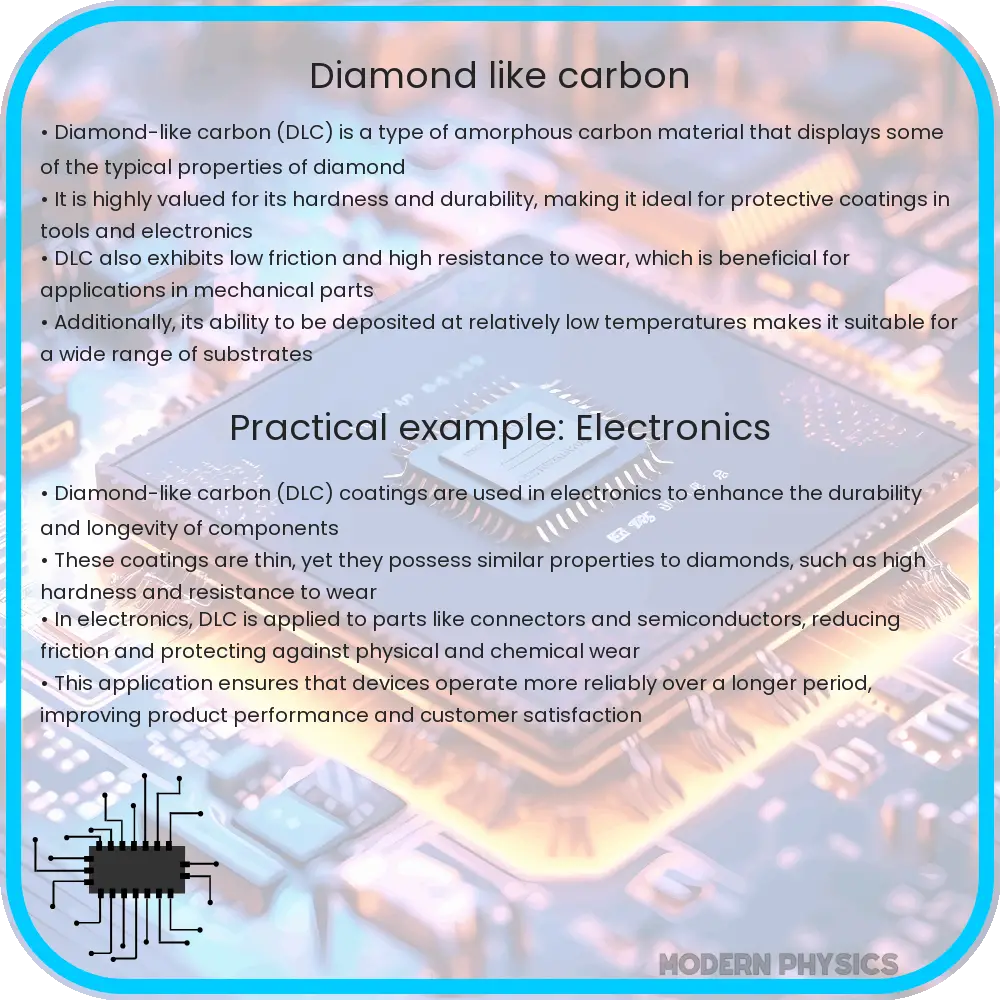
Diamond-like carbon (DLC) is a type of amorphous carbon material that exhibits some of the typical properties of diamond. It offers high hardness, low friction, good wear resistance, and chemical inertness. Due to these properties, DLC is used in a variety of applications, ranging from coatings for machine tools to biomedical implants.
Composition and Structure
DLC is comprised primarily of carbon atoms, similar to diamond. However, unlike diamond, which has a crystalline structure, DLC is amorphous, meaning it lacks a long-range order in its atomic arrangements. It often includes a mixture of sp3 (diamond-like) and sp2 (graphite-like) bonding. The ratio of sp3 to sp2 can greatly affect the material’s properties. The higher the sp3 content, the more diamond-like the material behaves in terms of hardness and resistance to wear.
Applications in Different Industries
DLC coatings are highly valuable in mechanical and engineering fields due to their ability to extend the life of components and improve overall performance. Below are some key applications:
- Automotive Industry: DLC is used for coating engine parts such as camshafts, pistons, and bearings. The coatings reduce friction and wear, thus enhancing engine efficiency and durability.
- Medical Field: Due to its biocompatibility and resistance to wear, DLC is used in various medical implants like artificial joints and dental instruments.
- Electronics: In electronics, DLC’s resistance to wear and high electrical insulation properties make it suitable for protective coatings in various electronic devices.
Advancements in Diamond-like Carbon Technology
Recent advancements in DLC technology focus on enhancing the deposition techniques to improve the quality and characteristics of the coatings. Techniques such as Plasma Enhanced Chemical Vapor Deposition (PECVD) and Filtered Cathodic Vacuum Arc (FCVA) have improved the ability to control the bonding structure during deposition, leading to higher sp3 contents and thus making the DLC coatings even more durable and effective.
Furthermore, researchers are exploring the doping of DLC coatings with other elements such as silicon, fluorine, and titanium. Doping can modify the mechanical and physical properties of DLC, making it even more versatile for various applications. For instance, silicon-doped DLC has shown to have better thermal stability and enhanced mechanical properties.
Environmental Impact and Sustainability
Considering the environmental footprint is crucial in modern materials engineering. DLC coatings are advantageous not only for their physical and mechanical properties but also for their environmental benefits. The application of DLC coatings can lead to reduced lubricant usage due to their low friction characteristics, thereby decreasing the environmental impact associated with the disposal and production of lubricants. Additionally, the increased lifespan of DLC-coated components contributes to reduced material wastage and energy consumption in manufacturing processes, aligning with sustainability goals.
Future Prospects
The potential for DLC applications continues to grow with ongoing research and technological innovations. One promising area is the renewable energy sector, where DLC coatings could be used to enhance the durability and efficiency of solar panels and wind turbines. Similarly, the aerospace industry could benefit from lightweight, durable DLC coatings for aircraft components to improve fuel efficiency and reduce greenhouse gas emissions.
Advancements in understanding the properties of DLC at the nano-scale also open up possibilities for use in nanotechnology and microelectronics, where ultra-thin, strong, and resilient materials are crucial.
Conclusion
The exploration of diamond-like carbon encapsulates the intersection of advanced material science and pragmatic engineering solutions. With its remarkable durability and versatility, DLC stands out as a material that not only pushes the boundaries of innovation but also contributes positively toward sustainability and efficiency in a wide array of industries. As technology progresses, the expansion of DLC applications is likely to play a pivotal role in shaping future developments in engineering and materials science. By forging ahead with research and application in diverse sectors, the impact of DLC could reach beyond current expectations, providing more efficient, eco-friendly solutions that cater to the ever-evolving technological needs of society.