
Explore Depth of Field in optics: Learn how aperture, lens focal length, subject distance, and sensor size impact image clarity and focus.
Understanding Depth of Field in Geometrical Optics
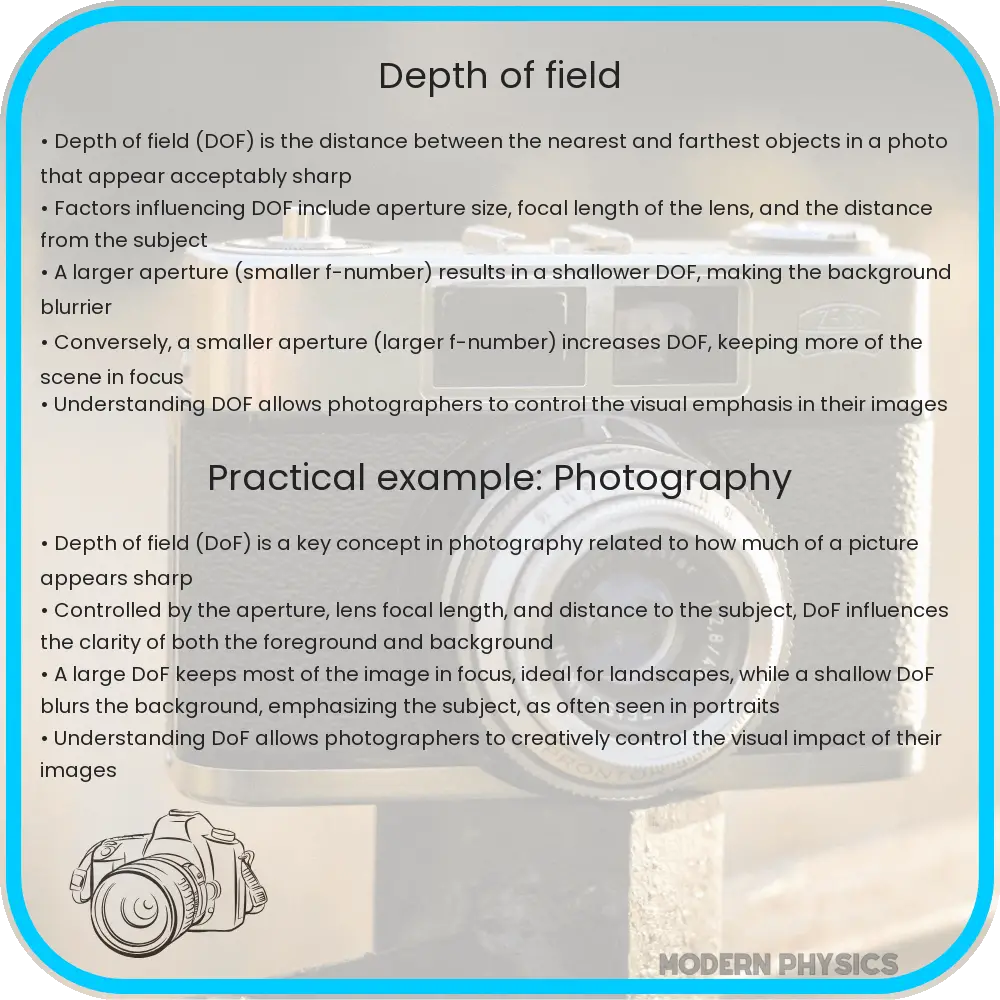
Depth of Field (DoF) is a fundamental concept in geometrical optics, crucial for understanding how images are captured and perceived. It refers to the range of distance within a scene that appears acceptably sharp in an image. This concept is particularly significant in photography, microscopy, and optical engineering, influencing the clarity and focus of the visuals captured.
Factors Influencing Depth of Field
The extent of DoF is influenced by several key factors:
- Aperture Size: The aperture of a lens is the opening through which light enters. A smaller aperture (represented by a larger f-number, like f/16) increases the DoF, making more of the scene appear in focus. Conversely, a larger aperture (smaller f-number, like f/2.8) decreases the DoF, resulting in a more pronounced focus on the subject and a blurred background.
- Lens Focal Length: Focal length, the distance between the lens and its focus, also impacts DoF. Longer focal lengths (like 200mm) yield a shallower DoF compared to shorter focal lengths (like 35mm).
- Subject Distance: The distance between the camera and the subject plays a crucial role. The closer the subject is to the camera, the shallower the DoF, making the background more blurred.
- Sensor Size: Cameras with larger sensors (like full-frame cameras) typically produce a shallower DoF at the same aperture and framing compared to those with smaller sensors (like crop-sensor cameras).
Application and Importance of DoF
Understanding and manipulating DoF is essential for achieving desired visual effects in various fields:
- In Photography, DoF is used creatively to highlight the subject, either by isolating it with a shallow DoF or by capturing extensive details in a scene with a deep DoF.
- In Cinematography, DoF helps in storytelling, directing the viewer’s attention, and creating mood and atmosphere.
- In Microscopy, controlling DoF is crucial for focusing on specific layers of the specimen being observed.
DoF is not just about aesthetic choice but also about the technical capabilities of the equipment used. Different lenses and camera settings offer varying degrees of control over DoF, allowing photographers and cinematographers to manipulate focus and blur to achieve their artistic vision.
Calculating Depth of Field
For a more technical understanding, DoF can be calculated using specific formulas. The DoF is determined by the circle of confusion (CoC), the aperture (f-number), the focal length of the lens, and the distance to the subject. The CoC refers to the maximum blur spot that appears acceptably sharp to the human eye and varies depending on camera sensor size and viewing conditions. The formula for calculating DoF is:
\[ \text{DoF} = \frac{2 \times N \times C \times D^{2}}{f^{2}} – \frac{N \times C \times D}{f} \]
Where \( N \) is the f-number, \( C \) is the circle of confusion, \( D \) is the distance to the subject, and \( f \) is the focal length.
Challenges and Limitations
Despite its usefulness, controlling DoF comes with challenges. In low light conditions, using a small aperture to achieve a greater DoF might require slower shutter speeds or higher ISO settings, potentially leading to motion blur or increased noise. Moreover, lenses have an optimal aperture range where they perform best, and extremely small apertures can lead to diffraction, which reduces overall image sharpness.
Conclusion
Depth of Field is a pivotal concept in geometrical optics, providing a blend of technical control and creative expression. Its understanding is essential for photographers, cinematographers, and optical engineers to manipulate the clarity and focus of an image. By mastering DoF, one can effectively control how much of a scene is in focus, guiding the viewer’s attention and enhancing the storytelling aspect of the visual medium. Whether it’s isolating a subject with a beautiful bokeh effect or capturing a landscape in all its detailed glory, the creative possibilities with DoF are limitless. As technology advances, new tools and techniques continue to evolve, offering even more ways to harness this fascinating aspect of optics. Thus, Depth of Field remains a fundamental and ever-relevant topic in the realm of visual arts and science.
Is this conversation helpful so far?