
Explore the fascinating role of degenerate electron pressure in preventing stellar collapse and shaping the fate of stars, from white dwarfs to black holes.
Degenerate Electron Pressure and Its Role in Stellar Collapse
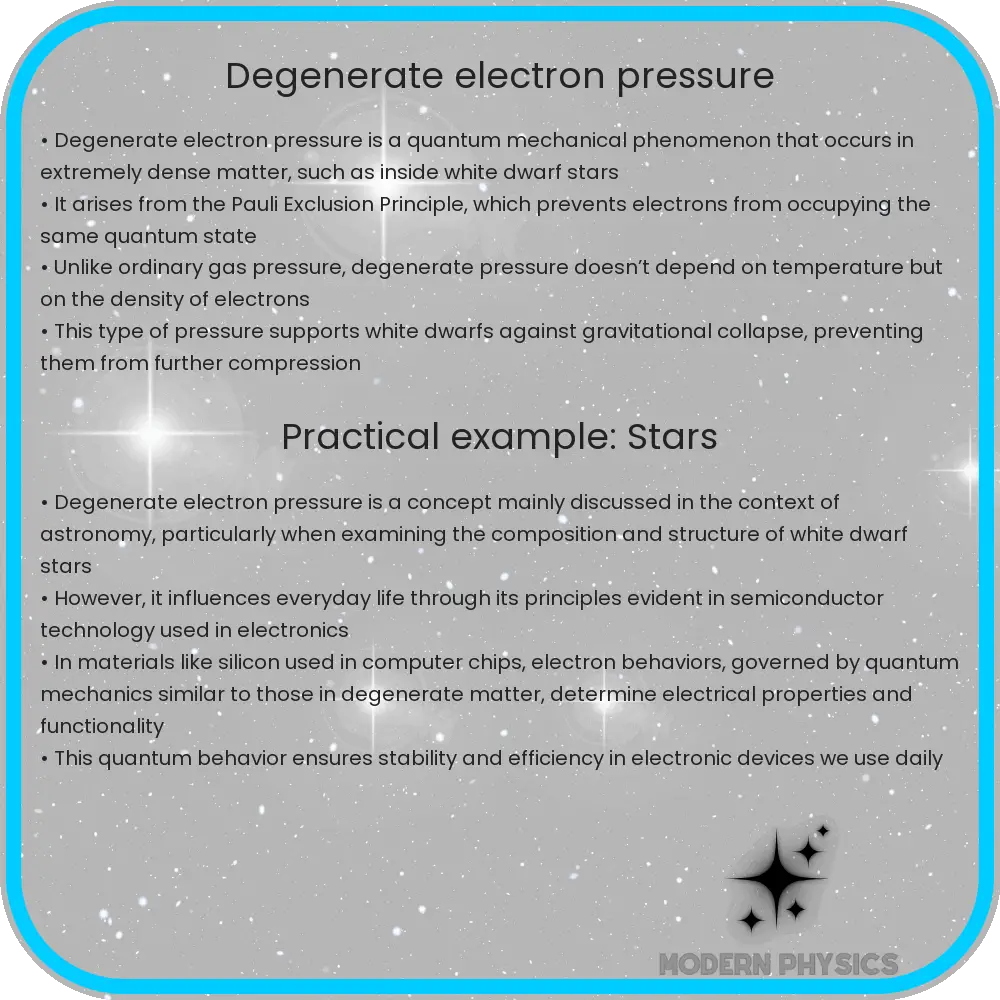
The concept of degenerate electron pressure is pivotal in understanding the life cycle of stars, particularly in the late stages leading to stellar collapse. This pressure arises from the principles of quantum mechanics, specifically the Pauli Exclusion Principle, which states that no two electrons can occupy the same quantum state simultaneously. This rule leads to a unique kind of pressure unrelated to temperature, playing a critical role in the dynamics of dense astrophysical objects like white dwarfs and neutron stars.
Density and Heat in Stellar Cores
As a star exhausts its nuclear fuel, the outward thermal pressure decreases, leading to an increase in gravitational compression. This compression raises the star’s core density to extreme levels, where normal thermal pressure is no longer sufficient to counteract gravitational collapse. In white dwarfs, electron degeneracy pressure becomes the dominant force that halts further collapse, supporting the star against gravity.
In these dense conditions, electrons are forced into higher energy states, creating a form of pressure that does not depend on temperature. This is the degenerate electron pressure. Unlike in normal gases, increasing the temperature in a degenerate gas does not significantly increase its pressure. This characteristic is crucial in the life cycle of stars, particularly as they evolve beyond the main sequence stage.
Implications for Stellar Evolution
The onset of electron degeneracy pressure marks a critical point in a star’s evolution. For stars with masses up to 1.44 times that of the Sun (the Chandrasekhar limit), electron degeneracy pressure can prevent further collapse, resulting in a stable white dwarf. However, if the star’s mass exceeds this limit, electron degeneracy pressure will be insufficient to stop the collapse, leading the star on a path towards becoming a neutron star or a black hole.
The balance between electron degeneracy pressure and gravitational forces determines the final fate of stars. Understanding this balance is essential for astrophysicists studying the life and death of stars, contributing to our broader understanding of the universe’s structure and evolution.
Transition to Neutron Stars and Black Holes
When a star significantly exceeds the Chandrasekhar limit, the scenario changes dramatically. The overwhelming gravitational force overpowers the electron degeneracy pressure, leading to further collapse. In these extreme conditions, protons and electrons merge to form neutrons, giving rise to a neutron star. If the mass of the collapsing core is even greater, it can lead to the formation of a black hole, a point in space where the gravitational pull is so strong that not even light can escape from it.
Heat Generation in Collapse
The collapse of a star into a denser state releases an immense amount of gravitational energy, which is converted into heat. This heat can lead to spectacular phenomena such as supernovae, where the outer layers of a star are expelled into space. The temperature within a collapsing core can reach billions of degrees, leading to the creation of heavy elements in a process known as nucleosynthesis. These elements are then dispersed into the interstellar medium during the supernova explosion, contributing to the cosmic cycle of matter.
The Role of Degenerate Electron Pressure in the Cosmos
Degenerate electron pressure is not only a crucial factor in the lifecycle of stars but also plays a significant role in the cosmic balance between matter and gravity. It exemplifies the strange and counterintuitive principles of quantum mechanics, particularly when they manifest on a cosmic scale. The study of this pressure and its effects provides insights into the fundamental forces that shape our universe, from the smallest particles to the largest celestial bodies.
Conclusion
The concept of degenerate electron pressure serves as a cornerstone in the field of astrophysics, explaining the behavior of stars at the end of their life cycles. It illustrates how quantum mechanics operates on a cosmic level, dictating the fate of massive celestial bodies. Through understanding the delicate balance between degenerate electron pressure and gravitational forces, scientists can unravel the mysteries of stellar evolution, from the formation of white dwarfs to the spectacular explosions of supernovae and the birth of neutron stars and black holes. This knowledge not only enhances our understanding of the universe but also underscores the interconnectedness of all its components, from the smallest particles to the grandest galaxies.